Market Structures (Grade 11 NSC Matric Economics): Revision Notes
📚Revision Notes
Market Structures
Introduction
Market structures help us understand how different types of markets work and how businesses behave within them. Economists classify markets into two main categories: perfect markets and imperfect markets. Each type has distinct characteristics that affect how prices are set, how much competition exists, and how easy it is for new businesses to enter the market.
Note
Understanding market structures is fundamental to economics because they explain why businesses behave differently in various competitive environments and how this affects consumers and the overall economy.
Perfect markets
Perfect competition represents an ideal market structure that exists only in economic theory. In this type of market, many large businesses produce exactly the same goods, and the only way they can compete is through price. These businesses are called price takers because they must accept the market price that is determined by the forces of supply and demand.
The equilibrium point is where supply and demand meet perfectly, with no shortages or surpluses in the market. However, the conditions needed for perfect competition simply don't exist in the real world.
Important
Perfect competition is purely theoretical - no real-world market meets all the strict conditions required for perfect competition to exist.
Characteristics of perfect competition
For a market to be perfectly competitive, it would need to meet several strict conditions:
- Products must be completely identical (homogeneous)
- Many buyers and sellers must participate
- No agreements or collusion between market participants
- Everyone has complete knowledge of market conditions
- Businesses can enter and exit the market freely
- No government interference in the market
- All producers face the same transport costs
- All producers use identical technology
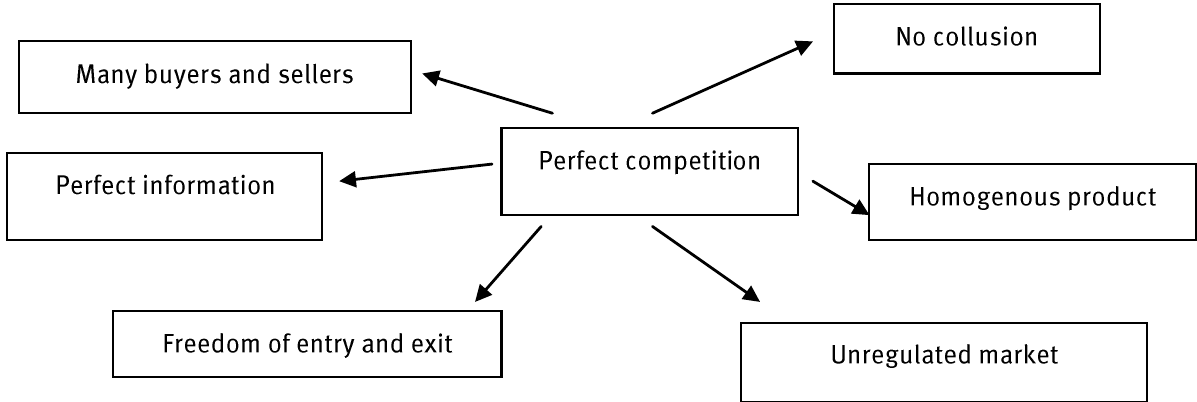
These conditions create a theoretical framework where no single business can influence the market price, making all participants price takers.
Imperfect markets
Most real-world markets are imperfect markets, where one or more producers can influence prices by changing the quantity they supply. Unlike perfect competition, businesses in imperfect markets become price makers rather than price takers.
Characteristics of imperfect markets
Imperfect markets share several common features:
- Products are not identical (differentiated)
- Fewer competitors exist, with some controlling supply and prices
- Producers sometimes work together to set prices (collusion)
- Market information is incomplete
- Significant barriers prevent new businesses from entering
- Government intervention through subsidies or regulations
- Different transport costs between producers
- Unequal access to technology
Markets become imperfect when only one or a few suppliers control key resources such as:
- The capital needed for production
- All sources of raw materials
- Patents or copyrights for specific processes
- Essential technology
Types of imperfect markets
Monopoly
A monopoly represents the most extreme form of imperfect competition. In this market structure, only one producer exists, giving them complete control over both price and quantity sold. Customers have no substitute goods or services available.

Key features of monopolies include:
- Single producer dominates the entire market
- Complete price-making power
- No substitute products available
- Extremely high barriers prevent other businesses from entering
Important
Monopolies have the greatest market power because they face no competition and customers have no alternatives. This can lead to higher prices and reduced consumer choice.
Oligopoly
An oligopoly occurs when a small number of large businesses control most or all production in a market. Each business produces enough of the total output to significantly influence both price and quantity supplied.

South Africa has a Competition Board that works to ensure fair competition between businesses and prevent harmful oligopolistic behaviour.
Oligopoly characteristics include:
- Few large firms dominate the market
- Difficult for new businesses to enter
- Firms often sell identical or very similar products
- Businesses use non-price strategies (like advertising or customer service) to attract customers
Note
In oligopolies, businesses must carefully consider their competitors' reactions when making pricing or production decisions, as each firm's actions significantly affect the others.
Monopolistic competition
Monopolistic competition exists when many sellers produce similar goods that differ only slightly from each other. Each producer can set their own price and quantity without significantly affecting the overall marketplace.
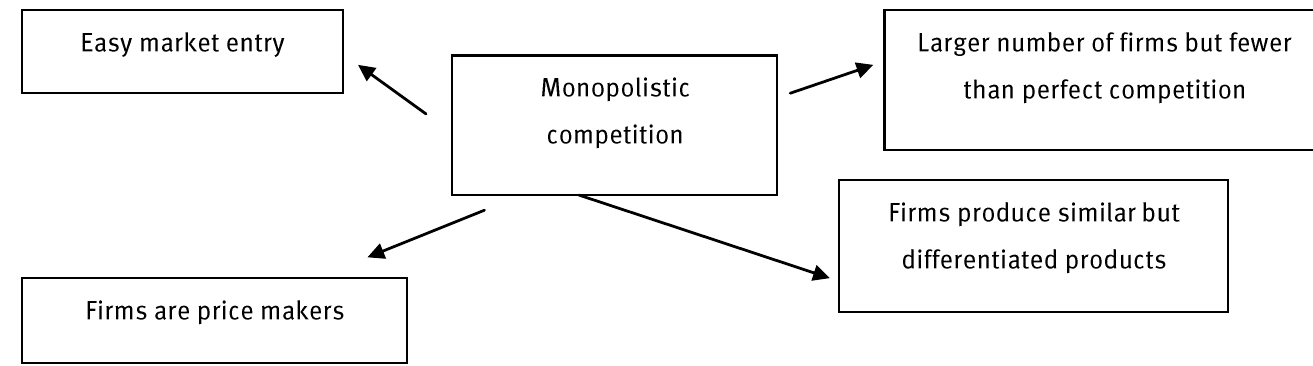
Features of monopolistic competition:
- Many firms participate, but fewer than in perfect competition
- Easy for new businesses to enter the market
- Firms act as price makers for their specific products
- Products are similar but differentiated (different brands, features, or quality)
Example
Real-World Example: Restaurant Industry
The restaurant industry demonstrates monopolistic competition perfectly:
- Many restaurants exist in most areas
- Each offers similar products (food and dining experience) but with unique characteristics
- Restaurants can set their own prices based on their specific offerings
- New restaurants can enter the market relatively easily
- Each restaurant competes through product differentiation (cuisine type, atmosphere, service quality)
Comparison of market structures
Understanding the differences between market structures helps explain business behaviour and market outcomes:
| Structure | Number of firms | Product characteristics | Market power | Entry and exit |
|---|---|---|---|---|
| Perfect competition | Many | Homogeneous product | Price taker | Free |
| Monopoly | One | Unique product | Price maker | Blocked |
| Monopolistic competition | Many firms but less than perfect competition | Heterogeneous product | Price maker | Free |
| Oligopoly | Few firms | Heterogeneous product | Price maker | Restricted |
This comparison shows how market structure affects business behaviour, from complete price acceptance in perfect competition to complete price control in monopolies.
Summary
Key Points to Remember:
-
Perfect competition exists only in theory - real markets always have some imperfections that allow businesses to influence prices
-
Price takers accept market prices (perfect competition) while price makers can set their own prices (imperfect markets)
-
Monopolies have complete market control with no substitutes, while oligopolies involve a few large firms dominating the market
-
Monopolistic competition combines many competitors with product differentiation, allowing some price-making power
-
Market entry barriers determine how easily new businesses can compete, ranging from free entry to completely blocked entry