El Niño and La Niña (Grade 11 NSC Matric Geography): Revision Notes
📚Revision Notes
El Niño and La Niña
What are El Niño and La Niña events?
El Niño and La Niña are significant climate phenomena that occur when the normal patterns of water and air movement in the tropical Pacific Ocean change dramatically. These events happen every few years and have far-reaching effects on weather and climate patterns around the world, including Africa.
Note
The names come from Spanish - El Niño means "The Boy Child" and La Niña means "The Girl Child." These names were originally given by fishermen who noticed unusual warming of ocean waters around Christmas time.
Normal circulation patterns in the Pacific Ocean
To understand El Niño and La Niña, we first need to understand what normally happens in the Pacific Ocean. Under typical conditions, a large-scale circulation system called the Walker circulation operates across the Pacific.
Important
Understanding normal Pacific circulation patterns is essential for grasping how El Niño and La Niña events represent such dramatic departures from typical conditions.
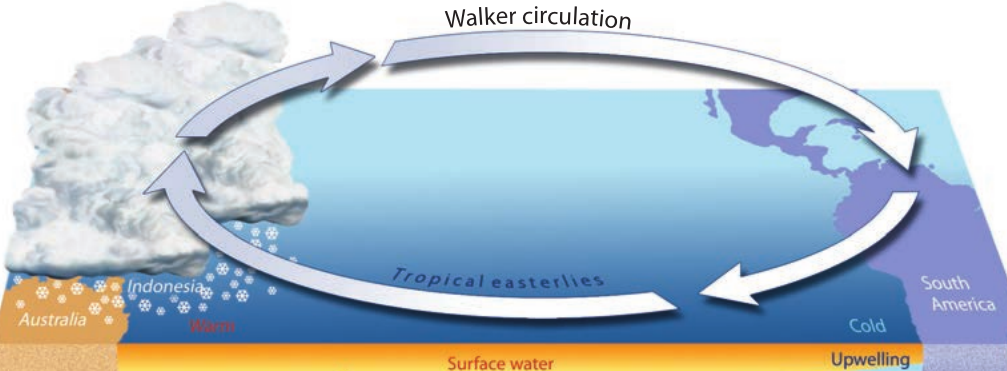
Atmospheric conditions during normal years
During normal conditions, the atmosphere behaves in a predictable pattern. Strong tropical easterly winds blow steadily from South America toward Australia and Indonesia. This creates a circulation cell where warm, moist air rises over the western Pacific (near Australia and Indonesia), creating low pressure and heavy rainfall in these regions.
Meanwhile, over the eastern Pacific near South America, cool, dry air descends, creating high pressure conditions. This results in relatively dry weather along the South American coast.
Ocean conditions during normal years
The ocean also follows a consistent pattern during normal conditions. The steady easterly winds push warm surface water westward, away from the South American coast. As this warm water moves away, deeper, colder water rises up to replace it through a process called upwelling.
This upwelling brings cold, nutrient-rich water to the surface along the South American coast, which supports rich marine ecosystems and fishing industries. The water temperature difference between the warm western Pacific and the cool eastern Pacific helps maintain the atmospheric circulation pattern.
El Niño processes
El Niño represents a dramatic disruption of these normal patterns. During an El Niño event, the entire Pacific circulation system changes significantly.
Important
El Niño events cause a complete breakdown of normal Pacific circulation patterns, creating weather disruptions that affect the entire globe.
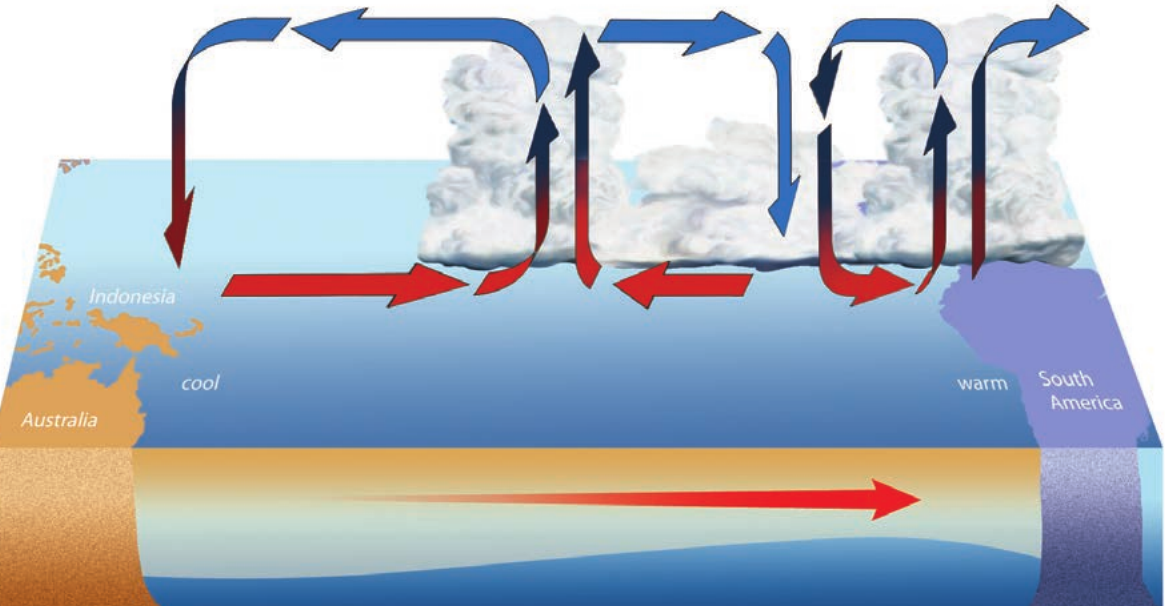
Changes in atmospheric pressure and winds
When El Niño develops, atmospheric pressure drops significantly in the eastern Pacific. This pressure change weakens the normal easterly winds, and in some places, these winds may even reverse direction completely. Without the strong easterlies pushing water westward, the normal circulation patterns break down.
Ocean temperature changes
As the easterly winds weaken, warm surface water that would normally be pushed toward Australia and Indonesia spreads eastward instead. The upwelling of cold water along the South American coast decreases dramatically, causing ocean temperatures to rise significantly in this region.
Disruption of circulation cells
The normal Walker circulation becomes completely disrupted during El Niño events. Instead of one large circulation cell, several smaller circulation cells may develop across the Pacific. Air that would normally rise over Australia and Indonesia may instead rise over the eastern Pacific, bringing unusual rainfall to normally dry regions.
Impact on regional weather
These changes create dramatically different weather conditions across the Pacific region. Areas that are normally dry, such as the coast of South America, may experience heavy rainfall and flooding. Conversely, regions that typically receive abundant rainfall, like parts of Australia and Indonesia, may face drought conditions.
La Niña processes
La Niña events represent the opposite extreme - an intensification of normal Pacific circulation patterns. During La Niña conditions, the usual circulation patterns become stronger and more pronounced than normal.
Intensified normal patterns
La Niña occurs when the normal Walker circulation operates with greater intensity than usual. The easterly winds become even stronger, pushing warm surface water further westward and enhancing the upwelling of cold water along the eastern Pacific coast.
Colder ocean temperatures
During La Niña events, the eastern Pacific Ocean becomes even colder than during normal years. This temperature difference between the eastern and western Pacific becomes more extreme, further strengthening the circulation patterns.
Enhanced weather contrasts
The intensified circulation during La Niña creates more extreme versions of normal weather patterns. Areas that typically experience dry conditions become even drier, while regions that usually receive heavy rainfall may experience even more intense precipitation.
Impact on Africa's climate
The El Niño and La Niña phenomena in the Pacific Ocean have significant effects on Africa's climate, even though Africa is far from the Pacific. This connection occurs through the global atmospheric circulation system.
Important
Despite being thousands of kilometers away from the Pacific Ocean, Africa's climate is significantly influenced by El Niño and La Niña events through interconnected global circulation patterns.
Connection through global circulation
The Walker circulation in the Pacific Ocean is part of a larger global system of atmospheric circulation cells, including the Hadley cells that operate over Africa. When the Pacific circulation patterns change during El Niño or La Niña events, these changes create ripple effects that influence circulation patterns around the world.
La Niña effects on Africa
During La Niña events, Africa tends to experience subsidence (sinking air) and drier conditions than normal. The intensified Pacific circulation patterns influence the global atmospheric system in ways that reduce rainfall over many parts of Africa. This can lead to drought conditions, reduced crop yields, and water scarcity.
El Niño effects on Africa
When El Niño events occur, the situation often reverses. The disrupted Pacific circulation patterns can lead to rising air and wetter conditions over Africa. This may result in increased rainfall, which can be beneficial for agriculture but may also cause flooding if the rains are particularly heavy.
Timing and characteristics of these events
El Niño and La Niña events are irregular climate phenomena that don't follow a predictable schedule. They typically occur every few years, but the timing, intensity, and duration can vary significantly.
Note
These events are relatively short-term climate variations that usually last between several months to a few years. They represent temporary disruptions or intensifications of normal circulation patterns, rather than permanent climate changes.
Prediction challenges
Scientists work to predict El Niño and La Niña events by monitoring temperature and pressure changes in the Pacific Ocean. Better prediction of these events could help countries prepare for potential drought or flooding conditions, potentially saving lives and reducing economic losses.
However, prediction remains challenging because these events involve complex interactions between the ocean and atmosphere systems. Small changes in one part of the system can have large, unexpected effects elsewhere.
Impact on food security
The timing and intensity of El Niño and La Niña events can have serious implications for food security, particularly in Africa. La Niña events may contribute to drought conditions that reduce crop yields and threaten livestock. El Niño events may bring beneficial rains in some areas but can also cause destructive flooding that damages crops and infrastructure.
Summary
Key Points to Remember:
- El Niño and La Niña are climate events that occur when normal Pacific Ocean circulation patterns change significantly every few years
- Normal Pacific circulation involves easterly winds, upwelling of cold water near South America, and the Walker circulation system
- El Niño disrupts these patterns, causing warmer ocean temperatures in the eastern Pacific and unusual weather patterns globally
- La Niña intensifies normal patterns, creating even stronger circulation and colder eastern Pacific waters
- Both phenomena significantly affect Africa's climate through connections in the global atmospheric circulation system, with La Niña generally bringing drier conditions and El Niño often bringing wetter conditions to Africa