Important Environmental Factors (Grade 11 NSC Matric Life Sciences): Revision Notes
📚Revision Notes
Important Environmental Factors
Introduction to environmental factors
The speed at which photosynthesis occurs can vary significantly depending on environmental conditions. When plants have access to the right amounts of raw materials, photosynthesis happens more quickly, but when these materials are limited, the process slows down.
Note
Understanding how environmental factors affect photosynthesis is crucial for explaining plant growth patterns and optimising agricultural practices.
Three main environmental conditions influence how quickly photosynthesis occurs in plants:
- Light intensity - the brightness of available light
- Carbon dioxide concentration - the amount of CO₂ in the surrounding air
- Temperature - the warmth of the environment
Understanding these factors helps us explain why plants grow better under certain conditions and how farmers can optimise crop production.
Light intensity
Light provides the energy needed to power photosynthesis, so the amount of available light directly affects how fast the process can occur.
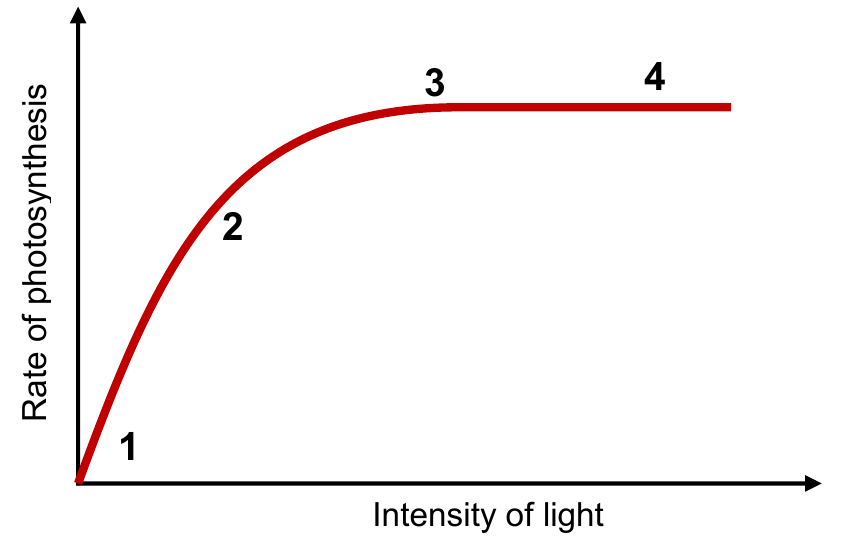
The relationship between light intensity and photosynthesis rate follows a predictable pattern:
Stage 1: Low light conditions When light levels are dim, photosynthesis occurs very slowly because there isn't enough energy to drive the light-dependent reactions efficiently.
Stage 2: Increasing light As light intensity increases, the rate of photosynthesis rises proportionally. More light energy means more reactions can take place simultaneously.
Stage 3: Optimum light levels At a certain light intensity, photosynthesis reaches its maximum rate for those particular conditions.
Stage 4: Light saturation Beyond the optimum point, adding more light doesn't increase the photosynthesis rate further. This happens because other factors (like CO₂ concentration or temperature) become limiting instead. The plant simply cannot process the reactions any faster, regardless of additional light.
Important
Light Saturation Point Once optimal light intensity is reached, other factors become limiting. This explains why simply increasing light won't always improve plant growth - you must consider all environmental factors together.
Carbon dioxide concentration
Carbon dioxide serves as the raw material for glucose production during photosynthesis. The amount of CO₂ available in the environment therefore affects how much glucose can be manufactured.
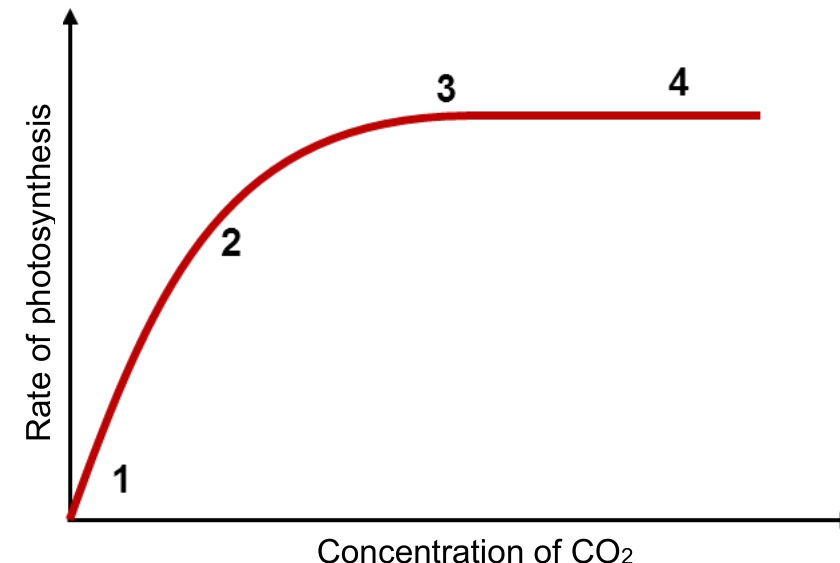
The relationship between carbon dioxide concentration and photosynthesis rate shows a similar pattern to light intensity:
Stage 1: Low CO₂ levels When carbon dioxide concentration is low, photosynthesis proceeds slowly because there isn't enough raw material for the light-independent reactions.
Stage 2: Rising CO₂ concentration As more carbon dioxide becomes available, the photosynthesis rate increases because the Calvin cycle can operate more efficiently.
Stage 3: Optimum CO₂ levels
At the ideal carbon dioxide concentration, photosynthesis occurs at its fastest possible rate under those conditions.
Stage 4: CO₂ saturation Once CO₂ concentration exceeds the optimum level, the rate plateaus. This occurs because the light-independent phase reactions cannot proceed any faster than their maximum capacity, even with excess carbon dioxide present.
Temperature
Temperature affects photosynthesis differently from light and CO₂ because it influences enzyme activity. Since photosynthesis relies on enzymes to catalyse its reactions, temperature changes have a more complex effect.
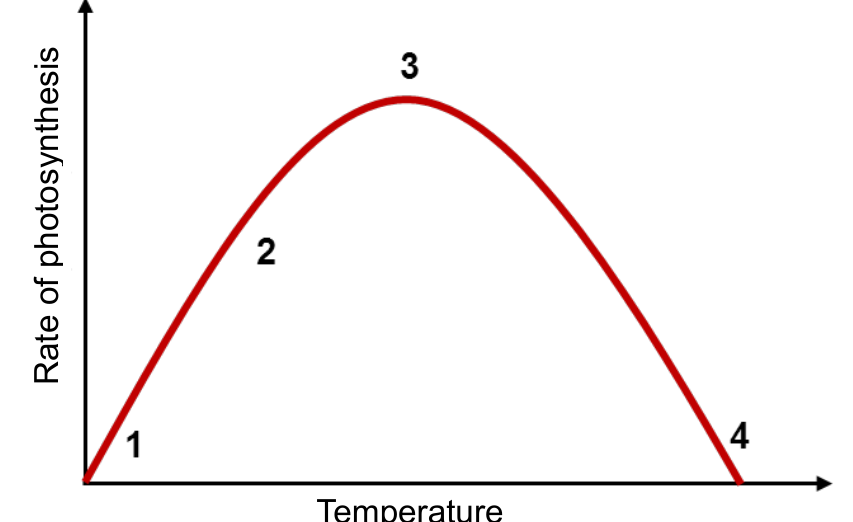
The relationship between temperature and photosynthesis rate creates a bell-shaped curve:
Stage 1: Low temperatures At cold temperatures, photosynthesis occurs slowly because enzyme activity is reduced. The molecules move more slowly and collide less frequently.
Stage 2: Rising temperatures As temperature increases, enzyme activity speeds up, causing photosynthesis to occur more rapidly. More molecular collisions lead to faster reactions.
Stage 3: Optimum temperature At the ideal temperature, enzymes work at their maximum efficiency, producing the highest photosynthesis rate possible.
Stage 4: High temperatures Beyond the optimum temperature, photosynthesis rate drops sharply. This decline happens because the heat denatures (destroys the shape of) the enzymes involved in photosynthesis, making them unable to function properly.
Important
Enzyme Denaturation Unlike light and CO₂ limitations, high temperatures cause permanent damage to enzymes. Once denatured, enzymes cannot recover their function even if temperature returns to optimal levels.
Greenhouses and controlled environments
Farmers and gardeners use greenhouses to create ideal conditions for plant growth by controlling the environmental factors that affect photosynthesis.
| Term | Definition |
|---|---|
| Greenhouse | A glass or plastic structure that traps heat and allows light to enter, used to grow plants |
| Greenhouse effect | The natural phenomenon where heat from the sun is trapped on Earth by CO₂ in the atmosphere |
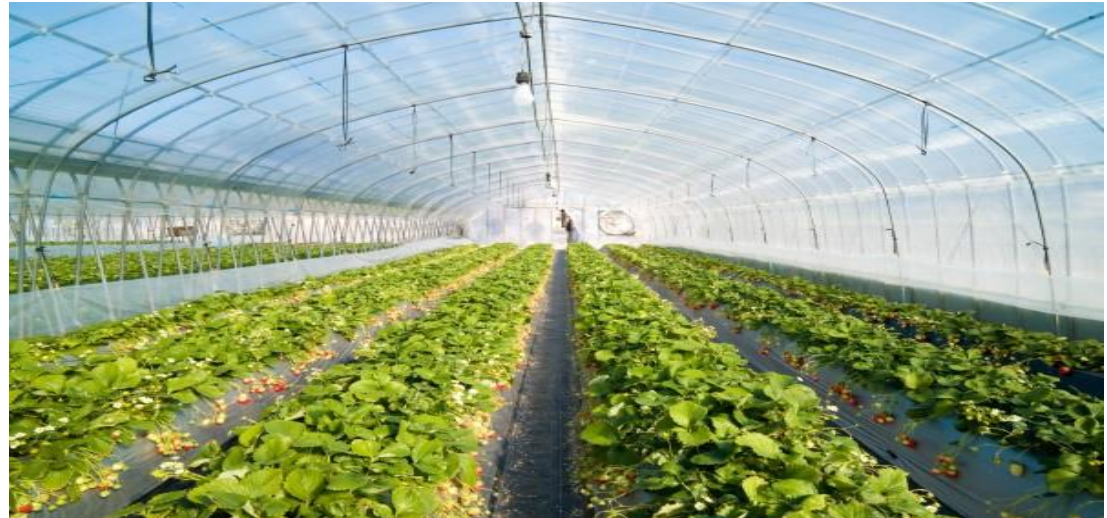
Greenhouses work by allowing light to enter through their transparent walls and roof whilst trapping heat inside the structure. This enables farmers to maintain optimum conditions for photosynthesis in several ways:
- Light control: Natural light passes through the transparent materials, and artificial lighting can extend the photoperiod for longer growing seasons
- CO₂ management: Additional carbon dioxide can be pumped into the greenhouse or generated using gas burners to maintain higher concentrations than normal atmospheric levels
- Temperature regulation: Heating and cooling systems maintain the optimum temperature range, preventing both cold damage and enzyme denaturation
Note
The Natural Greenhouse Effect The greenhouse effect occurs naturally on Earth when carbon dioxide in our atmosphere traps heat from the sun, keeping our planet warm enough to support life. However, increasing CO₂ levels from human activities are enhancing this effect, leading to global warming concerns.
Investigating photosynthesis factors
Scientists can design controlled experiments to determine which factors are necessary for photosynthesis or to measure photosynthesis rates under different conditions. In these investigations, researchers use two groups:
- The experimental group - receives all requirements for photosynthesis except the factor being tested
- The control group - receives all requirements including the factor being investigated
This experimental design allows scientists to isolate the effect of individual environmental factors and understand their specific contributions to photosynthesis rates.
Example
Worked Example: Testing Light Requirements
To investigate whether light is necessary for photosynthesis:
- Control group: Plant kept in bright light with adequate CO₂ and temperature
- Experimental group: Identical plant kept in complete darkness with same CO₂ and temperature
- Result: Only the control group produces starch, proving light is essential for photosynthesis
Summary
Key Points to Remember:
- Three key factors affect photosynthesis rate: light intensity, carbon dioxide concentration, and temperature
- Light and CO₂ both show saturation curves - rates increase then plateau when other factors become limiting
- Temperature creates a bell-shaped curve because high heat denatures the enzymes needed for photosynthesis
- Greenhouses allow farmers to control all three factors for optimum plant growth
- The greenhouse effect is essential for life on Earth but increasing CO₂ levels are causing global warming