Revision (Grade 11 NSC Matric Mathematics): Revision Notes
📚Revision Notes
Revision
What is analytical geometry?
Analytical geometry, also called coordinate geometry or Cartesian geometry, is the study of geometric properties and relationships between points, lines and angles in the Cartesian plane. In analytical geometry, we define geometric shapes using a coordinate system and algebraic principles. This branch of mathematics allows us to solve geometric problems using equations and formulas.
Note
Analytical geometry bridges the gap between algebra and geometry, making it possible to solve complex geometric problems using coordinate systems and algebraic methods. This approach is essential in fields like engineering, physics, and computer graphics.
Distance formula and theorem of Pythagoras
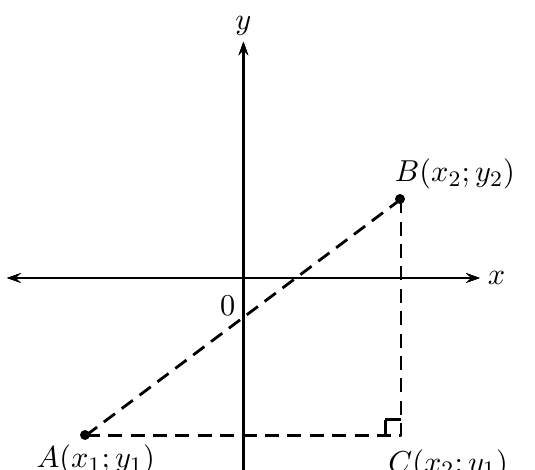
The distance formula is based on the theorem of Pythagoras and helps us find the length between any two points on a coordinate plane.
Important
Critical Foundation: The distance formula is essentially the Pythagorean theorem applied to coordinates. Understanding this connection helps you remember and apply the formula correctly.
Theorem of Pythagoras:
Distance formula: For two points with coordinates and , the distance between them is:
Note
Remember that , so the order of subtraction doesn't matter when we square the differences. This makes the formula flexible and reduces calculation errors.
Gradient and slope
Gradient (also called slope) measures how steep a line is. It tells us the rate of change between two points on a line.
Gradient formula: For a line passing through points and :
Important
Common Mistake to Avoid: Be consistent with your formula choice. Remember:
Always keep the order of subtraction the same for both numerator and denominator.
Types of lines and their gradients
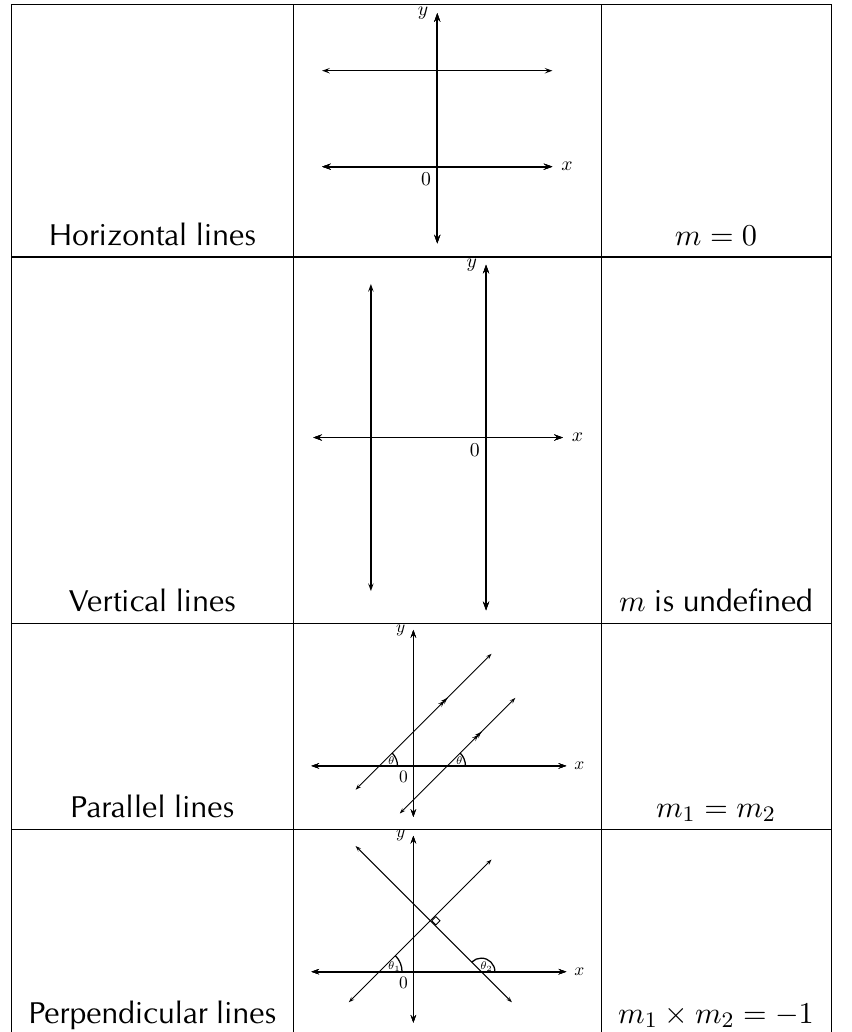
Different types of lines have specific gradient values that help us identify and work with them.
Note
Line Types and Their Gradients:
- Horizontal lines: These lines run left to right and have gradient
- Vertical lines: These lines run up and down and have gradient that is undefined
- Parallel lines: These lines never meet and have equal gradients:
- Perpendicular lines: These lines meet at right angles and their gradients multiply to give :
Mid-point of a line segment
The mid-point is the point that lies exactly halfway between two given points on a line segment.
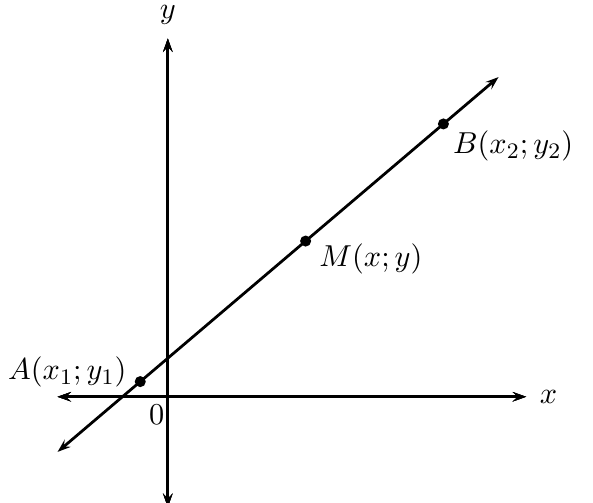
Mid-point formula: For two points and , the mid-point is:
Note
This formula simply averages the x-coordinates and y-coordinates of the two points. Think of it as finding the "middle" by taking the average of each coordinate separately.
Points on a straight line (collinear points)
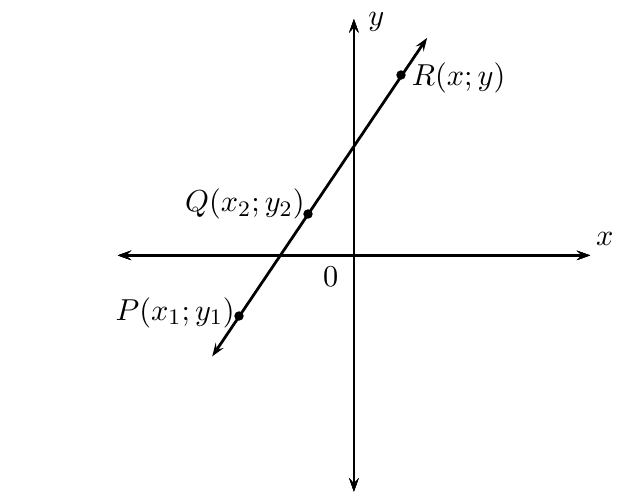
When three or more points lie on the same straight line, we call them collinear points. For any point on a straight line passing through points and :
Note
This equation tells us that the gradient between any two points on the same straight line is constant. This is a fundamental property that helps us determine if points are collinear.
Quadrilaterals and their properties
A quadrilateral is a closed shape with four straight line segments. Different types of quadrilaterals have specific properties.
Parallelogram
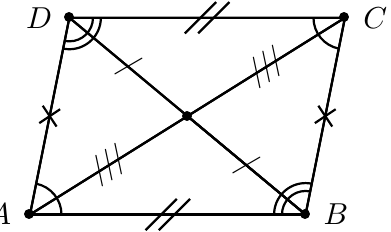
A parallelogram is a quadrilateral where both pairs of opposite sides are parallel.
Note
Parallelogram Properties:
- Both pairs of opposite sides are equal in length
- Both pairs of opposite angles are equal
- The diagonals bisect each other
Rectangle
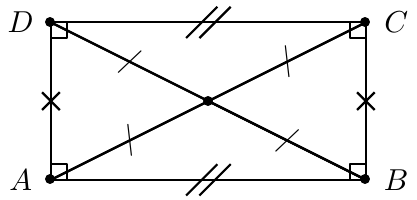
A rectangle is a parallelogram with all four angles equal to .
Note
Rectangle Properties:
- Both pairs of opposite sides are equal and parallel
- The diagonals bisect each other
- The diagonals are equal in length
Rhombus
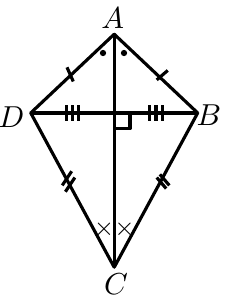
A rhombus is a parallelogram with all four sides equal in length.
Note
Rhombus Properties:
- Both pairs of opposite sides are equal and parallel
- The diagonals bisect each other at
- The diagonals of a rhombus bisect both pairs of opposite angles
Square
A square is a rhombus with all four interior angles equal to .
Note
Square Properties:
- Both pairs of opposite sides are equal and parallel
- The diagonals bisect each other at
- The diagonals are equal in length
- The diagonals bisect both pairs of interior opposite angles (all angles are )
Trapezium
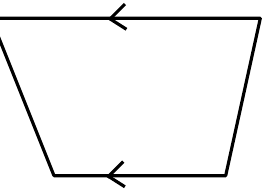
A trapezium is a quadrilateral with one pair of opposite sides parallel.
Kite
A kite is a quadrilateral with two pairs of adjacent sides equal.
Note
Kite Properties:
- One pair of opposite angles are equal (angles between unequal sides)
- The diagonal between equal sides bisects the other diagonal
- The diagonal between equal sides bisects the interior angles
- The diagonals intersect at
Worked example 1: Basic calculations
Example
Worked Example: Distance, Mid-point and Perpendicular Lines
Question: Given points and :
- Find the length of line segment
- Find the mid-point of line segment
- Show that the line through and is perpendicular to line
Solution:
Step 1: Assign coordinates
- Let and
- So: , , ,
Step 2: Apply the distance formula
The length of line segment is units.
Step 3: Apply the mid-point formula
For x-coordinate:
For y-coordinate:
The mid-point is .
Step 4: Calculate gradients and check perpendicularity
-
Gradient of :
-
Gradient of :
-
Product of gradients:
Since the product equals , line is perpendicular to line .
Worked example 2: Quadrilaterals
Example
Worked Example: Finding the Fourth Vertex of a Parallelogram
Question: Points , , and are points on the Cartesian plane. Find if is a parallelogram.
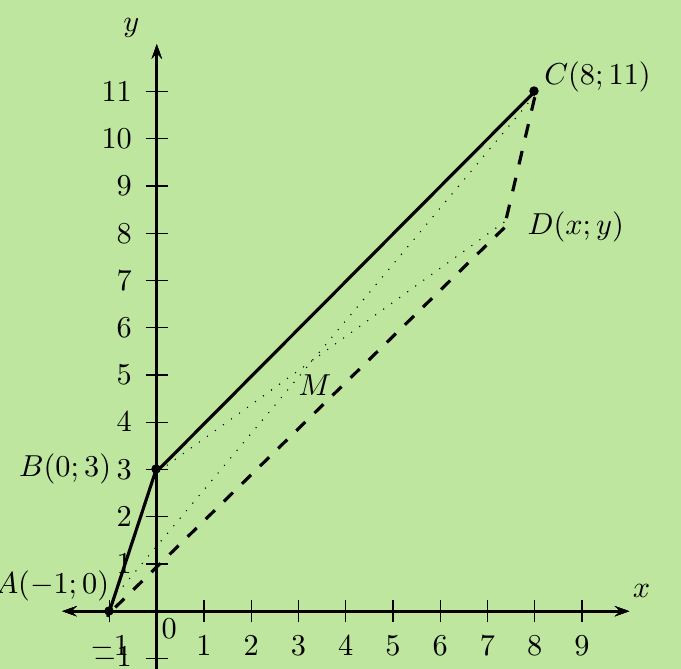
Solution:
Step 1: Use the property that diagonals of a parallelogram bisect each other
In a parallelogram, the mid-point of diagonal equals the mid-point of diagonal .
Step 2: Find the mid-point of
Let and
Step 3: Use the fact that this equals the mid-point of
Since and :
Step 4: Set the mid-points equal and solve
For x-coordinate: , so
For y-coordinate: , so , therefore
The coordinates of are .
Summary
Key Points to Remember:
- The distance formula uses Pythagoras:
- Perpendicular lines have gradients that multiply to give
- Parallel lines have equal gradients
- The mid-point formula averages the coordinates:
- In parallelograms, diagonals bisect each other, making their mid-points equal