Dependent and Independent Events (Grade 11 NSC Matric Mathematics): Revision Notes
📚Revision Notes
Dependent and Independent Events
Understanding the concept
When studying probability, we often need to determine whether one event affects the likelihood of another event occurring. This relationship between events is crucial for calculating combined probabilities correctly.
Dependent events occur when knowing the outcome of one event provides information about the probability of another event. In contrast, independent events occur when knowing the outcome of one event does not change the probability of the other event happening.
Note
Understanding the difference between dependent and independent events is fundamental to solving complex probability problems correctly. This concept appears frequently in exam questions and real-world applications.
Definition of independent events
Two events A and B are independent if and only if:
Important
This mathematical definition is the key formula for testing independence. Memorize this relationship - it's essential for identifying whether events are independent and for calculating combined probabilities correctly.
This mathematical definition tells us that for independent events, we can simply multiply their individual probabilities to find the probability that both events occur together.
Why this definition makes sense
Consider the basic probability formula: , where represents the number of outcomes in event A, and represents the total number of outcomes in the sample space S.
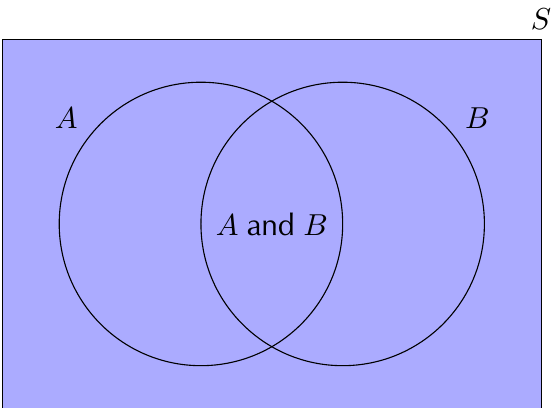
When we know that event B has occurred, we effectively change our sample space. The probability of A occurring given that B has happened becomes:
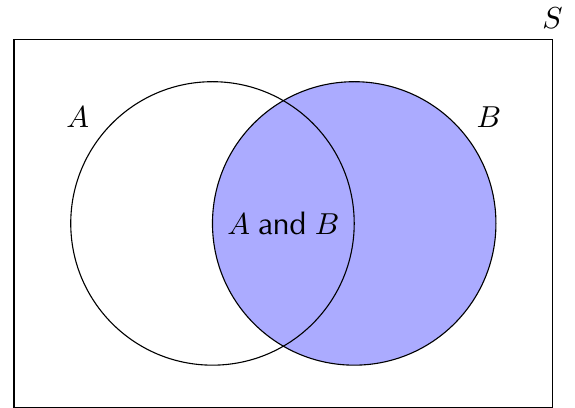
For events to be independent, knowing that B occurred should not change the probability of A. This means:
Through algebraic manipulation, this condition leads directly to our independence formula: .
Worked example 1: Sampling with replacement (independent events)
Example
Worked Example: Sampling with Replacement
Problem: A bag contains 5 red balls and 5 blue balls. We remove a ball, record its colour, and put it back. Then we remove another ball and record its colour.
Questions:
- What is the probability the first ball is red?
- What is the probability the second ball is blue?
- What is the probability the first ball is red and the second ball is blue?
- Are these events independent?
Solution:
Step 1: Probability of first ball being red
Since there are 10 balls total, with 5 red balls:
Step 2: Probability of second ball being blue
Because we replaced the first ball, there are still 10 balls total with 5 blue balls:
Step 3: Probability of red first and blue second We can list all possible outcomes when drawing two balls:
- Red first, red second
- Red first, blue second
- Blue first, red second
- Blue first, blue second
Since we're replacing the first ball, each outcome has equal probability.
The specific outcome "red first, blue second" has probability:
Step 4: Testing for independence
According to our definition, events are independent if:
Checking: ✓
Since the equation holds, the events are independent.
Worked example 2: Sampling without replacement (dependent events)
Example
Worked Example: Sampling without Replacement
Problem: Using the same bag with 5 red and 5 blue balls, we remove a ball and record its colour. However, this time we do not put the first ball back before drawing the second ball.
Solution:
Step 1: Count possible outcomes When removing two balls without replacement, we have four possible outcomes:
- Red first, red second:
- Red first, blue second:
- Blue first, red second:
- Blue first, blue second:
Step 2: Probability of first ball being red
Step 3: Probability of second ball being blue
Step 4: Probability of red first and blue second
From our calculations above:
Step 5: Testing for independence
Since , the events are dependent.
Key differences between scenarios
Important
Critical Distinction - Replacement vs No Replacement
The crucial difference between these examples is replacement:
- With replacement: Each draw is independent because the composition of the bag remains unchanged
- Without replacement: Each draw affects the composition for subsequent draws, creating dependence
This pattern applies to most sampling scenarios and is a common source of exam questions.
Important exam warnings
Important
Common Misconception Alert
Just because two events are mutually exclusive does not mean they are independent.
Key differences:
- To test for mutual exclusivity: Check if
- To test for independence: Check if
Events can be mutually exclusive and dependent, or non-mutually exclusive and independent, depending on the specific situation. Always test using the correct formula!
Using Venn diagrams for calculation
Note
Working with Venn Diagrams
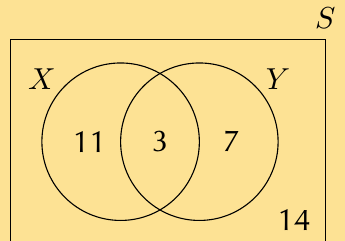
When working with Venn diagrams containing specific numbers, you can test for independence by calculating the required probabilities and applying the independence formula. Remember that the total sample space includes all regions of the diagram.
Summary
Summary
Key Points to Remember:
- Independent events: - knowing one event doesn't affect the other
- Dependent events: - knowing one event changes the probability of the other
- With replacement typically creates independent events, without replacement typically creates dependent events
- Mutual exclusivity and independence are completely different concepts - don't confuse them
- Always verify independence by checking whether the multiplication rule holds exactly