Summary (Grade 11 NSC Matric Mathematics): Revision Notes
📚Revision Notes
Summary
Fundamental trigonometric identities
The square identity and quotient identity form the foundation of trigonometry. These relationships are always true, regardless of the angle size.
Important
The Square Identity (Pythagorean Identity)
This means that for any angle θ, when you square the cosine and sine values and add them together, you always get 1. This identity is the most fundamental relationship in trigonometry.
Important
The Quotient Identity
This tells us that tangent is simply the ratio of sine to cosine for any angle. This relationship is essential for solving trigonometric equations.
Triangle notation and labelling
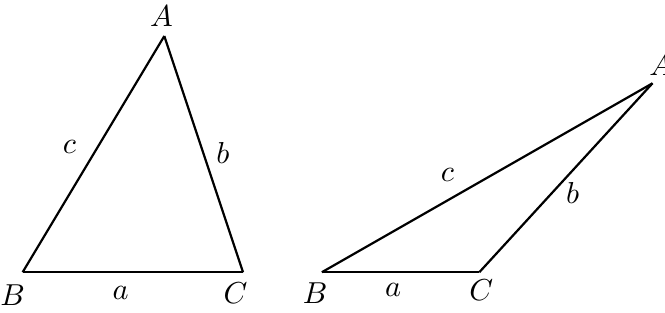
When working with triangles, we use a standard labelling system that helps us apply trigonometric rules correctly.
Note
Triangle Labelling Convention
In any triangle, we label the vertices with capital letters (A, B, C) and the sides opposite these vertices with corresponding lowercase letters (a, b, c).
- Side 'a' is opposite angle A
- Side 'b' is opposite angle B
- Side 'c' is opposite angle C
This consistent labelling system is crucial for applying the sine and cosine rules correctly.
Special angle properties
Understanding how trigonometric functions behave with different angle transformations is crucial for solving complex problems.
Negative angles
- (sine is an odd function)
- (cosine is an even function)
Periodicity identities
Trigonometric functions repeat their values in regular intervals:
Co-function identities
These show the relationship between trigonometric functions of complementary angles:
Triangle solution rules
These three rules allow you to solve any triangle problem, depending on what information you're given.
Sine rule
Use when you have two angles and a side, or two sides and a non-included angle:
Important
Sine Rule
Or in its reciprocal form:
Area rule
Use when you need to find the area of a triangle with two sides and the included angle:
Example
Area Rule Applications
- Area of △ABC =
- Area of △ABC =
- Area of △ABC =
The key is having two sides and the included angle between them.
Cosine rule
Use when you have two sides and the included angle, or when you have all three sides:
Important
Cosine Rule
Note that when the angle is 90°, this reduces to Pythagoras' theorem since .
Quadrant signs (ASTC method)
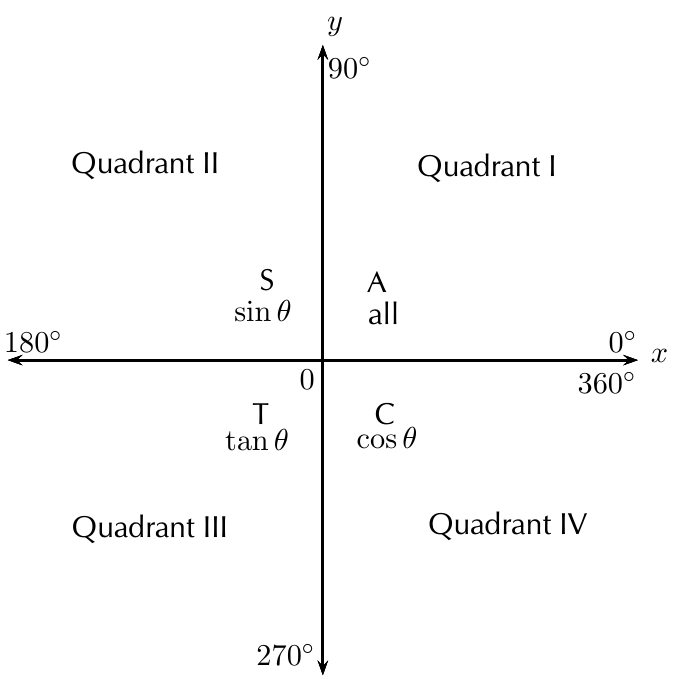
The signs of trigonometric functions change depending on which quadrant the angle falls in.
Important
ASTC Method - Quadrant Signs
- Quadrant I (0° to 90°): All functions are positive
- Quadrant II (90° to 180°): Sine is positive, cosine and tangent are negative
- Quadrant III (180° to 270°): Tangent is positive, sine and cosine are negative
- Quadrant IV (270° to 360°): Cosine is positive, sine and tangent are negative
Remember the mnemonic: "All Students Take Calculus" or "All Stations To Central"
General solutions for trigonometric equations
When solving trigonometric equations, there are usually multiple solutions due to the periodic nature of these functions.
For sine equations
If :
- or
For cosine equations
If :
- or
For tangent equations
If :
Note
Understanding General Solutions
Where (k is any integer)
The different forms account for the symmetry properties of trigonometric functions and ensure you find all possible solutions within any given domain.
Choosing the right rule
Knowing which rule to apply depends on the information given in the problem:
Summary
Rule Selection Guide
Use the area rule when:
- No perpendicular height is given
- You have two sides and the included angle
Use the sine rule when:
- No right angle is present
- Two sides and a non-included angle are given
- Two angles and one side are given
Use the cosine rule when:
- No right angle is present
- Two sides and the included angle are given
- All three sides are given
Exam tips
Important
Critical Exam Strategies
- Always check which quadrant your angle is in to determine the correct sign
- When finding general solutions, consider the domain specified in the question
- Use the appropriate inverse function on your calculator, but remember to find all solutions in the given interval
- Draw diagrams when solving triangle problems to visualise the given information
- Remember that the cosine rule reduces to Pythagoras' theorem when the angle is 90°
Summary
Key Points to Remember
- The fundamental identities and are your mathematical toolkit
- ASTC helps you remember which trig functions are positive in each quadrant
- Choose sine rule for non-included angles, cosine rule for included angles or three sides
- General solutions account for the periodic nature of trigonometric functions
- Always consider the domain when finding solutions to trigonometric equations