The Multiplier (Grade 12 NSC Matric Economics): Revision Notes
📚Revision Notes
The Multiplier
What is the multiplier effect?
The multiplier effect describes how a small initial change in spending can create a much larger change in the overall economy's output and income. Think of it like dropping a stone in a pond - the ripples spread outward, creating effects much bigger than the original stone.
When someone spends money in the economy (like government investment or business spending), this creates income for others. Those people then spend part of their new income, which creates income for even more people, and so on. This creates a knock-on effect where the final increase in national income is much larger than the original spending injection.
Note
The multiplier effect is like a ripple effect in water - one initial action creates multiple waves of consequences that spread throughout the entire economic system.
How to calculate the multiplier
The multiplier can be calculated using these formulas:
Where:
- M = the multiplier value
- mpc = marginal propensity to consume (the proportion of extra income that people spend)
- mps = marginal propensity to save (the proportion of extra income that people save)
Important
Critical relationship: always
This relationship is fundamental to understanding the multiplier - if people don't spend their extra income, they must be saving it. There's no other option in a simple model.
You can also calculate the multiplier by comparing the total change in income to the original injection:
Where:
- = change in total income
- = change in investment (the initial injection)
The multiplier in a two sector economy
In a simple two sector economy (households and businesses), the multiplier depends on the marginal propensity to consume (mpc). This tells us what proportion of any extra income gets spent rather than saved.
Here's how it works:
- The larger the mpc, the bigger the multiplier
- The smaller the mpc, the smaller the multiplier
- It's the money that stays in the economy that matters
Example
Worked Example: Two Sector Multiplier Calculation
Given data:
- Total income (Y) = R100,000
- Savings (S) = R40,000 = 40% (0.4)
- Expenditure (E) = R60,000 = 60% (0.6)
- Marginal propensity to consume = 0.6 (mpc)
- Marginal propensity to save = 0.4 (mps)
Step 1: Apply the multiplier formula
Result: The multiplier is 2.5, meaning that for every R1 of new investment, total income will eventually increase by R2.50.
The multiplier in a four sector economy
In a more realistic four sector model (households, businesses, government, and foreign sector), there are additional leakages that reduce the multiplier effect:
- mps = marginal propensity to save
- mrt = marginal rate of taxation
- mpm = marginal propensity to import
Note
These leakages represent money that "leaks out" of the circular flow and doesn't get re-spent domestically, reducing the multiplier effect. The more leakages there are, the smaller the multiplier becomes.
Understanding the multiplier through graphs
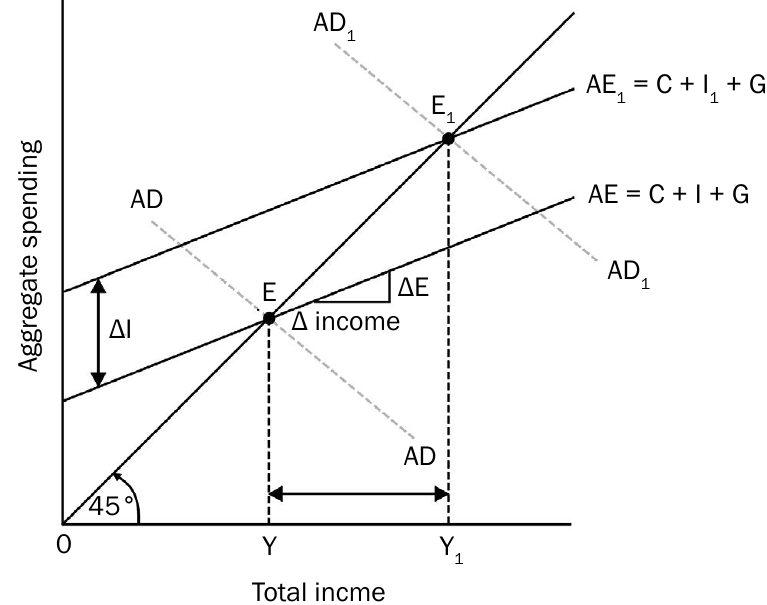
The graph above shows how the multiplier works visually. When there's an increase in investment (), this shifts the aggregate expenditure line upward from AE to AE₁. The economy moves from equilibrium point E to E₁, and the final increase in income (from Y to Y₁) is much larger than the original investment increase.
The 45-degree line represents points where total spending equals total income - these are equilibrium points where the economy settles.
How the multiplier effect works in practice
Example
Worked Example: Step-by-Step Multiplier Process
Let's trace through how a R1000 investment creates multiplied effects:
Step 1 - Initial injection: Businesses increase investment spending by R1000 (buying equipment from domestic suppliers)
Step 2 - First round: This R1000 becomes income for equipment suppliers. Total production and income both increase by R1000 initially.
Step 3 - Second round: Equipment suppliers receive this R1000 income, but don't spend it all. Some goes to taxes, savings, and imports. Let's say R300 "leaks out" and R700 gets spent on domestic goods.
Step 4 - Third round and beyond: The R700 spent becomes income for others, who again spend part of it domestically. This process continues with smaller amounts each round.
Step 5 - Final result: The total increase in national income ends up being R2500 (if the multiplier is 2.5), much more than the original R1000 investment.
The Keynesian approach
John Keynes was the famous economist who developed multiplier theory. He believed that economies need spending to grow, and that government could use the multiplier effect to boost economic growth.
The Keynesian approach suggests that government can:
- Increase government spending (G) and finance it through loans to stimulate economic growth
- Reduce taxation to put more money in consumers' pockets
- Reduce company taxes to encourage more business investment
Important
When consumers have more disposable income, they spend more, which increases aggregate demand. This leads to higher production, more employment, and economic growth through the multiplier effect.
This is why Keynesian economists often support government intervention during economic downturns.
Worked examples and calculations
Example
Worked Example: Calculating the Multiplier from Given Data
Given information:
- Original investment (I) = R40,000 million, increasing to R50,000 million
- Change in investment () = R10,000 million
- Original income (Y) = R100,000 million, increasing to R125,000 million
- Change in income () = R25,000 million
Step 1: Apply the multiplier formula
Result: The multiplier is 2.5, so every R1 of new investment leads to R2.50 increase in total national income.
What this tells us: The economy will experience disequilibrium when:
- Total spending does not equal production
- Total demand does not equal total supply
- Planned leakages do not equal planned injections
When these conditions exist, the economy will adjust through the multiplier process until a new equilibrium is reached.
Summary
Key Points to Remember:
-
The multiplier effect shows how small changes in spending can create much larger changes in national income through a ripple effect
-
The multiplier formula is or , where a higher propensity to consume creates a bigger multiplier
-
In a two sector economy, only saving acts as a leakage, but in a four sector economy, taxation and imports also reduce the multiplier effect
-
Keynes argued that government can use the multiplier to stimulate economic growth by increasing spending or reducing taxes
-
The multiplier works both ways - decreases in spending can also have multiplied negative effects on the economy