The Open Economy Circular Flow Model (Grade 12 NSC Matric Economics): Revision Notes
📚Revision Notes
The Open Economy Circular Flow Model
What is the open economy circular flow model?
The circular flow model shows us how an economy works by illustrating the relationships between income, production, and spending throughout the entire economic system. Think of it like a giant cycle where money and resources constantly move around between different groups of people and organisations.
An open economy is different from a closed economy because it includes trade and interactions with other countries - this is what makes it "open" to the rest of the world. The model helps us understand how money flows between households, businesses, government, and foreign countries through various markets.
Note
The circular flow model is essential for understanding macroeconomics because it shows the interconnected nature of economic activity. Every economic decision by one sector affects all other sectors in the system.
Key features of the open economy circular flow model:
- Shows how different sectors of the economy interact with each other
- Includes the foreign sector (imports and exports)
- Demonstrates how money enters and leaves the economic system
- Helps explain changes in national income and economic growth
The four main sectors
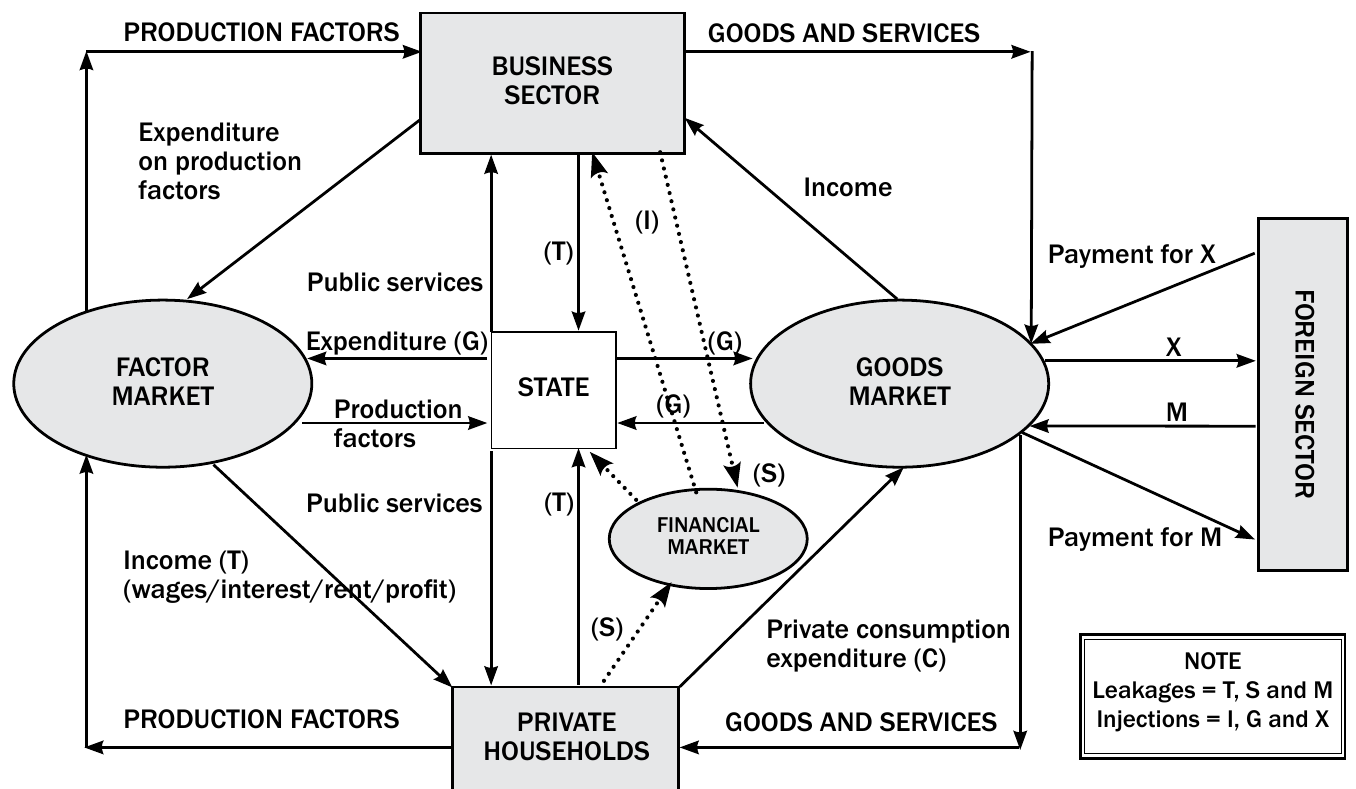
The open economy circular flow model includes four main participants or sectors:
Household sector
Households are the foundation of the economy because they:
- Own the factors of production (land, labour, capital) and sell these to businesses
- Consume goods and services by purchasing them from businesses with their income
- Receive income in the form of wages (for labour), rent (for land), interest (for capital), and profit (for entrepreneurship)
- Save money which flows into the financial markets
- Pay taxes to the government
Households are essentially both the suppliers of resources and the main consumers in the economy.
Business sector
The business sector plays a crucial role by:
- Purchasing factors of production from households through factor markets
- Using these resources to produce goods and services
- Selling products to households, government, and foreign countries
- Receiving income from sales revenue
- Investing in new equipment, buildings, and technology
- Paying taxes to the government
Important
Remember: Households act as consumers while firms act as suppliers of goods and services. This is a fundamental distinction in the circular flow model.
State/government sector
The government sector includes local, regional, and national government levels. The state:
- Provides public goods and services like education, healthcare, and infrastructure
- Collects taxes from both households and businesses
- Spends money on public services, employee salaries, and infrastructure projects
- Influences economic activity through its spending decisions
Government spending represents money being injected back into the economy.
Foreign sector
This sector represents all economic activity with other countries:
- Imports - goods and services flowing into our country from abroad (money leaves our economy)
- Exports - goods and services flowing out of our country to other nations (money enters our economy)
- International trade creates both inflows and outflows of money
The foreign sector is what makes this an "open" economy model rather than a closed one.
Understanding real and money flows
The circular flow model shows two types of movements:
Real flow
This refers to the physical movement of goods, services, and factors of production:
- Factors of production (labour, land, capital) flow from households to businesses
- Goods and services flow from businesses to households and other sectors
- Imports flow from foreign countries to South Africa
- Exports flow from South Africa to foreign countries
Money flow
This represents the monetary payments for real flows:
- Factor payments (wages, rent, interest, profit) flow from businesses to households
- Consumer spending flows from households to businesses
- The money flow always moves in the opposite direction to the real flow
Note
Understanding this dual flow helps explain how the economy maintains balance - when physical goods move one way, money moves the other way to pay for them. This is a fundamental principle of economic exchange.
Leakages and injections explained
Leakages
Leakages are withdrawals of money from the circular flow of income. They represent money that leaves the main spending stream:
| Component | Symbol | Explanation |
|---|---|---|
| Savings | S | Money households don't spend but save in financial institutions |
| Taxes | T | Money collected by government from households and businesses |
| Imports | M | Money spent on foreign goods and services |
Formula:
When households save money, pay taxes, or buy imported goods, this money "leaks out" of the main circular flow and isn't immediately available for domestic spending.
Injections
Injections are additions of money into the circular flow. They represent new spending that enters the economic system:
| Component | Symbol | Explanation |
|---|---|---|
| Investment | I | Money businesses spend on capital goods, equipment, and expansion |
| Government expenditure | G | Money government spends on goods, services, and public projects |
| Exports | X | Money earned from selling goods and services to foreign countries |
Formula:
These injections add new demand to the economy and help stimulate economic activity.
Equilibrium and disequilibrium conditions
Equilibrium
The economy is in equilibrium when the total amount of money leaking out equals the total amount being injected back in.
Equilibrium condition:
This means:
When this balance exists, the economy maintains a stable level of national income and economic activity.
Disequilibrium
The economy experiences disequilibrium in two situations:
Important
When injections exceed leakages :
- More money enters the economy than leaves it
- This creates additional demand for goods and services
- Businesses increase production to meet this demand
- National income increases - leading to economic growth
When leakages exceed injections :
- More money leaves the economy than enters it
- Demand for goods and services decreases
- Businesses reduce production
- National income decreases - leading to economic contraction
Mathematical relationships and calculations
The fundamental equation for national income in an open economy is:
Where:
- = National income
- = Consumption expenditure
- = Investment spending
- = Government expenditure
- = Exports
- = Imports
- = Net exports
Example
Worked Example: Calculating National Income
Using the data from the table:
| Component | Amount (R millions) |
|---|---|
| Consumption (C) | R110 |
| Investment (I) | R180 |
| Government spending (G) | R110 |
| Exports (X) | R25 |
| Imports (M) | R40 |
Step 1: Apply the national income formula
Step 2: Substitute the values
Step 3: Calculate net exports
Step 4: Final calculation
This shows the total national income for this economy.
Graphical representation
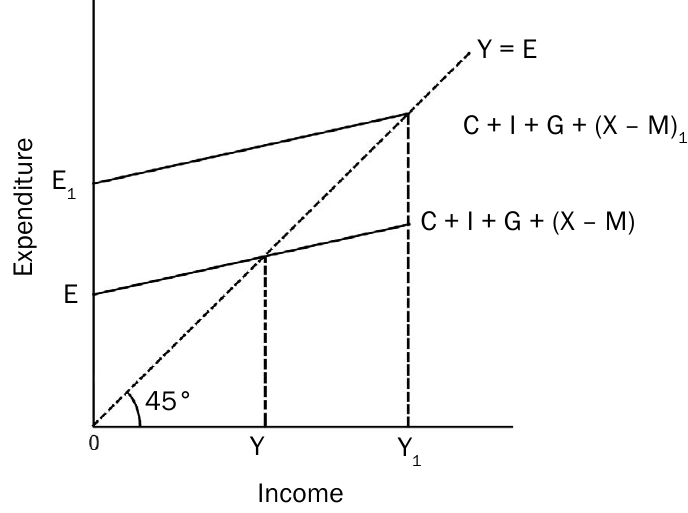
The circular flow can be represented graphically using an expenditure-income diagram:
- The 45-degree line represents the equilibrium condition where expenditure equals income
- The aggregate expenditure curve shows planned spending at different income levels
- Where these lines intersect shows the equilibrium income level
- Changes in injections shift the expenditure curve up or down
- This creates a new equilibrium at a different income level
Note
When expenditure increases, it means more goods and services are being purchased, which is beneficial for economic growth and employment. This graphical representation helps visualise how changes in spending affect the overall economy.
Different types of markets
The circular flow model operates through several interconnected markets:
Goods/product markets
These are markets where:
- Consumer goods and services are bought and sold
- Businesses sell their products to households, government, and foreign buyers
- Examples include retail stores, online marketplaces, and service providers
Factor markets
In these markets:
- Factors of production (land, labour, capital, entrepreneurship) are traded
- Households sell their labour and other resources to businesses
- Natural resources, workforce skills, and capital equipment change hands
Financial markets
These include several sub-markets:
Money markets:
- Short-term loans and funds are traded
- Banks, insurance companies provide services
- Very short-term financial needs are met
Capital markets:
- Long-term funds are borrowed and saved
- Examples include the Johannesburg Stock Exchange
- Government bonds, mortgage bonds, and company shares are traded
Foreign exchange markets:
- Different currencies are bought and sold
- Businesses buy foreign currency to pay for imports
- Major international centres include London, New York, and Tokyo
- Essential for international trade transactions
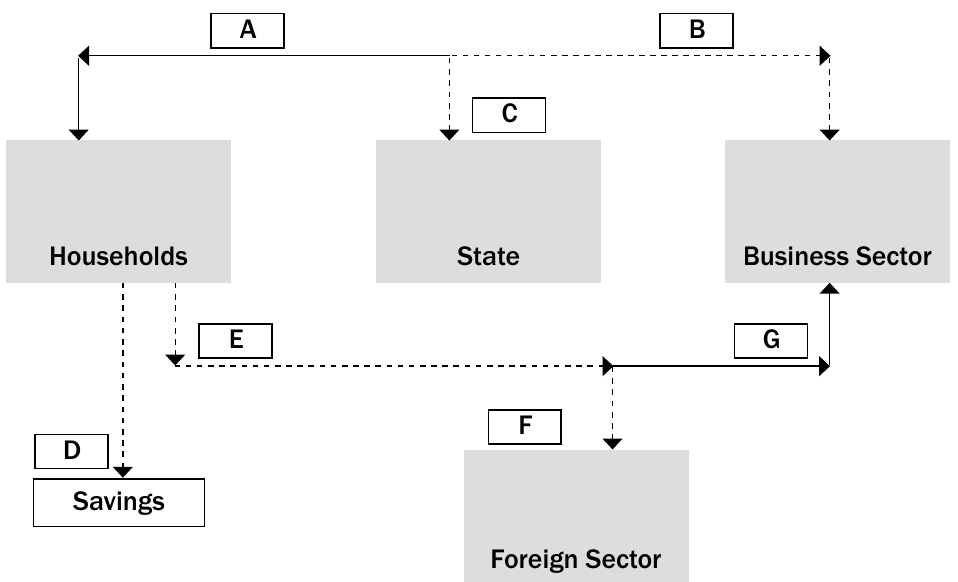
This simplified diagram shows how the different sectors connect through various flow channels, each representing different types of economic transactions and relationships.
Summary
Key Points to Remember:
-
The open economy circular flow model shows how money and resources move between households, businesses, government, and foreign countries in a continuous cycle
-
Leakages remove money from the circular flow, while injections add money back into the system
-
Economic equilibrium occurs when leakages equal injections , maintaining stable national income levels
-
The four main sectors each play distinct roles: households provide factors and consume goods, businesses produce goods and services, government provides public services and collects taxes, and the foreign sector enables international trade
-
Understanding the difference between real and money flows helps explain how physical goods and monetary payments move in opposite directions to maintain economic balance