The Foreign Exchange Market and the Balance of Payments Accounts (Grade 12 NSC Matric Economics): Revision Notes
📚Revision Notes
Foreign Exchange Markets and Establishment of Foreign Exchange Rates
What is a foreign exchange rate?
A foreign exchange rate represents the price of one country's currency expressed in terms of another country's currency. Think of it as the "cost" of buying foreign money with your domestic money. For example, if $1 = R10.00, this means you need 10 South African rand to purchase 1 US dollar.
In South Africa, currency trading happens through the interbank foreign exchange market. Unlike the Johannesburg Stock Exchange which has a physical building, this market exists electronically worldwide. Banks, businesses, and traders conduct transactions through computers, emails, fax, letters, and phone calls, making it a truly global electronic marketplace.
Note
The foreign exchange market operates 24 hours a day because when one major financial centre closes (like London), another opens in a different time zone (like Tokyo or New York), creating continuous global trading.
Understanding foreign exchange markets
A foreign exchange market is essentially a marketplace where people buy and sell different currencies. The major trading centres are located in financial capitals like London, New York, and Tokyo, where massive amounts of currency change hands daily.
These markets operate continuously because when one major financial centre closes, another opens in a different time zone, creating a 24-hour global trading environment.
How supply and demand determine exchange rates
Just like any other market, foreign exchange rates are determined by the interaction between supply and demand forces. When more people want to buy a particular currency (high demand), its price goes up. When fewer people want it (low demand), its price falls.
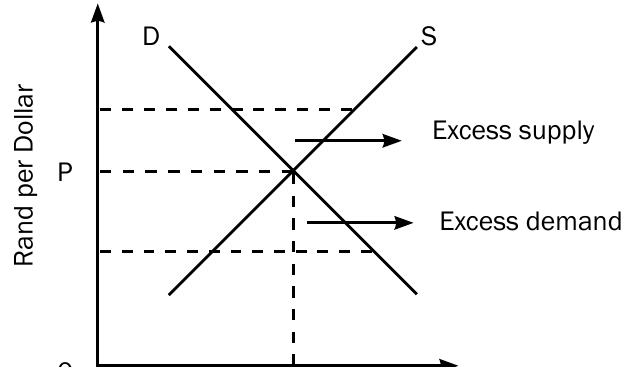
The graph above shows how supply and demand curves intersect to establish an equilibrium exchange rate. At point P (the equilibrium), the quantity of dollars demanded equals the quantity supplied. However, markets don't always stay in perfect balance:
- Excess supply occurs when the exchange rate is above equilibrium - more people want to sell dollars than buy them
- Excess demand happens when the rate is below equilibrium - more people want to buy dollars than can get them
Example
Worked Example: Supply and Demand in Action
If South African importers need more US dollars to pay for goods from America, this increases demand for dollars. On the flip side, when American importers want to buy South African products, they need rand, which increases the supply of dollars in the market.
Result: Higher demand for dollars = stronger dollar value relative to the rand
Factors that influence currency demand and supply
Understanding what drives people to buy or sell foreign currency helps explain exchange rate movements.
Demand factors for foreign exchange
The main factors that create demand for foreign currency include:
| Factor | Explanation |
|---|---|
| Importing goods | When SA businesses buy products from overseas, they need foreign currency to pay suppliers |
| Payment for foreign services | Paying for services like shipping, insurance, or consulting from foreign companies |
| Buying shares in another country | SA investors purchasing foreign company shares need that country's currency |
| Tourists spending money overseas | SA tourists need foreign currency for their trips abroad |
| Repayment of debt borrowed from foreign countries | Government or businesses repaying loans to foreign lenders |
Supply factors of foreign exchange
The main factors that create supply of foreign currency include:
| Factor | Explanation |
|---|---|
| Exporting goods | When SA sells products abroad, foreign buyers pay in their currency, which gets converted to rand |
| Providing services to foreign countries | SA companies earning foreign currency by offering services internationally |
| Receiving dividends on shares invested in foreign countries | Returns on SA investments in foreign companies |
| Inflow of foreign capital | Foreign investors bringing money into SA to invest in local businesses |
| Expenditure of money by foreign tourists | Foreign visitors spending their currency in SA |
| Raising new loans in foreign countries | SA borrowing money from overseas lenders |
Currency appreciation and depreciation
Currency values constantly change due to market forces. There are two main types of currency movements:
Appreciation occurs when a currency's value increases due to natural market forces. For example, if the rand strengthens from 1 dollar = R10 to 1 dollar = R9, the rand has appreciated because you now need fewer rand to buy one dollar.
Depreciation happens when a currency's value decreases due to market forces. If the rand weakens from 1 dollar = R9 to 1 dollar = R10, the rand has depreciated because you now need more rand to buy the same dollar.
Important
Critical Distinction: Market Forces vs Government Action
Appreciation/Depreciation = Changes caused by natural market forces (supply and demand)
Revaluation/Devaluation = Changes caused by deliberate government intervention
Never confuse these terms - they indicate completely different causes of currency movement!
Revaluation and devaluation
These terms apply when governments deliberately change their currency's value, typically under fixed exchange rate systems:
- Revaluation: Government deliberately increases the currency's value
- Devaluation: Government deliberately decreases the currency's value
These actions result from central bank intervention rather than natural market forces.
Government intervention in currency markets
Sometimes governments feel their currency is incorrectly valued by the market. They can intervene in two main ways:
Direct intervention
The central bank directly buys or sells foreign currency:
- When the currency is overvalued (too strong), the bank sells foreign exchange to weaken it
- When the currency is undervalued (too weak), the bank buys foreign exchange to strengthen it
Indirect intervention
The most common tool is interest rate changes:
- Overvalued currency: Increase interest rates to attract foreign investment, creating demand for the local currency
- Undervalued currency: Decrease interest rates to encourage capital outflow, reducing demand for the local currency
Note
Interest rate changes affect the balance of payments by influencing investment flows and economic activity. Higher interest rates attract foreign investors seeking better returns, while lower rates encourage domestic investors to look overseas for opportunities.
Exchange rate systems
Countries can choose different approaches to managing their currency values:
Free floating exchange rates
The currency value is determined purely by market forces - supply and demand for the currency with no government interference.
Managed exchange rates
Governments allow market forces to operate but intervene occasionally to prevent extreme fluctuations, keeping the currency within certain acceptable limits.
Fixed exchange rates
The government sets and maintains a specific exchange rate, often backed by gold reserves. South Africa used this system until 1932 when it abandoned the gold standard.
Terms of trade
The terms of trade measure how a country's export prices compare to its import prices, calculated using this formula:
| Year | 2008 | 2009 | 2010 | 2011 | 2012 | 2013 |
|---|---|---|---|---|---|---|
| Index | 105.3 | 113.7 | 122.0 | 124.7 | 123.0 | 121.4 |
| % Change | 0.0 | 8.0 | 7.3 | 2.2 | -1.7 | -1.6 |
Interpreting the data:
- Improvement: When the index increases, export prices are rising faster than import prices (good for the economy)
- Deterioration: When the index decreases, import prices are rising faster than export prices (challenging for the economy)
Example
Worked Example: Understanding Terms of Trade Changes
Scenario: If South Africa's terms of trade index moves from 120 to 125:
Step 1: Calculate the change Change = 125 - 120 = 5 points increase
Step 2: Interpret the result This is an improvement - South Africa's export prices have increased relative to import prices, meaning the country gets more value from its trade relationships.
What this means: South Africa can now buy more imported goods for the same amount of exports, improving the country's purchasing power internationally.
An improvement can result from:
- Export prices increasing
- Import prices decreasing
A deterioration can result from:
- Export prices decreasing
- Import prices increasing
Free trade versus protection
Free trade allows producers and consumers to buy goods and services from anywhere in the world without government interference. This promotes competition and efficiency.
Protection involves government policies that limit trade between countries, such as import restrictions, to protect domestic industries from foreign competition.
South Africa's foreign trade patterns
South Africa maintains a relatively open economy with foreign trade representing approximately 30% of GDP. This makes the economy quite sensitive to changes in international trade conditions.
Trade composition by sector
| Sector | Agriculture | Manufacturing | Mining |
|---|---|---|---|
| Exports | 4.02% | 50.29% | 45.69% |
| Imports | 1.54% | 82.53% | 15.92% |
The data reveals that:
- Manufacturing dominates both exports (50.29%) and imports (82.53%)
- Mining represents a significant portion of exports (45.69%) but smaller share of imports (15.92%)
- Agriculture plays a minor role in both trade flows
Regional trade relationships
| Region | Africa | Europe | NAFTA | Asia | Other |
|---|---|---|---|---|---|
| Imports % | 7.9 | 33.9 | 8.5 | 44.2 | 6.5 |
| Exports % | 14.7 | 27.4 | 9.7 | 45.3 | 2.9 |
| Total R billion | 130.8 | 352.7 | 104.6 | 448.4 | 113.7 |
Key insights:
- Asia is SA's largest trading partner (44.2% of imports, 45.3% of exports)
- Europe remains significant (33.9% of imports, 27.4% of exports)
- Trade is fairly balanced between developed (Europe, NAFTA) and developing (Asia, Africa) regions
Summary
Key Points to Remember:
-
Foreign exchange rates represent the price of one currency in terms of another, determined by supply and demand in global electronic markets
-
Market forces drive currency appreciation and depreciation, while governments can cause revaluation and devaluation through intervention
-
Multiple factors influence currency demand (imports, tourism, investments abroad) and supply (exports, foreign investment, tourism income)
-
Exchange rate systems range from completely free-floating to government-managed to fixed rates
-
South Africa's economy is significantly influenced by international trade, with Asia and Europe as major trading partners and manufacturing/mining dominating trade flows
-
The terms of trade formula helps measure how export and import prices compare: