The Role of the Public Sector (Grade 12 NSC Matric Economics): Revision Notes
📚Revision Notes
Fiscal Policy and Public Sector Failure
What is fiscal policy?
Fiscal policy is the action taken by government in respect of taxation, government spending and borrowing in order to influence economic activity. It is one of the most important tools that governments use to manage the economy and achieve their social and economic goals.
Note
Fiscal policy represents one of the two main macroeconomic policy tools available to governments, alongside monetary policy. While monetary policy focuses on interest rates and money supply, fiscal policy directly involves government spending and revenue decisions.
Features of fiscal policy
Understanding the key characteristics of fiscal policy helps us see how governments use this tool effectively:
Goal bound
The central government determines economic and social goals during the budgetary process. The budget becomes the primary vehicle used to realise these economic and social goals. This means that fiscal policy is always directed towards achieving specific objectives, whether they are economic growth, job creation, or social development.
Demand biassed
Fiscal policy is primarily a demand-side policy tool. The government improves infrastructure to support fiscal policy implementation. This means that fiscal policy works mainly by influencing the level of demand in the economy through government spending and taxation changes.
Cyclical
Business cycles have a significant effect on fiscal policy decisions. During an economic upswing, profits increase, and as a result, government income increases through higher tax collections. Conversely, during economic downturns, government revenue typically falls while spending on social support may increase.
Composition of fiscal policy
Fiscal policy operates through three main instruments: taxation, government spending, and borrowing. Understanding how these work together is crucial for grasping how governments manage the economy.
Budget positions
Note
The relationship between government income and expenditure creates different budget situations:
- Balanced budget: When income and expenditure are equal
- Budget surplus: When income is more than expenditure
- Budget deficit: When expenditure is more than income
Government expenditure
Government spending is classified in two main ways to help us understand where public money goes:
Functional classification includes:
- Social services (healthcare, education, social grants)
- Protection services (defence, police)
- Economic services (infrastructure, economic development)
- Interest payments on debt
- General administration
Economic classification includes:
- Current payments (salaries, day-to-day operations)
- Transfers and subsidies (grants to individuals and organisations)
- Payment for capital assets (infrastructure, buildings, equipment)
Government spends money to achieve several important objectives:
- Provide public and merit goods and services free of charge or at subsidised prices
- Pay interest on government debt
- Redistribute income to reduce inequality
- Influence aggregate demand and supply in the economy
Taxation
Government imposes taxes for several important reasons:
- Raise income to cover expenditure and fund public services
- Discourage harmful activities such as the use of demerit goods like tobacco and alcohol
- Convert external costs into private costs by making businesses pay for pollution and other negative effects
- Discourage imports to protect local industries
- Redistribute income from wealthy to poor through progressive taxation
- Influence aggregate demand and supply to manage economic cycles
Borrowing (State debt)
When government spending exceeds income, borrowing becomes necessary. The main budget must always balance mathematically - if there is a deficit, loans are made to balance it. If there is a surplus, the money is used to pay off existing state debt. These loans contribute to what we call public debt, which represents money the government owes to lenders.
Effects of fiscal policy
Fiscal policy has wide-ranging effects on the economy and society:
Income distribution
Note
Tax System Types and Their Effects:
- Progressive tax system: Fiscal policy aims to achieve a more even distribution of income by taxing higher earners at higher rates
- Regressive tax system: Can cause an uneven distribution of income, as it takes a larger percentage from lower-income earners
- Proportional tax system: Used when government does not wish to disturb the existing distribution of income
Consumption patterns
Direct and indirect taxes influence people's disposable income and spending patterns. An increase in taxes will generally cause spending to decrease, especially when people's savings are already low.
Price levels
- Direct taxes can reduce inflationary pressure by reducing disposable income
- Indirect taxes (like VAT) will raise the general price level directly
Work incentives and disincentives
Important
High and progressive income tax rates can discourage people from entering the labour market, accepting promotions, or working longer hours. This creates what economists call a disincentive effect.
The Laffer curve
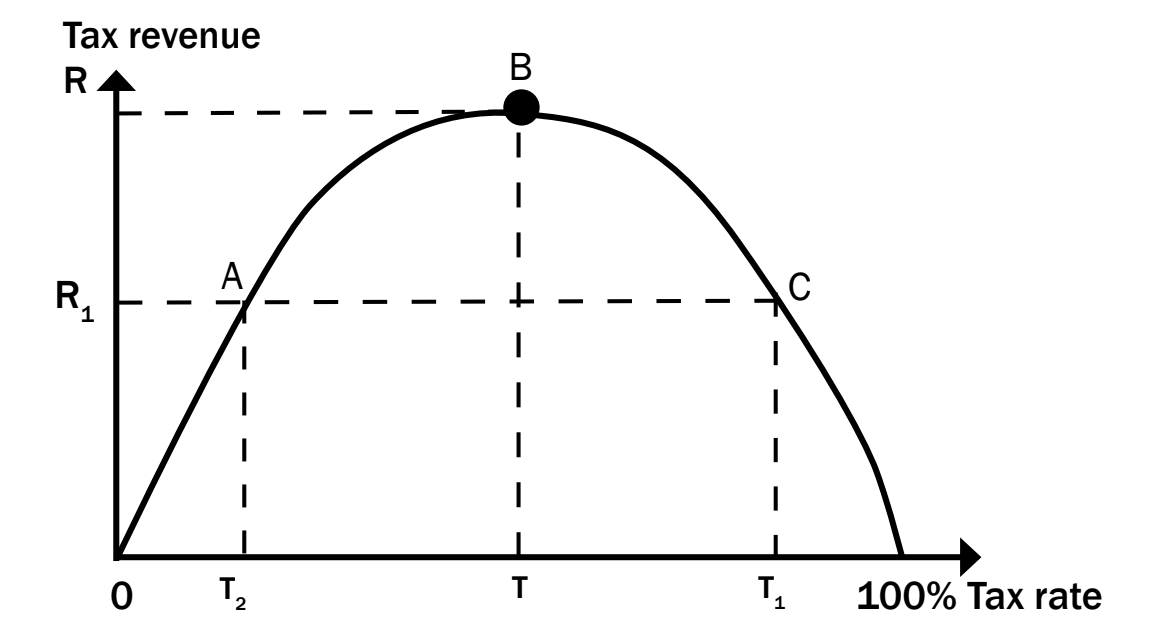
The Laffer Curve demonstrates the relationship between tax rates and tax revenue, showing that there is an optimal tax rate for maximising government income.
Note
Key Points About the Laffer Curve:
- At 0% tax rate, government collects no revenue
- As tax rates increase, revenue initially increases
- At the optimal point (T), government revenue is maximised
- Beyond this point, higher tax rates actually reduce total revenue
- At 100% tax rate, no one would work, so revenue would be zero again
The curve shows that two different tax rates can generate the same revenue level. For example, both a low tax rate (T₂) and a high tax rate (T₁) might generate the same revenue (R₁). However, the lower rate is generally preferable because it encourages more economic activity.
When tax rates become too high, people may:
- Work less or not at all
- Engage in tax avoidance or evasion
- Move their economic activities to lower-tax jurisdictions
What is public sector failure?
Public sector failure occurs when the public sector fails to provide goods and services effectively to the people. This represents a situation where government intervention in the economy produces worse outcomes than if the market had been left to operate on its own.
Characteristics of public sector failure
Ineffectiveness
The public sector is failing when these problems are prevalent:
- Missing targets: Government fails to achieve stated goals regarding inflation control, economic growth, and employment creation
- Policy incompetence: Poor coordination between monetary and fiscal policy, leading to conflicting economic signals
Inefficiencies
Important
This involves the wasteful use of resources, particularly taxpayers' money. Inefficiencies may occur in:
- Protection services (police, defence)
- Social services (healthcare, education, welfare)
- Economic services (infrastructure, business support)
- Administrative services
Money allocated in the budget for these services may be wasted through poor management, corruption, or inappropriate spending priorities.
Reasons for public sector failure
Understanding why governments sometimes fail helps us identify solutions and improvements:
Management failure
Ignorance and lack of leadership, experience, and proper training can result in poor decision-making. This might lead to policies that improve the welfare of some groups at the expense of others, rather than creating overall benefit for society.
Apathy
Government officials may show little or no interest in delivering efficient services to the public. This creates a culture where there is no accountability, and corruption and poor service delivery become acceptable. Citizens suffer when public servants don't care about the quality of their work.
Lack of motivation
Note
Unlike private sector workers who may receive bonuses and incentives for good performance, public sector workers often receive no rewards for successful service delivery. They are typically monitored only on following correct procedures rather than achieving results. This can lead to limited services, high costs, and low quality.
Bureaucracy
Bureaucrats often focus more on following rules and regulations than on efficiently delivering goods and services to people. They may become more interested in maintaining the bureaucratic system than in serving the public effectively. This can result in slow, inefficient service delivery.
Structural weaknesses
Important
Sometimes government objectives conflict with each other. For example, a government might simultaneously try to redistribute income and wealth while also trying to encourage economic growth. These conflicting goals can lead to policies that work against each other.
Special interest groups
Powerful groups such as trade unions, business associations, or professional bodies may attempt to influence government decisions to benefit themselves rather than society as a whole. This can lead to policies that serve narrow interests rather than the broader public good.
Effects of public sector failure
When governments fail to perform effectively, the consequences affect the entire economy and society:
Poor allocation of resources
Government failure means that resources are not used optimally, leading to waste and inefficiency. Scarce resources that could be used productively are instead misallocated or wasted entirely.
Economic instability
When government cannot use fiscal policy effectively, it becomes difficult to manage economic cycles. This can lead to prolonged periods of recession, high unemployment, or uncontrolled inflation.
Unfair distribution of income
If government fails to use the tax system effectively, income inequality may persist or even worsen. This can create social tensions and reduce overall economic welfare.
Social instability
Important
When the public sector fails to deliver required social services to the poor and vulnerable, it can destabilise society. People lose faith in government institutions, and social unrest may result.
Summary
Key Points to Remember:
- Fiscal policy is government action through taxation, spending, and borrowing to influence economic activity
- The three main instruments of fiscal policy are government expenditure, taxation, and borrowing
- The Laffer Curve shows there is an optimal tax rate that maximises government revenue
- Public sector failure occurs when government intervention produces worse outcomes than market solutions
- Main causes of failure include management problems, apathy, lack of motivation, excessive bureaucracy, structural weaknesses, and special interest group influence