Cyclones (Grade 12 NSC Matric Geography): Revision Notes
📚Revision Notes
Characteristics of Mid-Latitude Cyclones and Tropical Cyclones
Understanding cyclone characteristics for exams
When studying cyclones, it's essential to understand that there are two main types of cyclones that affect different parts of the world in different ways. These are mid-latitude cyclones and tropical cyclones, each with their own distinct characteristics that you need to master for your NSC Geography exam.
Note
The characteristics of these cyclone types are frequently tested in exams through multiple-choice questions, short answer questions, and diagram interpretation tasks. Understanding their key differences is crucial for exam success.
Let's explore the key differences between these two important weather systems.
Fundamental differences between cyclone types
Formation and location patterns
Mid-latitude cyclones and tropical cyclones form in completely different parts of the world due to varying atmospheric conditions. Mid-latitude cyclones develop between 40-60° North and South latitude, which explains their name - they form in the middle latitudes of our planet. These systems typically occur in areas between 30-60° North and South, covering regions like southern Africa during winter months.
In contrast, tropical cyclones originate much closer to the equator, forming around 5° North and South latitude over warm tropical oceans. However, they can affect much larger areas, occurring anywhere from 5-30° North and South latitude as they move away from their formation zones.
Important
Critical Exam Point: Remember the latitude ranges - mid-latitude cyclones form at 40-60°, while tropical cyclones form around 5° latitude. This is a common exam question!
Movement patterns and driving forces
One of the most important differences between these cyclone types lies in their movement patterns. Mid-latitude cyclones move from west to east, driven and pushed along by the powerful Westerly winds that dominate these latitudes. This means they typically approach South Africa from the west, bringing weather changes as they pass over the country.
Tropical cyclones follow the opposite pattern, moving from east to west. They are driven by the Trade Winds, particularly the Easterlies, which push these systems across ocean basins. This is why tropical cyclones often approach eastern coastlines of continents.
Seasonal occurrence patterns
The timing of when these cyclones occur reveals another crucial difference. Mid-latitude cyclones are year-round phenomena in both hemispheres, but they particularly affect South Africa during the winter months when the westerly wind belt shifts northward over the country.
Tropical cyclones are much more seasonal in nature, typically occurring from mid to late summer through early autumn. This timing coincides with when sea surface temperatures are at their warmest, providing the energy these storms need to develop and maintain their intensity.
Key identifying features
Mid-latitude cyclone characteristics
Mid-latitude cyclones have several distinctive features that make them identifiable on weather maps and satellite images. They are characterised by distinct frontal systems, including warm fronts, cold fronts, warm sectors, and cold sectors. These fronts create the characteristic "wave-like" appearance when viewed from above.
The weather associated with mid-latitude cyclones varies depending on which part of the system is passing over an area. Cold fronts bring overcast skies, lower temperatures, strong winds, and heavy rainfall, while warm sectors may experience clearer conditions between the frontal systems.
Example
Worked Example: Mid-latitude Cyclone Weather Sequence
As a mid-latitude cyclone approaches from the west:
- Warm front arrives: Light rain, gradual temperature rise
- Warm sector passes: Clearer skies, warmer temperatures
- Cold front arrives: Heavy rain, strong winds, temperature drops rapidly
- Cold sector follows: Clear skies, cold temperatures, strong winds
Tropical cyclone characteristics
Tropical cyclones have a completely different structure and appearance. Their most distinctive feature is the "eye" - a calm, clear area of intense low pressure at the centre of the storm. Around this eye, there is a vortex of stormy weather with incredibly strong winds and intense thunderstorm activity.
Unlike mid-latitude cyclones, tropical cyclones don't have frontal systems. Instead, they consist of warm, moist air throughout their structure, creating the violent winds and heavy precipitation that make them so dangerous.
Alternative names and terminology
Understanding the different names used for these cyclones is important for exam success. Mid-latitude cyclones are also known as frontal depressions, temperate cyclones, or extra-tropical cyclones. These names reflect either their frontal nature or their location outside the tropical zones.
Tropical cyclones have region-specific names: hurricanes in the Atlantic and Eastern Pacific, typhoons in the Western Pacific, and Willy-willies in Australia. Interestingly, tropical cyclones are often named alphabetically at the beginning of each season, which helps meteorologists and the public track multiple systems.
Note
The naming convention for tropical cyclones helps distinguish between multiple storms occurring simultaneously during peak season periods.
Geographic impact zones
The areas affected by these cyclone types reflect their different formation patterns and movement characteristics. Mid-latitude cyclones primarily impact the western sides of continents in mid-latitude regions. For South Africa, this means these systems approach from the southwest, affecting the western parts of the country first before moving eastward.
Tropical cyclones mainly affect the eastern sides of continents in tropical latitudes. This is why countries like Mozambique, Madagascar, and the eastern coast of Australia experience tropical cyclone impacts, while South Africa's east coast occasionally feels the effects of weakened tropical systems.
Visual representation on weather maps
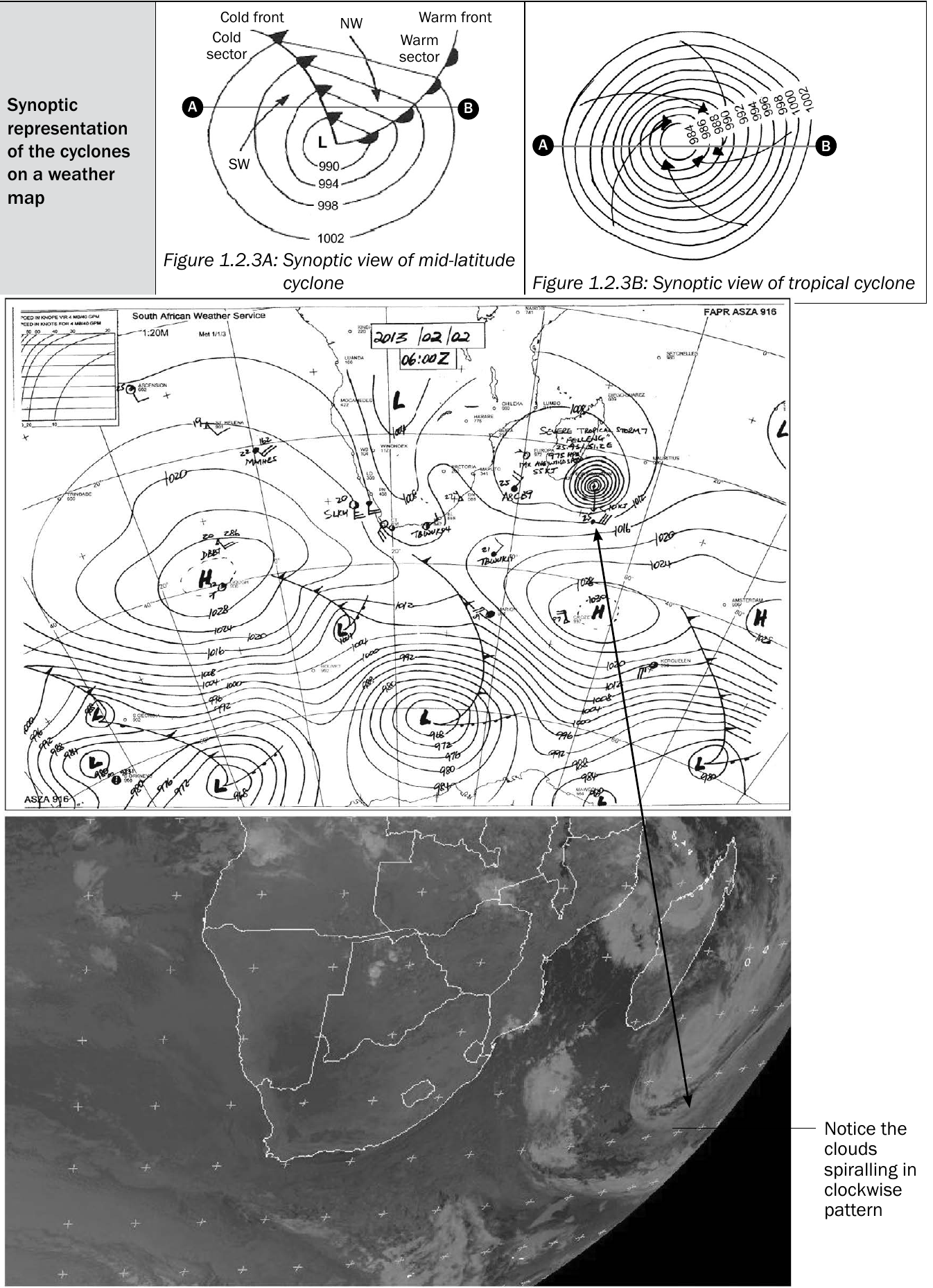
When examining weather maps and satellite imagery, these cyclone types have very different appearances. Mid-latitude cyclones show up as elongated systems with clear frontal boundaries marked by lines on synoptic charts. The isobars (lines of equal pressure) form wave-like patterns, and you can clearly see the warm and cold sectors.
Tropical cyclones appear as tight, circular systems with concentric isobars forming near-perfect circles around a central low-pressure area. On satellite images, they display the classic spiral cloud pattern with a clear eye at the centre, creating a spectacular swirling appearance.
Note
Map Reading Tip: On synoptic charts, look for the shape of isobars - wavy patterns indicate mid-latitude cyclones, while circular patterns indicate tropical cyclones.
Exam tips for cyclone characteristics
Important
Essential Exam Strategy
When answering exam questions about cyclone characteristics, remember to:
- Always specify which type of cyclone you're discussing
- Use correct geographical terminology and directional references
- Include specific latitude ranges when describing formation and occurrence areas
- Mention the driving wind systems (Westerlies for mid-latitude, Easterlies for tropical)
- Describe both the structural features and associated weather patterns
- Reference seasonal timing for each cyclone type
Common exam mistakes include confusing the movement patterns, mixing up the formation latitudes, or not clearly distinguishing between the weather patterns associated with each type.
Summary
Key Points to Remember:
- Formation locations: Mid-latitude cyclones form at 40-60° latitude, while tropical cyclones form around 5° latitude
- Movement patterns: Mid-latitude cyclones move west to east (pushed by Westerlies), tropical cyclones move east to west (pushed by Easterlies)
- Key identifying features: Mid-latitude cyclones have frontal systems and sectors, tropical cyclones have an eye and vortex structure
- Seasonal timing: Mid-latitude cyclones occur year-round (affecting SA in winter), tropical cyclones occur in mid-late summer to early autumn
- Geographic impact: Mid-latitude cyclones affect western sides of continents, tropical cyclones affect eastern sides of continents