Tropical Cyclones (Grade 12 NSC Matric Geography): Revision Notes
📚Revision Notes
Tropical Cyclones
What are tropical cyclones?
A tropical cyclone is a powerful weather system characterised by extremely low atmospheric pressure that develops in warm tropical regions. These massive rotating storms form between 5° and 30° latitude in both the Northern and Southern hemispheres. They bring together intense thunderstorms with strong circular wind patterns that create some of the most destructive weather phenomena on Earth.

The defining feature of tropical cyclones is their distinctive wind circulation pattern. In the Southern Hemisphere (including areas around South Africa), winds rotate in a clockwise direction, whilst in the Northern Hemisphere, they spin counter-clockwise. This difference occurs due to the Coriolis effect, which is caused by the Earth's rotation.
Note
The Coriolis effect is a fundamental force that affects all moving objects on Earth due to our planet's rotation. This same effect influences ocean currents, wind patterns, and even the direction water appears to drain in different hemispheres.
Regional names for tropical cyclones
Different regions around the world use various names for these storm systems:
- Hurricanes - used in the Americas
- Typhoons - used in China and Japan
- Willywillies - used in Australia
- Tropical cyclones - the scientific term used globally
Note
These storms are given individual names alphabetically within each season to help meteorologists and the public track them more easily. For example, 'Alfred' would indicate the first tropical cyclone of a particular season.
Formation conditions
For a tropical cyclone to develop, four essential conditions must be present:
Important
Critical Formation Requirements:
- High sea surface temperature - at least 27°C is required to provide enough energy
- Coriolis force - needed to start the spinning motion (absent at the equator)
- Abundant moisture - from warm ocean water that evaporates into the atmosphere
- Low wind shear - minimal interference from upper-level winds to allow the system to organise
All four conditions must be present simultaneously for cyclone formation to occur.
Structure of a tropical cyclone
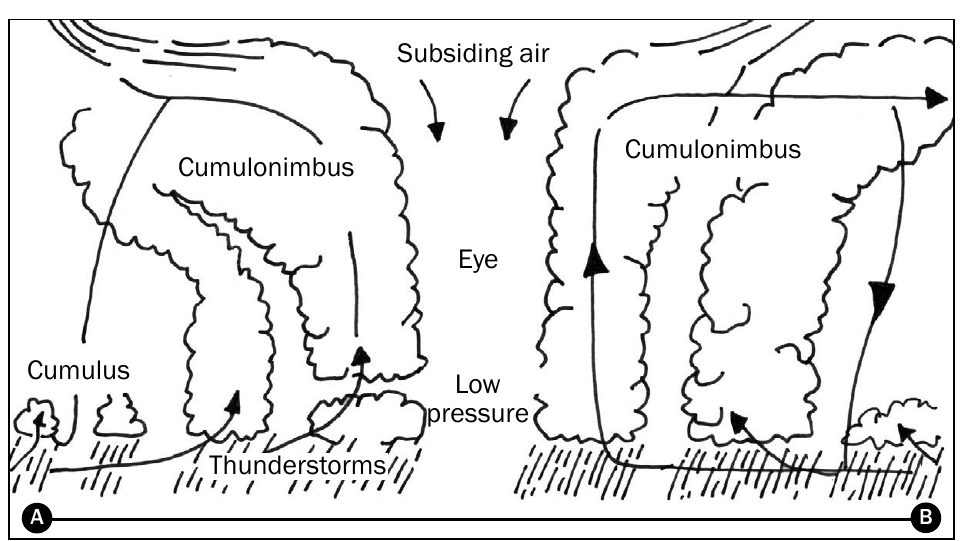
The cross-sectional structure of a mature tropical cyclone reveals several distinct zones and features that work together to maintain this powerful weather system.
The eye
At the centre of every tropical cyclone lies the eye - a remarkably calm area typically 20-50 kilometres in diameter. Within the eye, air moves downward (subsides), creating clear skies and light winds. This subsiding air warms as it descends, preventing cloud formation and creating the characteristic calm conditions.
Eyewall and surrounding areas
Surrounding the eye is the most intense part of the storm, where towering cumulonimbus clouds reach extreme heights. These clouds produce the heaviest rainfall and strongest winds in the entire system. The cumulonimbus clouds extend both inward towards the eye and outward from the centre.
Air circulation patterns
The diagram shows how air moves throughout the cyclone system. Warm, moist air spirals inward at low levels, rises rapidly in the thunderstorms, then flows outward at high altitudes. This creates a continuous cycle that maintains the storm's intensity as long as conditions remain favourable.
Note
This circulation pattern creates a self-sustaining system where the cyclone essentially feeds on itself, drawing energy from warm ocean waters and releasing it through condensation in the towering thunderstorms.
Thunderstorms and rainfall
Throughout the cyclone, except in the eye, intense thunderstorms produce torrential rainfall. These storms are most concentrated in bands that spiral around the eye, creating the characteristic appearance seen in satellite images.
Impact on weather patterns
Tropical cyclones significantly influence regional weather patterns as they move across ocean basins. They can bring:
- Extreme rainfall leading to flooding
- Destructive winds exceeding 120 km/h
- Storm surges that inundate coastal areas
- Changes in local pressure systems
Note
Understanding the structure and behaviour of tropical cyclones is essential for weather prediction and disaster preparedness, particularly in regions like the southwestern Indian Ocean where they can affect South Africa's coastal areas.
Summary
Key Points to Remember:
- Tropical cyclones are low-pressure systems that form in warm tropical waters between 5° and 30° latitude
- They require sea temperatures of at least 27°C, moisture, Coriolis force, and low wind shear to develop
- The eye is the calm centre with subsiding air, surrounded by intense thunderstorms and cumulonimbus clouds
- Wind circulation is clockwise in the Southern Hemisphere and counter-clockwise in the Northern Hemisphere
- Different regions use different names: hurricanes, typhoons, willywillies, but they're all tropical cyclones