Oceans and Ocean Currents (Grade 12 NSC Matric Geography): Revision Notes
📚Revision Notes
Oceans and Ocean Currents
How oceans influence South Africa's climate
South Africa is almost completely surrounded by oceans, which play a major role in shaping our country's climate patterns. The surrounding waters have a significant impact on both temperature and rainfall across different regions.
Temperature moderation by oceans
Oceans act as natural climate stabilisers because water has a special property - it takes a very long time to warm up and an equally long time to cool down. This creates two different types of climate conditions:
Maritime climate develops in coastal areas where the ocean's influence is strongest. In these regions, the temperature differences between the warmest and coldest periods are fairly small, creating more stable conditions throughout the year.
Continental climate occurs in areas that are further away from the ocean's moderating effects. These inland locations experience much more extreme temperature swings, with very hot days and very cold nights or seasons.
Example
Worked Example: Comparing Maritime vs Continental Climates
You can clearly see this difference when comparing winter temperatures between cities:
- Johannesburg (inland location): Reaches 25°C during the day but drops to just 1°C at night - that's a huge 24°C difference
- Durban (coastal location): Reaches 24°C during the day and only cools to 15°C at night - just a 9°C difference
This shows how the ocean keeps coastal temperatures much more stable and comfortable.
Note
The key principle is that water heats up slowly and cools down slowly, which acts like a natural thermostat for coastal areas. This is why people living near the coast experience milder weather conditions compared to those living inland.
The three major ocean currents affecting South Africa
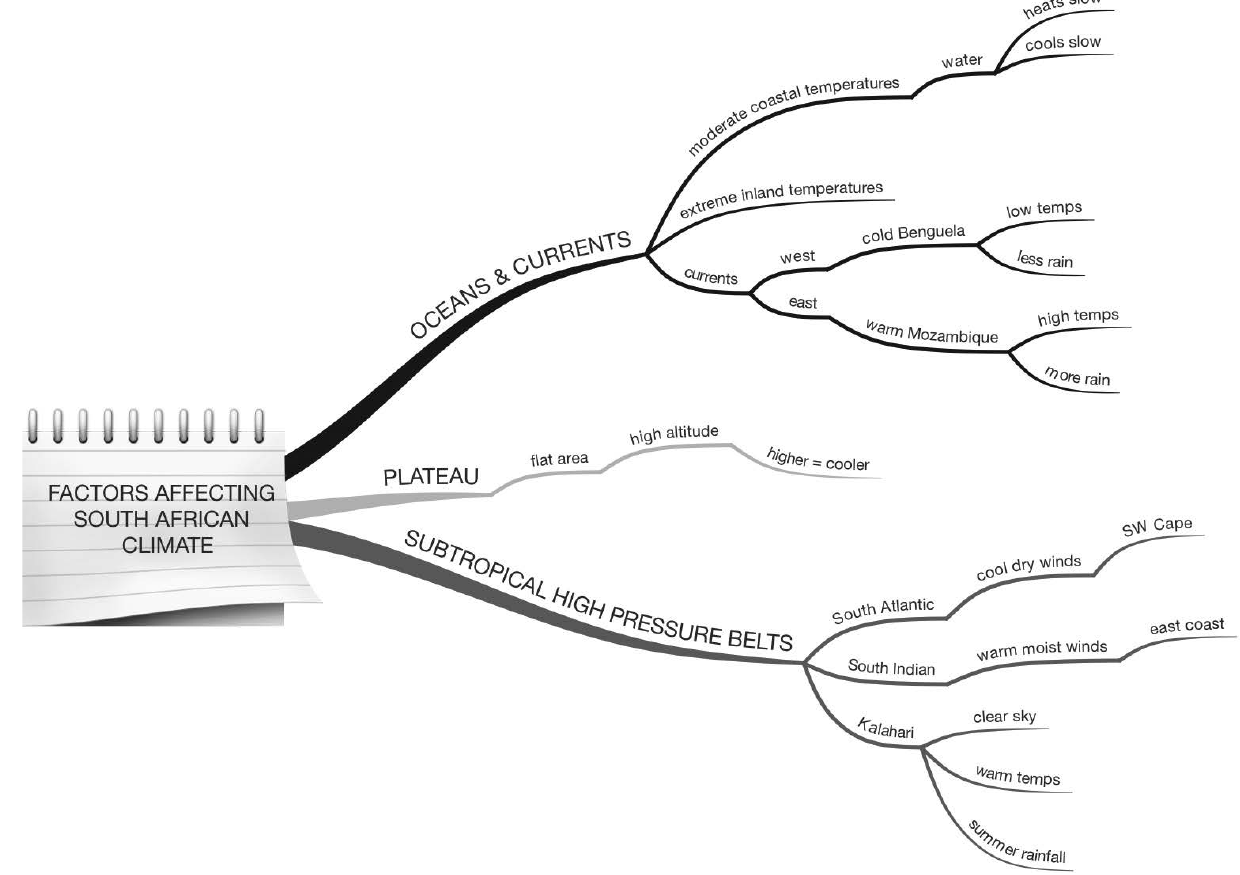
Three important ocean currents flow around South Africa's coastline, and each one brings completely different climate conditions to the regions they influence.
Benguela current - the cold western current
The Benguela current flows northward along South Africa's west coast and is classified as a cold current. This current brings cold water from the Southern Ocean up along our western coastline, creating distinctive climate patterns:
- Cooler temperatures: The cold water keeps the west coast much cooler than it would naturally be at this latitude
- Very little rainfall: Cold water cannot hold much moisture in the atmosphere, so there's less evaporation and much less rain
- Desert-like conditions: This current is one of the main reasons why the west coast is so dry and arid
Mozambique current - the warm eastern current
The warm Mozambique current flows southward along the eastern coastline, bringing tropical characteristics from the warmer northern waters:
- Higher temperatures: This warm water increases temperatures all along the east coast
- Much more rainfall: Warm water creates lots of evaporation, putting more moisture into the atmosphere and causing higher rainfall
- Rain throughout the year: Unlike other parts of the country, the east coast gets rain in all seasons thanks to this current
Agulhas current - the southern warm current
The Agulhas current is another warm current that flows westward along South Africa's southern coast. While it's important to know this current exists, its main effect is to keep the south coast relatively moderate and pleasant.
Important
Remember the pattern: Cold current = cooler temperatures + less rainfall, while Warm currents = higher temperatures + more rainfall. This fundamental relationship explains most of South Africa's climate variations.
Temperature patterns created by ocean currents
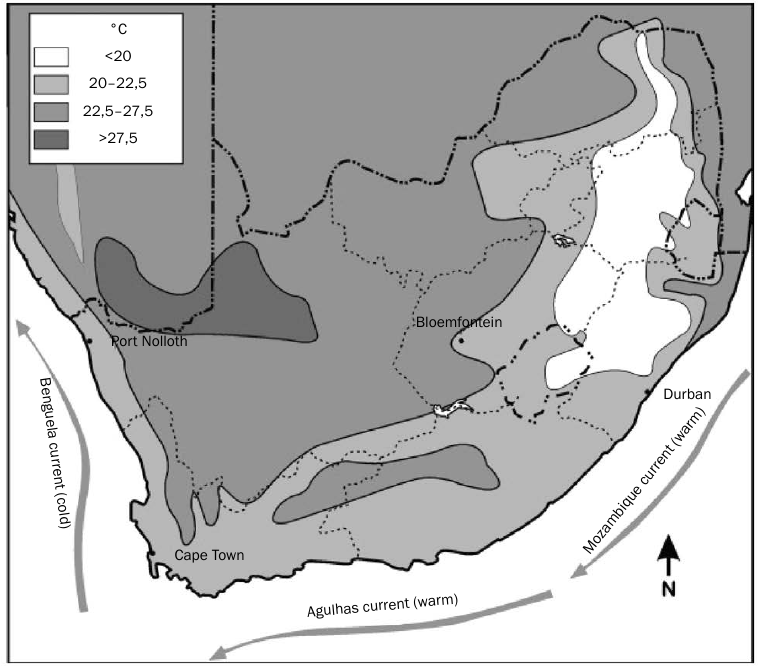
The different ocean currents create a clear temperature pattern across the country. If you look at a temperature map of South Africa, you'll notice that the eastern areas are consistently warmer than the western areas. This east-to-west temperature difference is directly caused by the warm Mozambique current heating the east coast while the cold Benguela current cools the west coast.
Note
This temperature gradient is most obvious right along the coastlines where the currents have their strongest influence. As you travel further inland, the moderating effects of these currents become weaker, and the more extreme continental climate takes over.
Rainfall patterns influenced by currents
The ocean currents also create South Africa's distinctive rainfall pattern. The warm Mozambique current on the east promotes abundant rainfall through increased evaporation, while the cold Benguela current on the west contributes to the extremely dry conditions of the western regions.
This current-driven rainfall pattern explains several important features of South Africa's climate:
- The east coast receives heavy rainfall and supports lush, green vegetation
- The west coast experiences desert-like conditions with very limited rainfall
- There's a general pattern of decreasing rainfall as you move from east to west across the country
- The east coast can receive rain year-round, while the west coast may go months without any precipitation
Important
Critical Pattern to Remember: The east coast is both warmer AND wetter, while the west coast is both cooler AND drier. This is not a coincidence - it's directly caused by the different types of ocean currents affecting each coast.
Summary
Key Points to Remember:
-
Water's special property: Oceans heat up and cool down very slowly, which moderates temperatures along coastlines compared to inland areas
-
Three key currents:
- Cold Benguela current (west coast)
- Warm Mozambique current (east coast)
- Warm Agulhas current (south coast)
-
East versus west pattern: East coast is both warmer and wetter due to the warm Mozambique current, while west coast is cooler and much drier due to the cold Benguela current
-
Maritime versus continental climates: Coastal areas have small temperature ranges (maritime climate), while inland areas experience extreme temperature swings (continental climate)
-
Temperature and rainfall connection: Warm ocean currents increase both local temperatures and rainfall amounts, while cold currents decrease both temperature and precipitation