Global Winds / Planetary Winds (Grade 12 NSC Matric Geography): Revision Notes
📚Revision Notes
Global Air Circulation
Global air circulation refers to the large-scale movement of air masses around our planet. This complex system creates the wind patterns that influence weather and climate across different regions of the Earth.
Three global wind systems
The Earth's atmosphere contains three major wind systems that work together to create global circulation patterns:
- Tropical easterlies - These winds blow from east to west in tropical regions
- Westerlies - These winds blow from west to east in temperate regions
- Polar easterlies - These winds blow from east to west in polar regions
Each of these wind systems covers vast areas and plays a crucial role in transferring heat and moisture around our planet.
Note
These three wind systems form the foundation of global atmospheric circulation, with each system covering approximately one-third of the Earth's surface from equator to pole. Understanding their positions and directions is essential for predicting weather patterns and climate conditions worldwide.
The Coriolis force
A fundamental force shapes how these global winds move. The Coriolis force is caused by the Earth's rotation and has a significant impact on wind direction:
Important
The Coriolis Effect on Wind Direction:
- In the southern hemisphere, the Coriolis force deflects moving air to the left
- In the northern hemisphere, the Coriolis force deflects moving air to the right
This deflexion is essential for understanding why winds don't blow straight from high to low pressure areas, but instead follow curved paths around the globe.
The tri-cellular arrangement
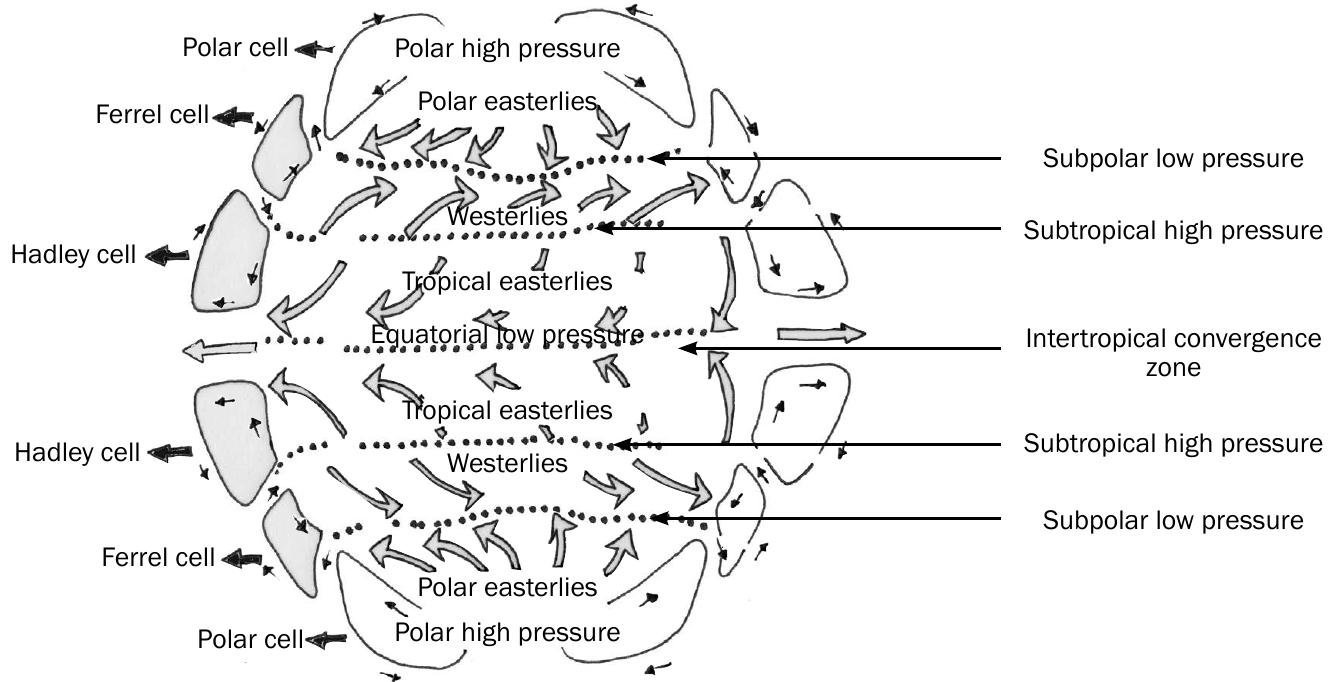
The global circulation system is organised into a tri-cellular pattern, which means there are three circulation cells in each hemisphere. These cells work together with pressure belts to create the overall global air circulation system.
Note
The tri-cellular model is a simplified but highly effective way to understand global atmospheric circulation. This systematic arrangement helps explain why certain regions experience consistent weather patterns and why climate zones exist at predictable latitudes around the world.
The diagram above shows how this tri-cellular system operates across both hemispheres, creating a structured pattern of air movement.
Circulation cells explained
The three types of circulation cells each have distinct characteristics and operate at different latitudes:
Hadley cells
These are located nearest to the equator and are driven by intense solar heating. Warm air rises at the equator and moves towards the subtropics before descending.
Ferrel cells
These middle-latitude cells are found between the Hadley and Polar cells. They help transfer heat between tropical and polar regions.
Polar cells
Located at the highest latitudes, these cells are driven by cold, dense air that sinks at the poles and moves towards lower latitudes.
Pressure belts and convergence zones
The circulation system creates several important pressure belts that form distinct bands around the Earth:
- Polar high pressure - Found at both poles where cold air sinks
- Subpolar low pressure - Located around 60° latitude in both hemispheres
- Subtropical high pressure - Found around 30° latitude, where air from Hadley cells descends
- Equatorial low pressure - Located at the equator where warm air rises
The Intertropical Convergence Zone (ITCZ) is particularly important as it marks where trade winds from both hemispheres meet near the equator, creating a zone of low pressure and frequent precipitation.
Note
These pressure belts are not perfectly uniform bands around the Earth due to the distribution of land and ocean masses, seasonal changes, and local geographic features. However, they provide a fundamental framework for understanding global pressure patterns and their associated weather systems.
Wind patterns within the system
The interaction between pressure belts and the Coriolis force creates predictable wind patterns that are consistent across similar latitudes:
- Trade winds blow from the subtropical high pressure belts towards the equatorial low pressure
- Westerlies dominate the middle latitudes between subtropical and subpolar regions
- Polar easterlies blow from polar high pressure areas towards subpolar low pressure zones
These wind patterns are crucial for understanding global weather systems and how heat and moisture are distributed around the Earth.
Summary
Key Points to Remember:
- Global air circulation consists of three main wind systems: tropical easterlies, westerlies, and polar easterlies
- The Coriolis force deflects winds left in the southern hemisphere and right in the northern hemisphere
- The tri-cellular arrangement creates organised circulation patterns through Hadley, Ferrel, and Polar cells
- Pressure belts and convergence zones work together to drive global wind patterns
- This system is essential for heat and moisture transfer around our planet