Catchment and River Management (Grade 12 NSC Matric Geography): Revision Notes
📚Revision Notes
Catchment and River Management
What is catchment and river management?
Catchment and river management involves the sustainable use and protection of water resources within drainage basins. A catchment area (also called a drainage basin) is the area of land that drains water into a particular river system. Understanding how rivers change and how human activities affect them is crucial for maintaining healthy water systems.
Note
A catchment area functions as a natural water collection system where all surface water and groundwater eventually flows towards a single outlet point, typically a river mouth or lake. This interconnected system means that activities anywhere within the catchment can affect water quality and flow downstream.
River capture (stream piracy)
River capture is a fascinating geomorphological process where one river system "steals" water from another river system. This happens through a process called headward erosion.
How river capture works
The process begins when a more powerful river erodes backwards (upstream) through headward erosion. This erosion gradually cuts through the watershed boundary that separates two different river systems. Eventually, the eroding river breaks through and captures the water from the neighbouring river system.
Important
Headward erosion is the dominant process in river capture. The more powerful river (usually at a lower elevation) erodes upstream more rapidly than the neighbouring river system. This creates a gradual breakthrough that permanently redirects water flow from one catchment to another.
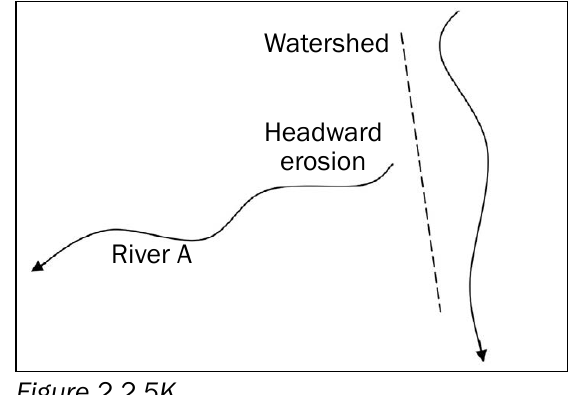
Features created by river capture
When river capture occurs, it creates several distinctive landforms that you need to recognise:
Example
Worked Example: Identifying River Capture Features
When examining a landscape affected by river capture, look for these diagnostic features:
Step 1: Locate the captor river - the stronger river that captures water from another system
Step 2: Identify the captured river - the river that loses its water to the captor river
Step 3: Find the waterfall - forms where the captured river drops down to meet the lower-level captor river
Step 4: Spot the wind gap - a dry valley left behind where the original river used to flow
Step 5: Observe the elbow of capture - the sharp bend where the river changes direction after being captured
Step 6: Locate the misfit stream - a small stream flowing in what is now an oversized valley (too big for the amount of water it carries)
Importance of managing drainage basins
Managing our water resources effectively is critical, especially in South Africa where water is scarce. The interconnected nature of water systems means that effective management requires a comprehensive understanding of how catchment areas function as complete systems.
South Africa's water challenge
South Africa faces significant water challenges that make catchment management essential. Our country is not water-rich compared to global standards, which makes every drop of water precious. River systems are valuable natural resources that need protection, and because water bodies are interconnected, problems in one area inevitably affect others downstream.
Important
All water sources are shared resources that require careful management. What happens in the upper reaches of a catchment directly impacts communities, ecosystems, and economic activities in the lower reaches.
Multiple uses of water
Water resources serve many different purposes in our society, creating competing demands that must be carefully balanced. Agriculture relies heavily on irrigation for crop production, while industry needs water for manufacturing processes and cooling systems. Domestic use encompasses drinking water, sanitation, and household needs, and water is essential for hydroelectric power generation. Additionally, water bodies provide important recreation opportunities through swimming, boating, and tourism activities.
Note
The challenge for catchment managers is balancing these competing water demands while ensuring long-term sustainability of the resource and maintaining healthy ecosystems.
Ecosystem functions
Rivers and catchment areas serve important environmental roles that extend far beyond human needs. River systems are integral parts of the water cycle, continuously moving water between the atmosphere, land surface, and underground reserves. They provide habitats for diverse plants and animals, supporting complex food webs and biodiversity. Rivers function as complete ecosystems that support biodiversity, and a single river connects multiple ecosystems throughout its catchment area, from mountain headwaters to coastal estuaries.
Human impact on drainage basins
Unfortunately, human activities often damage river systems and catchment areas. Understanding these impacts helps us develop better management strategies to protect these vital resources for future generations.
Pollution sources
Various human activities contaminate water systems in different ways. Landfills and mining activities pollute groundwater, which eventually reaches rivers as contaminated base flow. Industrial discharge presents a direct threat when factories and sewage treatment works release contaminated water directly into rivers. Agricultural runoff carries fertilisers and pesticides from farming areas into water systems, while informal settlements often lack proper sanitation infrastructure, leading to domestic waste and poor sanitation directly polluting rivers.
Important
These pollution sources often work together, creating cumulative impacts that can severely degrade water quality throughout an entire catchment system.
Water abstraction issues
Taking too much water from river systems creates serious problems for both human communities and natural ecosystems. Excessive groundwater pumping through boreholes reduces the water that feeds rivers naturally, leading to reduced base flow and stressed river ecosystems. Non-native plants (alien vegetation) consume large amounts of water very quickly in river zones, reducing water availability for both human use and indigenous vegetation. Additionally, overgrazing removes vegetation that would normally help groundwater recharge and increases surface runoff, reducing the amount of water that infiltrates into groundwater systems.
Infrastructure impacts
Human-built structures fundamentally change how rivers behave, often with unintended consequences. Dams alter the natural flow patterns of rivers, changing seasonal flood cycles that many ecosystems depend upon. Wetland drainage increases flooding risks by removing natural water storage areas that would normally absorb excess water during heavy rains. Flood control methods such as concrete channels and levees restrict rivers' natural flow paths and processes, preventing the formation of natural floodplains.
Note
While infrastructure often provides important benefits, understanding and managing its impacts on natural river processes is essential for sustainable water resource management.
Exam tips for catchment management
When preparing for examinations on catchment and river management, focus on developing a comprehensive understanding of the interconnected processes and management challenges. Use correct geographical terminology consistently throughout your answers, and always explain processes clearly with cause-and-effect relationships. Give specific examples from South African contexts when possible, as this demonstrates practical understanding of local challenges.
For river capture questions, practice drawing clear, labelled diagrams that show all the diagnostic features. Consider both positive and negative human impacts in your discussions, and always link water management to broader environmental and social issues to show understanding of the complexity of sustainable resource management.
Summary
Key Points to Remember:
- River capture creates distinctive landforms through headward erosion that you must be able to identify and explain
- South Africa's water scarcity makes catchment management critically important for sustainable development
- Human activities have significant negative impacts on river systems through pollution, over-extraction, and infrastructure changes
- Effective river management requires understanding the interconnected nature of water systems and ecosystems
- Rivers serve multiple functions for society, the economy, and the environment that must be balanced through careful management