Genetic Evidence (Grade 12 NSC Matric Life Sciences): Revision Notes
📚Revision Notes
Genetic Evidence
Introduction to genetic evidence
Genetic studies provide some of the strongest evidence for human evolution by comparing the DNA of different species. Scientists can examine both nuclear DNA (found in cell nuclei) and mitochondrial DNA (found in mitochondria) to understand evolutionary relationships and determine when different species shared common ancestors.
Note
Genetic evidence has revolutionised evolutionary biology by providing quantitative, measurable data that can be analysed statistically, offering more precise insights than fossil evidence alone.
DNA comparisons between humans and great apes
Genetic similarities within modern humans
When scientists compare the nuclear DNA of different modern humans from around the world, they discover remarkable genetic uniformity. Modern humans share an incredible 99.9% of their genes, meaning there is only a 0.1% genetic difference between any two people on Earth. This tiny variation demonstrates that all modern humans are very closely related and share recent common ancestors.
Note
This extraordinary genetic similarity among modern humans suggests that our species went through a population bottleneck in the relatively recent past, meaning all current humans descended from a small group of ancestors.
Genetic relationships between humans and apes
The genetic similarities extend beyond humans to include our closest relatives, the great apes. Studies reveal that humans and apes share between 96.9% and 98.8% of their genes. While this represents a slightly larger genetic difference than between humans, it still shows an enormous amount of shared genetic material, providing strong evidence for common ancestry.
Chimpanzees as our closest relatives
Among all the African apes, chimpanzees show the closest genetic relationship to humans. Humans and chimpanzees share 98.8% of their genes, with only a 1.2% genetic difference. This difference is approximately 10 to 12 times larger than the genetic variation found between modern humans, but it still represents remarkable similarity considering we are different species.
Important
Despite sharing 98.8% of our genes with chimpanzees, this 1.2% difference represents millions of base pairs in our DNA, which accounts for the significant anatomical and behavioural differences between the two species.
Mitochondrial DNA analysis and evolutionary timelines
Understanding mitochondrial DNA
Mitochondrial DNA (mtDNA) provides scientists with a powerful tool for understanding evolutionary relationships. Unlike nuclear DNA, mtDNA is inherited only from mothers and changes at a relatively predictable rate over time. By comparing the mtDNA differences between species, scientists can calculate approximately when those species last shared a common ancestor.
Note
The predictable mutation rate of mitochondrial DNA makes it function like a "molecular clock" - the more differences between species' mtDNA, the longer ago they shared a common ancestor.
Phylogenetic relationships and divergence times
The analysis of mtDNA allows scientists to construct phylogenetic trees that show evolutionary relationships and divergence times. These diagrams help us visualise when different species branched off from their common ancestors.
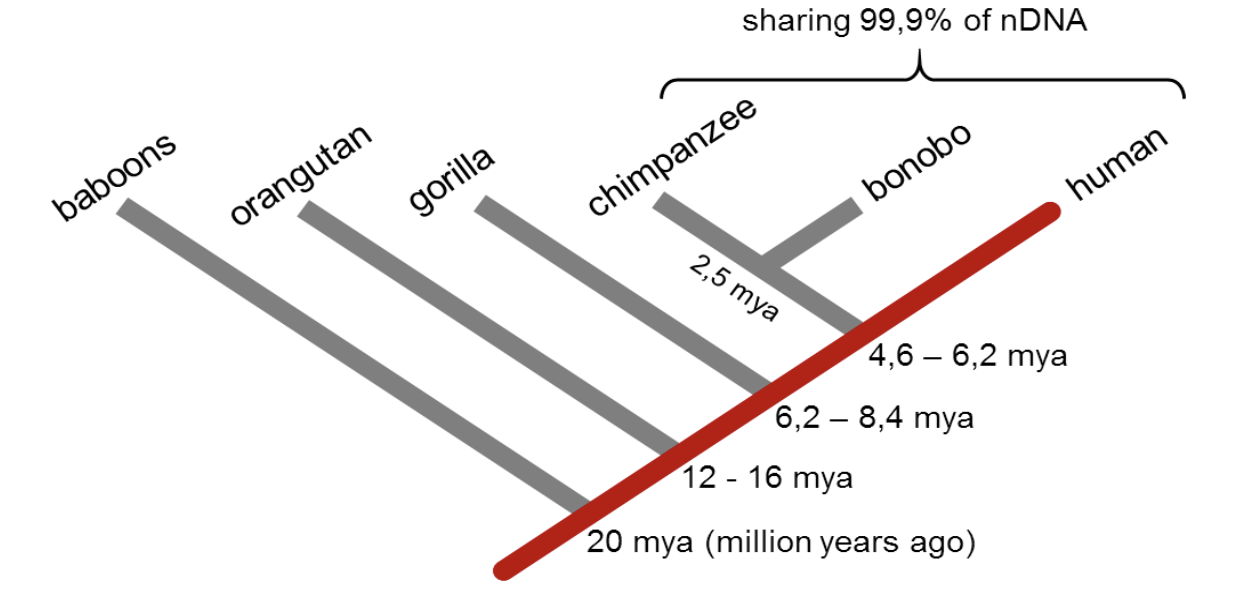
The phylogenetic tree shows the evolutionary timeline stretching back 20 million years. Key divergence points include:
- Baboons separated earliest from the human lineage
- Orangutans diverged from the human-African ape lineage around 12-16 million years ago
- Gorillas split from the human-chimpanzee lineage approximately 6.2-8.4 million years ago
- The most recent split occurred between humans and their closest relatives (chimpanzees and bonobos) around 2.5-4.6 million years ago
Example
Worked Example: Reading Phylogenetic Trees
When interpreting a phylogenetic tree:
- Find the branching point (node) where two species separate
- Follow the timeline to see when this separation occurred
- Remember: The closer the branching point to the present, the more recently the species shared a common ancestor
For humans and chimpanzees: Their branching point is approximately 2.5-4.6 million years ago, making them our closest living relatives.
Common ancestry and evolutionary implications
Evidence for shared ancestry
The remarkable genetic similarities between humans and great apes, combined with mtDNA analysis, provide compelling evidence that all these species descended from common ancestors. The amount of shared genetic material indicates that humans and other hominids must have evolved from a common ape-like ancestor.
Timeline of human evolution
Based on genetic evidence, scientists conclude that humans and apes shared a common ape-like ancestor approximately 5-6 million years ago. This timeline aligns with fossil evidence and helps scientists understand when the human lineage began its separate evolutionary path.
Note
The genetic timeline of 5-6 million years ago for human-ape divergence closely matches the age of the earliest hominin fossils found in Africa, providing independent confirmation of this evolutionary timeline.
Significance for understanding human evolution
Genetic studies have revolutionised our understanding of human evolution by providing quantitative evidence for relationships that were previously based mainly on fossil comparisons. The genetic data confirms that humans are part of the great ape family and helps establish more precise timelines for evolutionary events.
Common misconceptions and exam tips
Important
Common misconception: Some students think that humans evolved directly from modern chimpanzees. This is incorrect - humans and chimpanzees evolved from a common ancestor, but neither species evolved from the other.
Note
Exam tip: Remember the specific percentages - 99.9% similarity between humans, and 98.8% similarity between humans and chimpanzees. These exact figures often appear in NSC exam questions.
Note
Exam tip: When interpreting phylogenetic trees, focus on the branching points (nodes) which represent common ancestors, and the timeline showing when divergence occurred.
Remember!
Summary
Key Points to Remember:
- Modern humans are genetically very similar, sharing 99.9% of their genes with only 0.1% variation
- Humans and chimpanzees are closest relatives among great apes, sharing 98.8% of their genes
- Mitochondrial DNA analysis allows scientists to calculate when species separated from common ancestors
- Phylogenetic trees show evolutionary relationships and divergence times stretching back millions of years
- Genetic evidence indicates humans and apes shared a common ancestor approximately 5-6 million years ago