Protein Synthesis (Grade 12 NSC Matric Life Sciences): Revision Notes
📚Revision Notes
Protein Synthesis
Introduction
Protein synthesis is one of the most important processes in living cells. It's how your cells use the genetic information stored in DNA to create the thousands of different proteins your body needs to function properly.
Note
Think of protein synthesis as your cellular factory system - DNA contains the blueprints, and protein synthesis is the manufacturing process that builds the actual products (proteins) your body needs. This analogy helps you understand the relationship between the instructions (DNA) and the final products (proteins).
Key terminology
Understanding protein synthesis requires knowing some important scientific terms. There are some essential definitions you need to master.
Note
Master these key terms first! Understanding protein synthesis becomes much easier once you're comfortable with this vocabulary. Take time to memorise these definitions as they form the foundation for everything else.
Let's break down these terms in simple language:
- Amino acids are the basic building blocks that get joined together to make proteins, just like how bricks are joined to build a wall
- Base triplet refers to groups of three nitrogenous bases found next to each other on the DNA strand
- Transcription is the first step where the cell makes a working copy (mRNA) of the DNA instructions
- Translation is the second step where this working copy is used to actually build the protein
- Codons are three-base groups on mRNA that specify which amino acid should be added next
- Anti-codons are matching three-base groups on tRNA that ensure the right amino acid gets delivered
What is protein synthesis?
Protein synthesis is the process through which cells manufacture proteins by linking together different amino acids. Your body uses 20 different types of amino acids, and these can be combined in countless ways to create the specific proteins your body needs.
The sequence and number of amino acids determine what type of protein gets formed. Even small proteins contain at least 50 amino acids linked together, while most proteins contain 300 or more amino acids. The connections between amino acids are called peptide bonds.

Important
The genetic information stored in your DNA determines exactly which amino acids will be used and in what order they'll be arranged to create each specific protein. This means that every protein your body makes is precisely controlled by your genetic code.
The two stages of protein synthesis
Note
Two-Stage Process Overview
Protein synthesis happens in two distinct stages that occur in different parts of the cell:
Stage 1: Transcription (occurs in the nucleus)
Stage 2: Translation (occurs in the cytoplasm)
This two-stage process ensures that the original DNA remains safely protected in the nucleus while protein production happens in the cytoplasm where all the necessary materials are available.
Stage 1: Transcription
Transcription is the first stage of protein synthesis and takes place inside the cell's nucleus. During this stage, the cell creates a working copy of the genetic instructions.
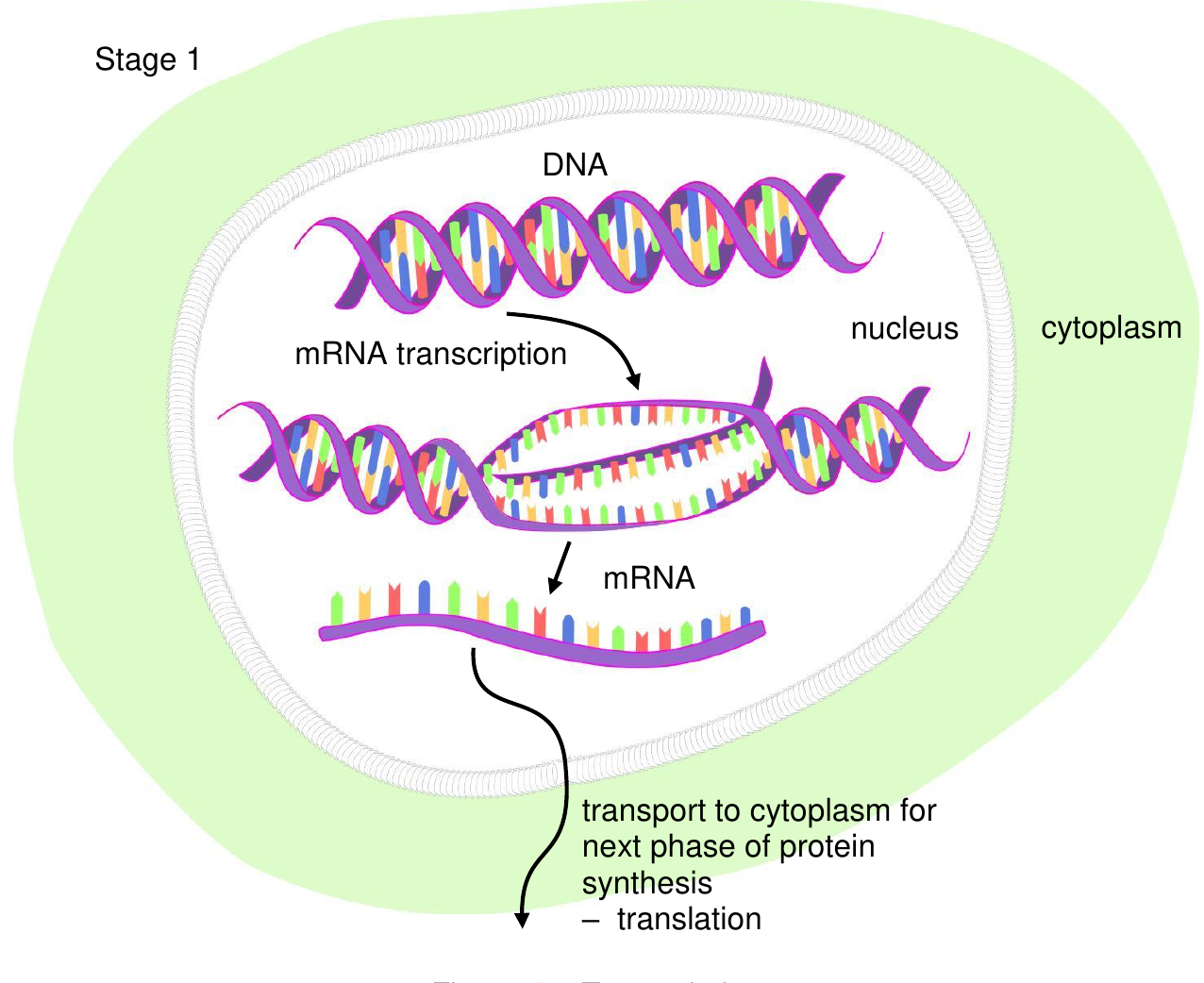
Here's how transcription works step by step:
- DNA unwinds: A specific section of the DNA double helix unwinds and separates. This happens because the weak hydrogen bonds between the nitrogenous bases break, allowing the two DNA strands to separate in that particular region.
- Template formation: One of the DNA strands acts as a template (like a pattern or guide) for creating the mRNA copy.
- mRNA synthesis: The cell uses free RNA nucleotides floating in the nucleoplasm to build a complementary strand of messenger RNA (mRNA). This mRNA strand contains the genetic code needed to make the specific protein.
- Codon formation: The mRNA is organised into groups of three adjacent nitrogenous bases called codons. Each codon specifies which amino acid should be added to the growing protein chain.
- Nuclear exit: Once transcription is complete, the newly formed mRNA molecule moves out of the nucleus through nuclear pores and travels into the cytoplasm, where it will attach to a ribosome for the next stage.
Important
Critical Point: The original DNA never leaves the nucleus! Only the mRNA copy travels to the cytoplasm. This protects the master genetic instructions while allowing protein production to occur where it's needed.
Stage 2: Translation
Translation is the second stage of protein synthesis and occurs in the cytoplasm. This is where the mRNA instructions are actually used to build the protein.
Example
Step-by-Step Translation Process
Here's how translation works step by step:
-
tRNA involvement: Transfer RNA (tRNA) molecules in the cytoplasm each carry a specific amino acid. Each tRNA has three adjacent nitrogenous bases called an anti-codon.
-
Base pairing: The anti-codon on each tRNA is complementary to specific codons on the mRNA. This ensures that the correct amino acid gets delivered to the right position in the growing protein chain.
-
Amino acid delivery: According to the sequence of codons on the mRNA, tRNA molecules bring the required amino acids to the ribosome in the correct order.
-
Peptide bond formation: The amino acids are linked together by peptide bonds to form the required protein. Each new amino acid gets added to the growing chain until the complete protein is finished.
The process continues until the ribosome reaches a "stop" signal on the mRNA, indicating that the protein is complete.
Complete protein synthesis process
The entire process of protein synthesis can be visualised as a coordinated system where both transcription and translation work together. The DNA in the nucleus serves as the master instructions, mRNA carries these instructions to the protein-making machinery, and tRNA ensures that the right building materials (amino acids) are delivered in the correct sequence.
Note
The Coordinated System
This process is essential for all life because proteins serve so many critical functions - they can be enzymes that speed up chemical reactions, structural components that give cells their shape, or signalling molecules that help cells communicate with each other. The precision of this system ensures that your body can make exactly the right proteins at exactly the right time.
The key flow to remember is: DNA → mRNA → protein
Remember!
Summary
Key Points to Remember:
-
Protein synthesis occurs in two stages: transcription (in the nucleus) and translation (in the cytoplasm)
-
Transcription creates mRNA from DNA: The cell makes a working copy of genetic instructions that can safely leave the nucleus
-
Translation builds proteins from amino acids: tRNA molecules deliver the correct amino acids based on mRNA codons, and peptide bonds link them together
-
The genetic code flows from DNA → mRNA → protein: This is the central pathway of gene expression in all living cells
-
Location matters: Transcription must happen in the nucleus where DNA is located, while translation happens in the cytoplasm where ribosomes and amino acids are available