The Probability Scale (Grade 12 NSC Matric Mathematical Literacy): Revision Notes
📚Revision Notes
The Probability Scale
Understanding probability is essential for interpreting how likely events are to occur in everyday situations. Whether you're looking at weather forecasts, medical test results, or games of chance, probability helps us make sense of uncertainty by giving us a way to measure and compare different levels of likelihood.
What is the probability scale?
The probability scale is a numerical system that measures how likely an event is to happen. Every probability value falls somewhere between two extremes:
- 0 represents an impossible event (something that will never happen)
- 1 represents a certain event (something that will definitely happen)
All possible probabilities exist somewhere on this continuous scale between 0 and 1.
Note
The probability scale provides a standardised way to communicate uncertainty across all fields of study, from science and medicine to economics and sports. This universal language allows us to compare the likelihood of very different types of events.
Different ways to express probability
Probability values can be written in three different formats, and it's important to understand how they relate to each other:
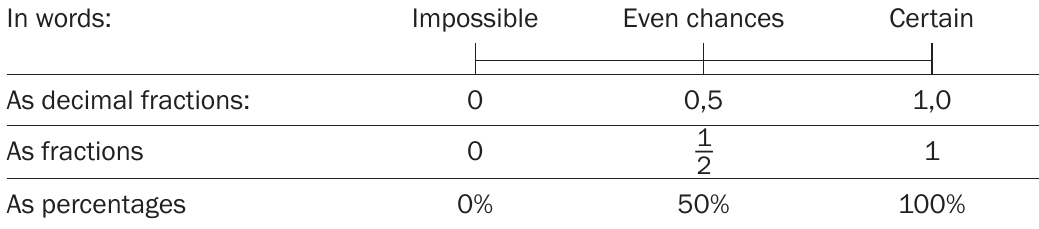
Understanding that these formats are interchangeable is crucial for solving probability problems and interpreting real-world data.
Understanding the scale positions
Impossible events (0)
- These have no chance of happening
- Examples: Rolling a 7 on a standard six-sided die, or finding a living dinosaur
Even chances (0.5 or 1/2 or 50%)
- These events are equally likely to happen or not happen
- Examples: Getting heads when flipping a fair coin, or randomly selecting a red card from a standard deck
Certain events (1 or 100%)
- These will definitely happen
- Examples: The sun rising tomorrow, or rolling a number between 1 and 6 on a standard die
Note
The term "even chances" is particularly important in probability. When an event has even chances, it means there's exactly a 50-50 split between the event happening or not happening.
Converting between formats
You need to be comfortable switching between decimals, fractions, and percentages. Here are some key conversions to remember:
- 3/4 = 0.75 = 75%
- 1/2 = 0.5 = 50%
- 1/4 = 0.25 = 25%
All of these values are less than 1, which is crucial because probability can never be bigger than 1.
Important
Critical Rule: Probability can never exceed 1 or be less than 0
This is a fundamental property of probability. If you ever calculate a probability greater than 1 or less than 0, you know immediately that an error has been made in your calculation.
Worked examples
Example
Worked Example 1: Coin Toss Probability
When you flip a fair coin, there are two equally likely outcomes: heads or tails.
- Probability of heads =
- Probability of tails =
Notice how both outcomes have exactly the same probability, which is what makes this "even chances."
Example
Worked Example 2: T-shirt Selection
If you have 5 T-shirts (3 blue and 2 red) and you pick one without looking:
- Probability of selecting blue =
- Probability of selecting red =
Note that , which makes sense since you must select either a blue or red T-shirt.
Example
Worked Example 3: Impossible and Certain Events
- Probability of rolling an 8 on a standard six-sided die = (impossible)
- Probability of rolling a number from 1 to 6 on the same die = (certain)
These examples show the extreme ends of the probability scale in action.
Summary
Exam Tips and Key Strategies:
- Always check that your probability answer is between 0 and 1
- If you get a value greater than 1, you've made an error
- Practice converting between fractions, decimals, and percentages
- Remember that "even chances" means exactly 50% likelihood
- Use the probability scale to check if your answers make sense
Important
Common Mistakes to Avoid:
- Never write a probability greater than 1 - this is mathematically impossible
- Don't confuse probability with actual outcomes - a 50% chance doesn't mean something will happen exactly half the time in a small sample
- Remember that 0.5 is the same as 1/2 and 50% - these are just different ways of writing the same value
Summary
Key Points to Remember:
- The probability scale runs from 0 (impossible) to 1 (certain)
- Probability can be expressed as fractions, decimals, or percentages
- All three formats are equivalent ways of expressing the same likelihood
- Even chances means 0.5 = 1/2 = 50%
- Probability values can never exceed 1 or be less than 0