Using Predictions in Various Situations (Grade 12 NSC Matric Mathematical Literacy): Revision Notes
📚Revision Notes
Using Predictions in Various Situations
Weather predictions
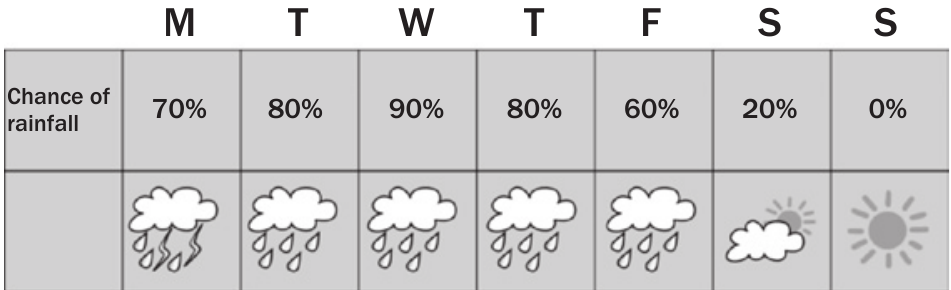
Weather forecasts are predictions about future weather conditions based on probability. When you hear that there's a "20% chance of rain," this doesn't mean it will definitely rain or not rain - it means that based on historical data and current conditions, it rained 20% of the time under similar circumstances.
Note
The percentage in a weather forecast represents the likelihood of that weather event occurring based on historical patterns under similar conditions. This probabilistic approach is essential for understanding how weather predictions work.
How meteorologists make weather predictions
Meteorologists are scientists who study and predict weather patterns. They use specialised instruments to measure various weather characteristics including:
- Temperature
- Air pressure
- Humidity
- Wind speed and direction
These scientists compare current measurements with historical weather data they have collected over many years. For example, if current conditions match those that previously resulted in rain 20% of the time, they'll forecast a "20% chance of rain."
Understanding weather forecasts
The key function of weather forecasts is to provide probabilistic information rather than absolute certainty. When meteorologists predict weather conditions, they're making educated estimates based on patterns from the past.
Important
Weather forecasts are based on probability, not certainty. This is a fundamental concept that students must understand when interpreting any weather prediction.
Weather forecasters predict all aspects of daily weather conditions, not just the probability of rainfall. They provide comprehensive information about expected temperatures, wind conditions, and other weather features.
Worked example
Example
Worked Example: Interpreting Probability in Weather Forecasts
Question: If a weather forecast says there is an 80% chance that it will rain in your area, does that mean you will definitely see rain? Is there a chance that it will not rain where you are?
Solution: No, an 80% chance of rain does not guarantee that it will definitely rain. Forecasters know it rained on 80% of days in the past with similar weather conditions, but they can only provide a probability, not an exact prediction of what will happen.
There is also a 20% probability of no rain (since ).
Improving weather prediction accuracy
Weather forecasters can make their predictions more reliable by implementing several key strategies:
-
Collecting more data over longer time periods - The more historical information available, the more accurate the predictions become
-
Improving measurement methods - Better instruments and technology provide more precise weather characteristic data
-
Enhanced data analysis - As computers become more powerful and specialised, scientists can improve their methods of analysing weather patterns and making predictions
Note
Research has found that prediction accuracy increases significantly when meteorologists have access to decades of historical data rather than just a few years of information.
Key exam tips
Note
Important Points for Examinations:
- Remember that probability percentages in weather forecasts represent historical patterns, not guarantees
- Always consider the complement: if there's an 80% chance of rain, there's a 20% chance of no rain
- Weather predictions become more reliable with more data and better technology
- Understand that meteorologists use probability because weather systems are complex and variable
Summary
Key Points to Remember:
- Weather forecasts are based on probability, not certainty - they show the likelihood of weather events based on historical data
- An 80% chance of rain means there's also a 20% chance of no rain
- Meteorologists use instruments to measure current weather characteristics and compare them to historical patterns
- Prediction accuracy improves with more data collection over longer periods and better analysis methods
- Weather forecasts provide probabilities for all weather aspects, not just rainfall