What Is Chemical Equilibrium? (Grade 12 NSC Matric Physical Sciences): Revision Notes
📚Revision Notes
What Is Chemical Equilibrium?
Understanding equilibrium through balance
Note
The Treadmill Analogy
Think about running on a treadmill. When you run, you're moving your legs forwards constantly, but you stay in the same position. The treadmill moves backwards at exactly the same rate as you move forwards. This creates a balanced state where there's constant motion but no overall change in your position.
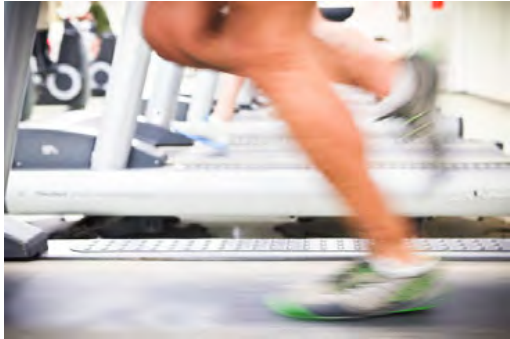
Chemical reactions can work in a similar way. In some reactions, the forwards process and reverse process occur at equal rates, creating a balanced state called chemical equilibrium.
Key questions about chemical reactions
To understand chemical equilibrium properly, we need to consider three important questions about how reactions behave:
Question 1: Do all reactions go to completion?
When reactants are mixed together, we might expect them to be completely used up to form products. This is called going to completion. However, this doesn't always happen - sometimes reactants remain even after the reaction appears to have stopped.
Question 2: Can reactions be reversed?
Most reactions we study seem to go in one direction: reactants → products. But some reactions are reversible, meaning they can also go: products → reactants. These reactions can proceed in both directions under the right conditions.
Question 3: Can reactions reach a stable state?
In some reactions, there comes a point where reactants are still present, but no further changes seem to occur. The reaction appears to have stopped, even though reactants and products are both present. This stable state is what we call chemical equilibrium.
Defining chemical equilibrium
Chemical equilibrium occurs when a reversible reaction reaches a state where the rate of the forwards reaction equals the rate of the reverse reaction. At this point, the concentrations of all reactants and products remain constant, even though the reaction continues at the molecular level.
Important
Key Definition: Chemical Equilibrium
A reaction is in chemical equilibrium when the rate of the forwards reaction equals the rate of the reverse reaction.
Real-world examples of chemical equilibrium
Example 1: Carbonated drinks
When you open a bottle of carbonated drink, you might notice bubbles forming. This happens because of an equilibrium reaction between carbon dioxide gas and carbonic acid in the liquid:
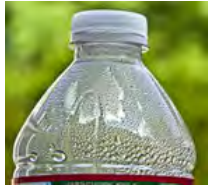
In a sealed bottle, CO₂ dissolves into the liquid to form carbonic acid, while carbonic acid simultaneously breaks down to release CO₂ gas. When these processes occur at equal rates, equilibrium is established.
Example 2: Oxygen transport in blood
Haemoglobin in your blood carries oxygen around your body through an equilibrium reaction:
In your lungs, haemoglobin picks up oxygen. In your body tissues, it releases oxygen where it's needed. This reversible process is essential for life.
Open and closed systems
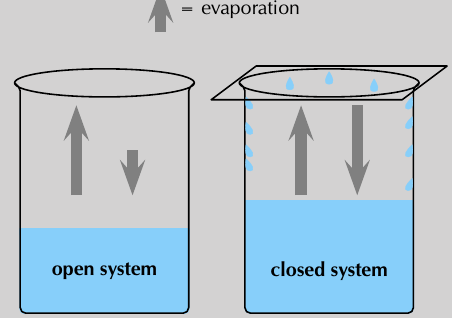
For chemical equilibrium to be established and maintained, reactions typically need to occur in closed systems.
Open systems
An open system allows both matter and energy to move freely in and out of the system.
Note
Open System Definition
An open system is one whose borders allow the movement of energy and matter into and out of the system.
Closed systems
A closed system allows energy to enter or leave, but prevents matter from escaping.
Note
Closed System Definition
A closed system is one in which only energy can move into and out of the system. Matter cannot be gained by the system nor lost from the system.
Why closed systems matter for equilibrium
Important
Critical Concept: Systems and Equilibrium
In an open system, reactants or products can escape, making it difficult to establish equilibrium. In a closed system, all substances remain within the system, allowing equilibrium to be reached and maintained.
Understanding reversible reactions
Reversible reactions are chemical reactions that can proceed in both directions. The reactants can form products, and the products can reform the original reactants.
Note
Reversible Reaction Definition
A reversible reaction is a chemical reaction that can proceed in both the forwards and reverse directions. In other words, the reactants and products of the reaction may reverse roles.
Notation for reversible reactions
We use a special double-headed arrow (⇌) to show reversible reactions:
Forwards and reverse reactions
For any reversible reaction:
- The forwards reaction proceeds from left to right
- The reverse reaction proceeds from right to left
For example, in the reaction:
- Forwards reaction:
- Reverse reaction:
Dynamic equilibrium
Dynamic equilibrium is the state achieved when the forwards and reverse reaction rates become equal in a reversible reaction.
Important
Dynamic Equilibrium Definition
There is a dynamic equilibrium in a reversible reaction when the rate of the forwards reaction equals the rate of the reverse reaction. The amounts of reactants and products remain constant.
Characteristics of dynamic equilibrium
Note
Four Key Characteristics of Dynamic Equilibrium
- Equal rates: Forwards and reverse reactions occur at the same rate
- Constant concentrations: The amounts of all substances remain constant
- Continuous activity: Reactions continue at the molecular level
- No apparent change: The system appears stable to external observation
How equilibrium is reached
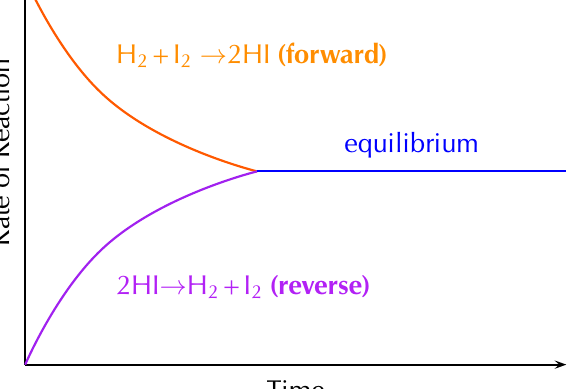
The process of reaching equilibrium follows a predictable pattern:
Initially:
- The forwards reaction rate is high (many reactants available)
- The reverse reaction rate is low (few products available)
Over time:
- Forwards reaction rate decreases (fewer reactants remain)
- Reverse reaction rate increases (more products form)
At equilibrium:
- Both reaction rates become equal
- Concentrations remain constant
- The system reaches dynamic equilibrium
Worked examples
Example
Worked Example 1: Identifying System Types
Question: Which of the following represents a closed system?
- a) A pot of water (without a lid) heated to 80°C
- b) A pot of water (with a lid) heated to 80°C
Solution:
- Option (a) is an open system because water vapour can escape
- Option (b) is a closed system because the lid prevents water vapour from escaping while still allowing heat energy to enter
Answer: (b)
Example
Worked Example 2: Writing Reversible Reactions
Question: For the reversible reaction , write:
- a) The forwards reaction
- b) The reverse reaction
Solution:
- a) Forwards reaction (left to right):
- b) Reverse reaction (right to left):
Example
Worked Example 3: Understanding Equilibrium
Question: In the equilibrium , what happens to the reaction rates over time?
Solution:
- Initially: Rate of forwards reaction > Rate of reverse reaction
- As time progresses: Forwards rate decreases, reverse rate increases
- At equilibrium: Rate of forwards reaction = Rate of reverse reaction
- The concentrations of H₂, I₂, and HI remain constant
Summary
Exam Tips for Chemical Equilibrium
- Remember the definition: Equilibrium occurs when forwards and reverse reaction rates are equal
- System types: Open systems allow matter and energy exchange; closed systems only allow energy exchange
- Reversible reactions: Use ⇌ symbol and remember forwards goes left to right
- Dynamic nature: Even at equilibrium, molecules continue reacting - it's not a static state
- Constant concentrations: At equilibrium, amounts of substances stay the same, not rates
Summary
Key Points to Remember
- Chemical equilibrium occurs when the rate of forwards reaction equals the rate of reverse reaction in a closed system
- Open systems allow both matter and energy to move in and out, while closed systems only allow energy transfer
- Reversible reactions can proceed in both directions, shown by the ⇌ symbol
- Dynamic equilibrium means reactions continue at the molecular level even though concentrations remain constant
- Equilibrium can only be established in closed systems where reactants and products cannot escape