Darwin, Adaptations, and Natural Selection (HSC SSCE Biology): Revision Notes
📚Revision Notes
Darwin, Adaptations, and Natural Selection
Introduction: The development of evolutionary thinking
The diversity of life on Earth has fascinated humans for centuries. Long before Charles Darwin, various thinkers proposed ideas about how species came to exist:
- 580 BCE - Anaximander (Greek philosopher): Suggested humans could not have appeared on Earth in their current form
- Later Greek period - Empedocles: Theorised that early Earth had monsters that became extinct, while better suited organisms survived
- 1744 CE - Carl Linnaeus: Proposed that God created a small number of organisms that interbred to produce greater variety
- 1794 - James Hutton: First person to formally state the idea of natural selection - that the best-adapted organisms would survive and multiply
- 1794 - Erasmus Darwin (Charles Darwin's grandfather): Suggested in his book Zoonomia that all cold-blooded animals had a common origin
- 1800 - Jean Baptiste Lamarck: Incorrectly suggested that characteristics acquired during an individual's lifetime could be passed to offspring
Note
While many thinkers throughout history contributed ideas about the origin and diversity of life, it wasn't until the mid-19th century that a comprehensive, evidence-based theory of evolution would emerge.
By 1858, Charles Darwin and Alfred Russel Wallace realised they had been working independently on the same ideas about evolution. They copresented their theory to the Linnean Society in 1858, proposing possible mechanisms to explain how evolutionary change occurred.
The voyage of the HMS Beagle
In 1831, 22-year-old Charles Darwin boarded the survey ship HMS Beagle as ship's naturalist and dining companion for Captain Robert Fitzroy. This five-year voyage would transform biology forever.
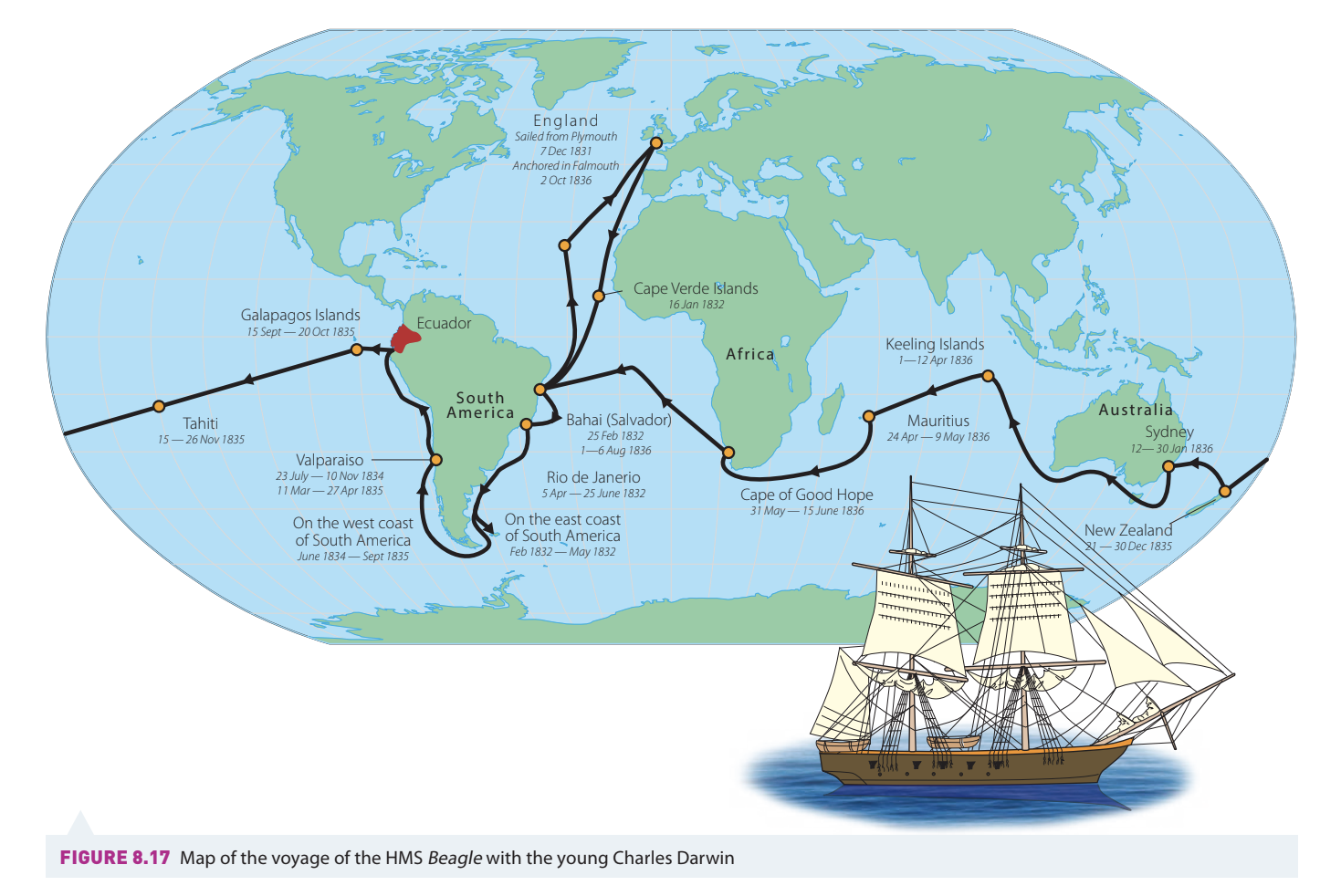
Darwin's journey around the world
The Beagle visited several continents, including South America, Australia, and Africa. Darwin kept extensive, meticulous notes and collected thousands of specimens to take back to England for identification.
At the start of his journey, Darwin shared the prevailing belief that all species on Earth had been independently created. However, his observations during the voyage would challenge this view.
Important observations during the voyage
St Jago, Canary Islands: Darwin observed that fossilised invertebrates in rock strata on the beach were similar to shells of present-day organisms littering the beach. This suggested a connection between ancient and modern species.
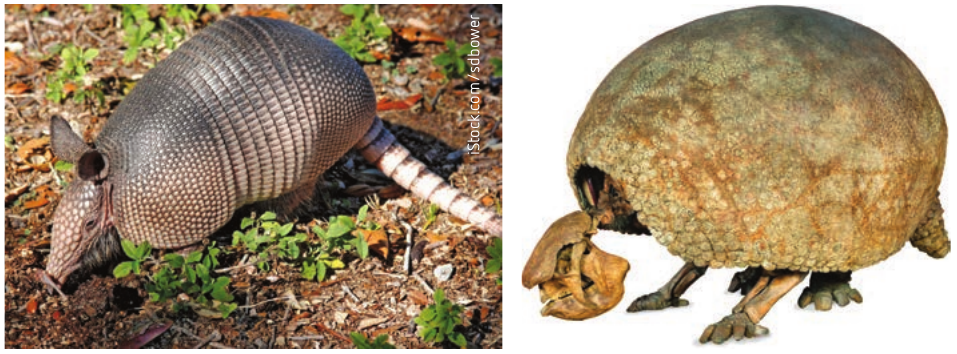
Argentina, Bahia Blanca: Darwin found the outer shell of an armadillo and later unearthed a fossil shell of a glyptodont. He recognised the remarkable similarity between these extinct and living species.
Note
Darwin began to wonder whether there was a relationship between ancient extinct species and present-day living species. This observation of similarities between fossils and living organisms became a key piece of evidence supporting evolutionary theory.
Darwin in the Galapagos Islands
Darwin's visit to the Galapagos Islands, off the coast of Ecuador, provided crucial evidence that strengthened his emerging ideas about evolution.
The Galapagos Islands are an archipelago of volcanic islands spanning the equator. They consist of 18 main islands, three smaller islands, and numerous rocky islands and islets. The islands are home to unique species including fur seals, sea lions, tortoises, sea turtles, marine iguanas, and the famous Galapagos (or Darwin's) finches.
Darwin's finches of the Galapagos Islands
Darwin observed and collected specimens of small ground finches living on each of the Galapagos Islands. Upon returning to England, he presented these specimens to John Gould, a famous English ornithologist, who classified them as 14 different species, 12 of which were new to science. Gould noted that the birds were similar to those found in South America.
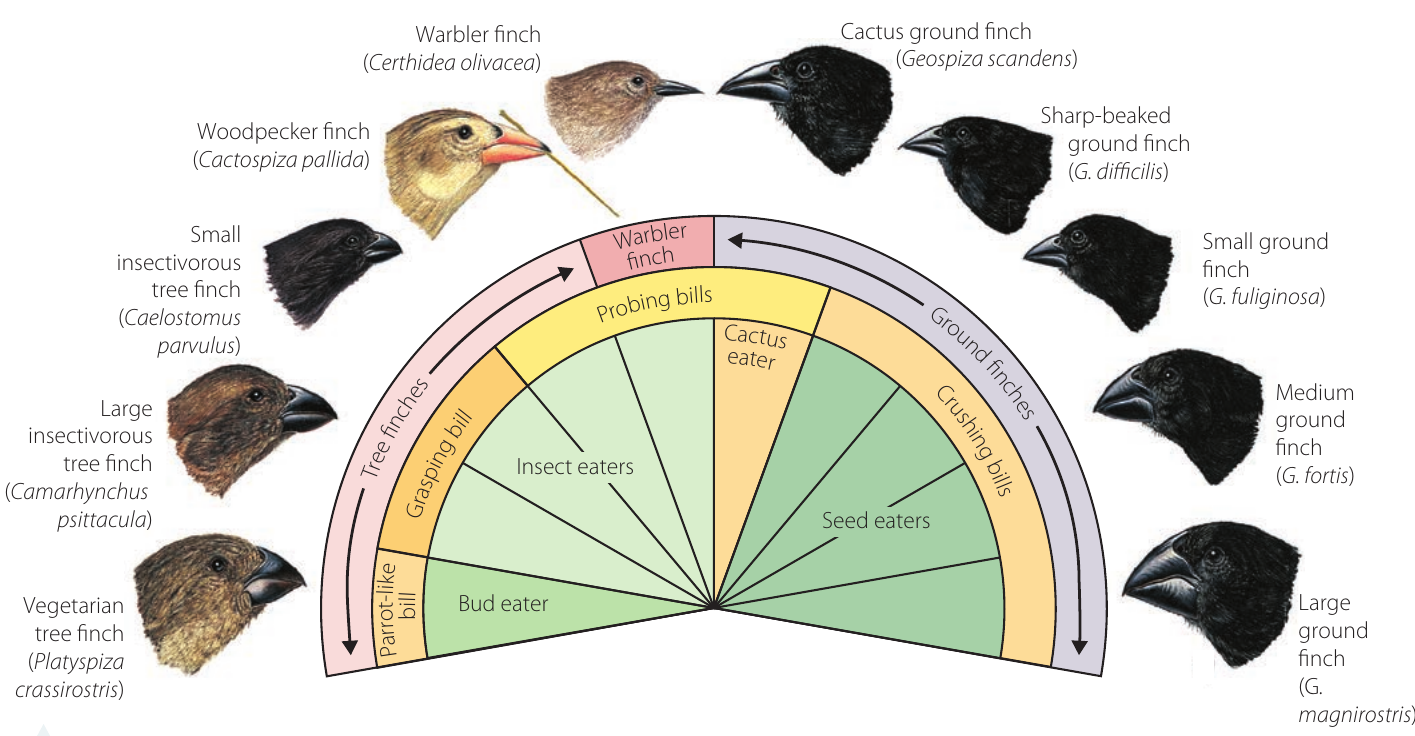
Darwin's observations about finch beaks
Darwin was particularly intrigued by the variation in beak shapes among the finches. He wrote: "The most curious fact is the perfect gradation in the size of the beaks in the different species of Geospiza, from one as large as that of a hawfinch to that of a chaffinch..."
Example
Darwin's Reasoning Process: Finch Evolution on the Galapagos
Darwin reasoned that the different finches found from island to island could be explained through the following process:
- A few South American finches arrived on one of the remote Galapagos islands
- These finches had naturally occurring variations in colour, beak size, and leg length
- The descendants gradually populated the other islands, each with different environmental conditions
- Depending on the island conditions, some birds thrived and reproduced
- Finches not adapted to their island's conditions died out
This observation led Darwin to wonder whether all Galapagos finches had descended from an original population from mainland South America that had been gradually modified over time.
John Gould's contribution
The classification of Darwin's finches is attributed to John Gould, ornithologist at the Zoological Society of London in 1837. This classification was highly significant because it helped Darwin realise that:
- Species on separate islands were related to species on the South American mainland
- Species could split from a common ancestor
- Related species might exist at the same time, even in the same geographical area
Note: John Gould later moved to Tasmania and classified more than 40% of all Australian bird species.
Evidence from modern research: The Grants' study
Peter and Rosemary Grant from Princeton University spent 40 summers on Daphne Major in the Galapagos Islands studying evolution in real time. Their research provides compelling evidence for natural selection.
The study method
The Grants caught, measured, and tagged finches living on Daphne Major over a 40-year period starting in 1973. One key measurement they took was beak depth - the vertical height of the beak.
When the Grants began their investigation in 1973, the food available to finches on Daphne Major was abundant soft small seeds.
1976 data: Before the drought
In 1976, the Grants measured beak depth in 751 birds. The results showed a normal distribution with a mean beak depth of approximately mm.
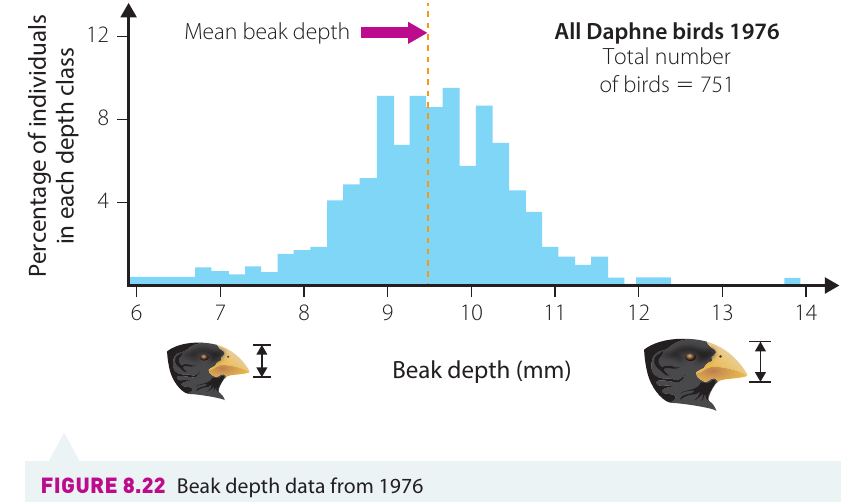
The distribution indicates that most birds had beak depths suitable for eating soft, small seeds - the abundant food source at that time.
Climate changes: 1973-1978
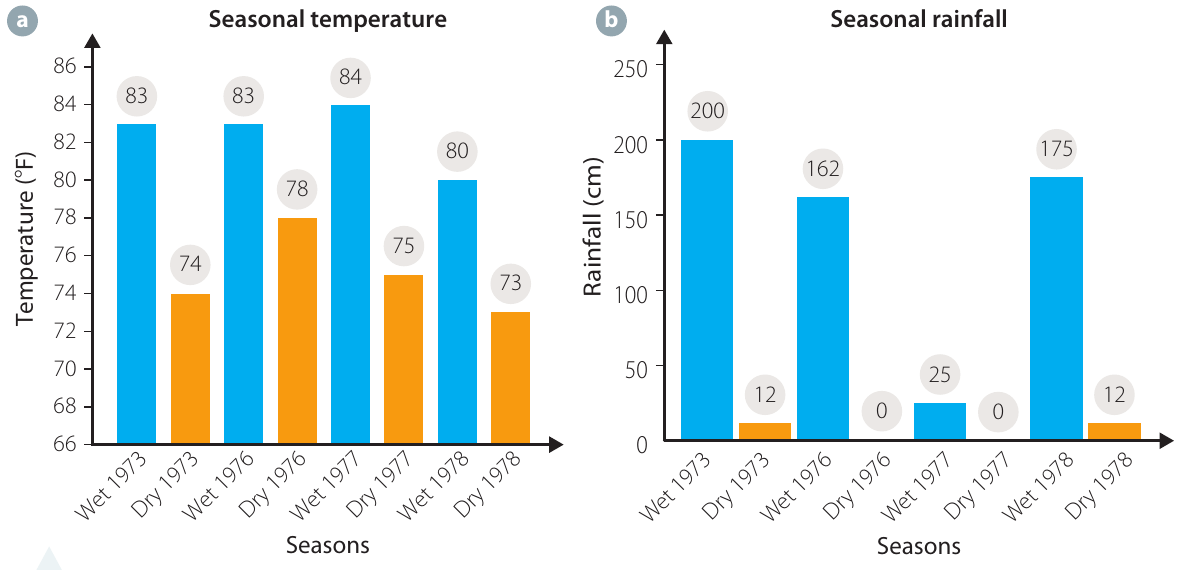
The climate data for Daphne Major reveals dramatic differences between wet and dry seasons:
Important
Key observations from the climate data:
- Wet seasons consistently had higher temperatures (around ) and much more rainfall ( cm)
- Dry seasons had lower temperatures (around ) and minimal rainfall ( cm)
- 1977 was particularly significant: The dry season had very low rainfall ( cm), creating drought conditions
This drought had a major impact on the finch population. With limited rainfall, soft small seeds became scarce. Only larger, harder seeds remained available - seeds that required deeper, stronger beaks to crack open.
1978 data: After the drought
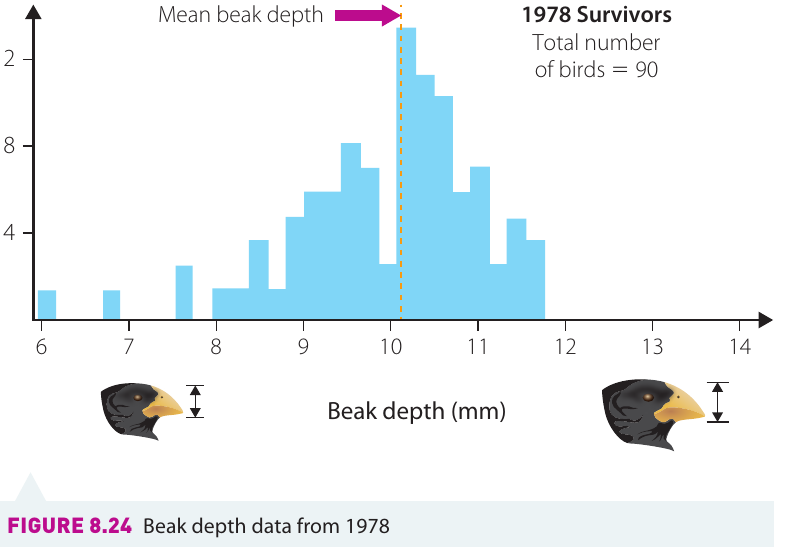
By 1978, only 90 birds survived out of the original 751. The surviving birds showed a different beak depth distribution:
Key changes from 1976 to 1978:
- The mean beak depth increased to approximately mm
- The distribution shifted toward larger beak depths
- Birds with deeper beaks had a survival advantage during the drought
- Birds with shallower beaks were more likely to die because they couldn't crack the harder seeds
What this research demonstrates
The Grants' research provides direct evidence of natural selection in action:
Example
Natural Selection Demonstrated: The Grants' Finch Study
- Variation existed: The 1976 population showed variation in beak depth (mean mm)
- Environmental pressure occurred: The 1977 drought changed the available food supply from soft small seeds to harder large seeds
- Selection happened: Birds with deeper beaks could crack harder seeds and survived
- Population changed: The 1978 population had, on average, deeper beaks (mean mm) than the 1976 population
If this environmental pressure continued, the average beak depth in future generations would continue to increase, demonstrating evolution through natural selection.
Darwin in Australia: Native flora and fauna
On 12 January 1836, the Beagle sailed into Sydney Harbour. Darwin's 2-month stay in the colony provided valuable observations that helped formulate his ideas on evolutionary change.
Key observations in Australia
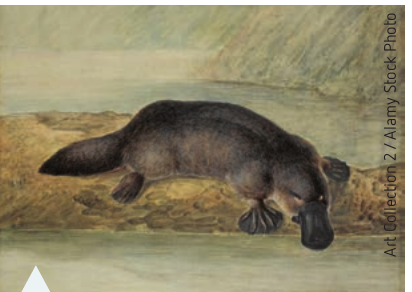
While in Sydney, Darwin embarked on an overland journey to Bathurst. He was the first British scientist to observe a rat-kangaroo and a platypus in their natural environments near Wallerawang.
Darwin made several important observations comparing Australian animals to European species:
Similarities Darwin noticed:
- The platypus was very similar to water rats in England in behaviour and habitat
- The rat-kangaroo (potoroo) was similar to rabbits in both behaviour and appearance
- Magpies and crows resembled jackdaws in England but were clearly different species
- Ant lions behaved like those in England despite being different species
Darwin's observations and evolutionary theory
| Darwin's observation | Connection to evolutionary theory |
|---|---|
| Australian birds (magpies, crows) similar to English birds (jackdaws) but different species | Organisms in similar environments can evolve similar features (convergent evolution) |
| Potoroo (rat-kangaroo) similar to European rabbit in size and behaviour | If organisms live in similar habitats, similar variations would be favoured by natural selection |
| Platypus similar to water rats in behaviour and habitat | Natural selection enables organisms to survive and breed in similar conditions |
| Ant lions behave like English species but are different species | Similar behaviours can evolve independently in different locations |
| Eucalyptus trees described as "scrubby" with leaves "not shed periodically" | Plant adaptations reflect harsh environmental conditions; evergreen trees in southern hemisphere differ from northern hemisphere |
Darwin's reflections
Darwin's observations of Australian marsupials and monotremes revealed similarities with European mammals living in similar environments. This led him to an important realisation: organisms could evolve to become similar through a process called convergent evolution.
Note
Darwin began to question why a Creator would create such different creatures for similar environments. He wrote in his diary:
"Surely two distinct creators must have been at work; their object however has been the same and certainly the end in each case is complete... Would any two workmen ever hit on so beautiful, so simple & yet so artificial a contrivance?"
These observations helped Darwin move away from the idea of independent creation toward a theory of evolution through natural selection.
Darwin's theory of evolution by natural selection
Darwin published On the Origin of Species by Means of Natural Selection or the Preservation of Favoured Races in the Struggle for Life in 1859 (now simply called Origin of Species). The theory is sometimes known as "survival of the fittest".
The five main tenets of Darwin's theory
Important
Darwin's Theory of Evolution by Natural Selection
Darwin's theory rests on five key principles:
1. Variation exists within populations
- Individuals within a species show natural differences in their characteristics
- These variations include features like size, colour, beak shape, and leg length
2. More offspring are produced than can survive
- Populations have the potential to grow exponentially
- Limited resources (food, water, shelter) mean not all offspring can survive to reproduce
3. Those offspring better adapted to their environment will survive and reproduce
- Individuals with advantageous variations are more likely to survive
- These individuals are more likely to reproduce and pass on their characteristics
- This is the process of natural selection
4. The favourable adaptations are passed on to the next generation
- Offspring inherit characteristics from their parents
- Advantageous traits become more common in the next generation
5. Over time, favourable adaptations increase in the population (as long as the environment does not change)
- Gradual accumulation of favourable traits leads to evolutionary change
- Populations become better adapted to their environment over many generations
- If the environment changes, different traits may become favourable
Key collaborators and influences
Darwin's work was influenced and supported by many others:
- Alfred Russel Wallace: Independently developed similar ideas; copresented theory with Darwin in 1858
- John Gould: English ornithologist who classified Darwin's finch specimens
- James Hutton: First to formally state the idea of natural selection (1794)
- Erasmus Darwin: Charles Darwin's grandfather; proposed common origin for animal groups
- Robert Fitzroy: Captain of HMS Beagle
- Peter and Rosemary Grant: Modern researchers who provided evidence of natural selection in Darwin's finches
Summary
Key Points to Remember:
-
Charles Darwin's five-year voyage (1831-1836) on HMS Beagle laid the foundation for modern evolutionary biology through careful observation and specimen collection
-
The Galapagos Islands finches provided crucial evidence for Darwin's theory, showing how beak variations adapted to different food sources on different islands
-
The Grants' 40-year study on Daphne Major demonstrated natural selection in action: after the 1977 drought, average beak depth increased from mm to mm because birds with deeper beaks could crack harder seeds and survived
-
Darwin's observations in Australia revealed convergent evolution - organisms in similar environments can evolve similar features even when not closely related (e.g., platypus and water rats)
-
Darwin's Theory of Evolution by Natural Selection has five key tenets: variation exists in populations, more offspring are produced than survive, better-adapted individuals survive and reproduce, favourable adaptations are inherited, and over time these adaptations increase in the population