Modern Examples of Evolution (HSC SSCE Biology): Revision Notes
📚Revision Notes
Modern Examples of Evolution
Introduction
While Darwin's original work on evolution was groundbreaking, modern scientists have been able to observe evolution happening in real time by studying organisms with short generation times. These contemporary examples help us understand that evolution is not just a process from millions of years ago, but something we can witness occurring today.
Organisms that produce many offspring quickly are particularly valuable for studying evolution because we can observe changes across multiple generations within a relatively short period.
Note
Studying modern examples of evolution provides direct evidence for natural selection and allows scientists to test evolutionary theories through observation and experimentation, rather than relying solely on fossil evidence.
The cane toad
Introduction to Australia
The cane toad (Bufo marinus) provides a remarkable example of rapid evolution in action.
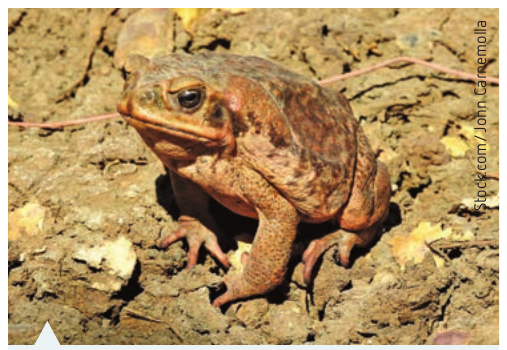
In , cane toads were deliberately brought to Australia from Central and South America to act as a biological control (a living organism used to manage the population of another organism). The goal was to control cane beetles, which were severely damaging the sugar cane industry. Initially, only cane toads were released. Today, an estimated million cane toads live across Australia.
Characteristics enabling success
Two key characteristics have allowed cane toads to thrive and outcompete native amphibian species:
- Rapid reproduction - cane toads breed quickly and produce large numbers of offspring
- Toxicity throughout life - they remain poisonous during all stages of their life cycle, from tadpoles to adults
Without natural predators in Australia, cane toads reproduced extensively and gradually spread across northern Australia.

Note
The cane toad's success in Australia demonstrates how the absence of natural predators and competition can allow an introduced species to thrive. This lack of selective pressure from predators, combined with their own advantageous traits, created ideal conditions for rapid population growth and spread.
Evolution of movement speed
Research by Professor Rick Shine from the University of Sydney has revealed fascinating evolutionary changes in cane toad populations. The toads at the leading edge of the invasion (the invasion front) possess specific genes that enable them to move faster than other cane toads.
The speed of the invasion front has increased dramatically:
- In the s: approximately km per year
- Currently: approximately km per year
This change occurred because cane toads naturally sorted themselves by movement speed. Slower individuals fell behind, while faster toads reached the frontline. The faster toads had an adaptive advantage - they could invade new habitats first, access resources, and breed before slower toads arrived. These "athletic" toads then produced similarly athletic offspring.
Modern cane toads at the invasion front are larger and faster, moving approximately m per day compared to just m per day for slower individuals. They also tend to move in straighter lines, making their spread more efficient.
Important
What surprises biologists is how quickly this evolution has occurred. Evolution was traditionally thought to require thousands or millions of years, yet significant changes in cane toads have happened within just a few decades. This demonstrates that evolution can operate on much shorter timescales than previously believed.
Impact on other species
Cane toads are not only evolving themselves - they are also creating selection pressure on other organisms, causing them to evolve in response.
Different native animals show varying levels of vulnerability to cane toad toxins. The cane toad acts as a selective force, with some animals being killed while others survive. This creates conditions for evolution in these species.
Example
Evolutionary Response in Red-Bellied Black Snakes
Researchers have observed that in areas where red-bellied black snakes and cane toads coexist, the snakes have evolved smaller heads.
Why this happened:
- Snakes with larger heads could consume larger, more poisonous toads
- These snakes died from the toxins
- Snakes with smaller heads could only eat smaller prey, avoiding the large toxic toads
- The smaller-headed snakes survived and reproduced
- Result: The population shifted toward snakes with smaller heads
This is a clear example of natural selection driving evolutionary change in response to a new selection pressure.
Exam tip: When explaining modern examples of evolution, always relate them back to Darwin and Wallace's theory. Show how variation exists, how selection pressure acts, and how favourable characteristics become more common over generations.
Antibiotic-resistant strains of bacteria
Discovery and early use of antibiotics
Antibiotics are chemicals that can inhibit bacterial growth or destroy bacteria. They work by targeting the bacterial cell wall and disrupting bacterial metabolism.
Alexander Fleming discovered the first antibiotic, penicillin, in . However, it could not be used medically at that time. In the late s, Australian scientist Howard Florey, working with Ernst Chain, purified and stabilised penicillin. It became available for medical use in .
This was a major advancement in medicine. Many infections and diseases that were previously serious or fatal could now be treated successfully. The number of deaths from bacterial diseases dropped significantly.
Note
The discovery and development of antibiotics revolutionized medicine, turning previously fatal bacterial infections into treatable conditions. This period marked one of the greatest achievements in medical history, saving countless lives worldwide.
Development of antibiotic resistance
With widespread antibiotic use, a concerning problem has emerged: bacteria have evolved strains resistant to many, or even all, available antibiotics. This resistance develops through the normal process of natural selection.
Although bacteria typically reproduce asexually through binary fission (producing identical clones), they can also exchange genetic material through a process called conjugation.
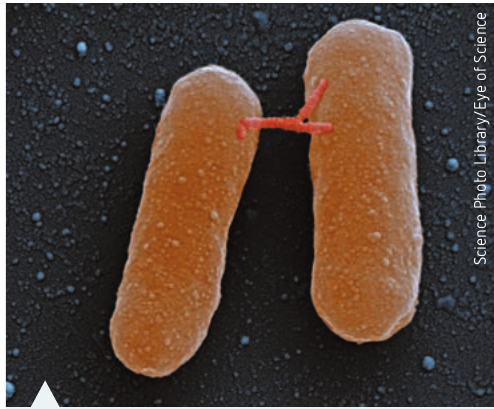
During conjugation, bacteria transfer genetic material between cells through a structure called the sex pilus. This process creates variation within bacterial populations, which is essential for evolution to occur.
Important
Conjugation is crucial to understanding antibiotic resistance because it allows bacteria to share resistance genes rapidly across populations, even between different bacterial species. This horizontal gene transfer speeds up the spread of antibiotic resistance far beyond what would be possible through reproduction alone.
How resistance evolves
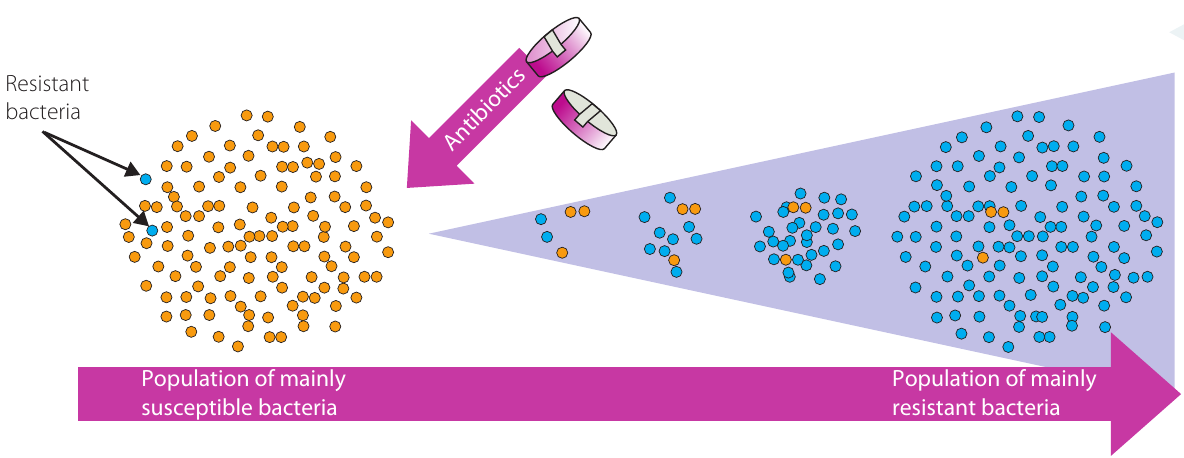
The development of antibiotic resistance perfectly demonstrates Darwin and Wallace's Theory of Evolution by Natural Selection:
Example
Step-by-Step Development of Antibiotic Resistance
Step 1: Variation exists Within any bacterial population, some individuals have genetic variations that make them resistant to certain antibiotics.
Step 2: Selection pressure When an antibiotic is introduced, it acts as a selection pressure on the bacterial population.
Step 3: Survival of the fittest Bacteria with resistance variations survive while susceptible bacteria die.
Step 4: Reproduction The resistant bacteria reproduce, passing their resistance genes to offspring.
Step 5: Population change Over successive generations, the population becomes increasingly resistant as the proportion of resistant bacteria grows.
This process can occur very rapidly because bacteria reproduce quickly, sometimes producing a new generation every minutes.
MRSA: A dangerous example
Staphylococcus aureus (commonly called "golden staph") normally lives harmlessly in the nose, mouth, or on the skin of many people. It typically causes only mild infections like boils, but can become serious when it infects surgical wounds, blood, lungs, or the urinary tract.
A strain called MRSA (methicillin-resistant S. aureus) has evolved resistance to multiple antibiotics including methicillin, amoxicillin, penicillin, and oxacillin. While some antibiotics still work against MRSA, continued overuse of antibiotics - particularly in the food industry - is rapidly leading to further resistance.
Important
Factors Contributing to Antibiotic Resistance:
- Prescribing antibiotics for viral infections (like influenza and common colds) where they have no effect
- Patients not completing full antibiotic courses, which allows some bacteria to survive
- Overuse in agriculture and food production
People most at risk from S. aureus infections include those with weakened immune systems, particularly patients in hospitals and nursing homes.
Remember: Always complete your antibiotic course as prescribed. Stopping early can allow resistant bacteria to survive and multiply.
Biofilms and protection
Many micro-organisms do not exist as individual free-floating cells but attach to each other or to surfaces, forming biofilms - communities of micro-organisms living together on a surface (like dental plaque on teeth).
Biofilms can have different phenotypes (observable characteristics) and properties compared to free-living bacteria. This almost multicellular behaviour provides bacteria with enhanced protection and properties that help them resist antibiotics. Scientists believe antibiotics may be unable to penetrate the biofilm structure, making the bacteria within much harder to kill.
Note
Learning aid: Think of biofilms as bacterial "cities" where bacteria live together with enhanced protection, compared to individual bacteria living alone. Just as a city provides protection and resources to its inhabitants, biofilms provide bacteria with collective defenses against antibiotics and harsh environmental conditions.
Remember!
Summary
Key Points to Remember:
-
Modern examples show evolution in action: Evolution can be observed happening over decades rather than requiring millions of years, particularly in organisms with short generation times.
-
Cane toads demonstrate rapid adaptation: Since their introduction in , cane toads have evolved to move faster (from km/year to km/year invasion speed), and this faster movement has become more common because it provides an adaptive advantage at the invasion front.
-
Selection pressure drives change: Both cane toads and bacteria demonstrate how selection pressure (new habitats for toads, antibiotics for bacteria) causes populations to change over time as certain characteristics become more advantageous.
-
Antibiotic resistance is evolution by natural selection: When antibiotics kill susceptible bacteria, resistant individuals survive and reproduce, making resistance increasingly common in bacterial populations. This is why finishing antibiotic courses and using them responsibly is crucial.
-
Evolutionary changes can cascade: The evolution of cane toads has caused evolutionary changes in other species, like red-bellied black snakes developing smaller heads, showing how one species' evolution can create selection pressure on others.