Microevolutionary Changes and Speciation (HSC SSCE Biology): Revision Notes
📚Revision Notes
Microevolutionary Changes and Speciation
Understanding evolution and the environment
What drives evolutionary change?
Environmental change acts as a major driving force behind changes in living organisms. The environment consists of two main components:
Note
Biotic factors - the living surroundings of organisms
Abiotic factors - the non-living surroundings, including:
- Physical conditions: temperature, water availability, light, wind, slope, and tides
- Chemical conditions: presence or absence of gases (oxygen, carbon dioxide), pH levels, and concentrations of chemicals such as salts and heavy metals
When the environment changes, resources often become limited. This creates competition among organisms for essential resources:
- In plants: light, soil nutrients, and water
- In animals: food, water, shelter, mates, and breeding territory
Selection pressures
Environmental changes create selection pressures that influence which organisms survive and reproduce. The main selection pressures include:
- Environmental change
- Competition
- Predation
- Disease
Organisms with variations that make them better suited to the changed environment have a survival advantage. A population with diverse individuals is more likely to survive sudden environmental changes because some individuals will possess beneficial traits.
Important
A population with diverse individuals is more likely to survive sudden environmental changes because some individuals will possess beneficial traits that allow them to thrive under new conditions.
Natural selection and adaptation
When resources become limited, organisms compete for survival. Those with advantageous variations compete more successfully, survive longer, and pass their genes to the next generation. This process is called natural selection - organisms without helpful variations are less likely to survive and reproduce.
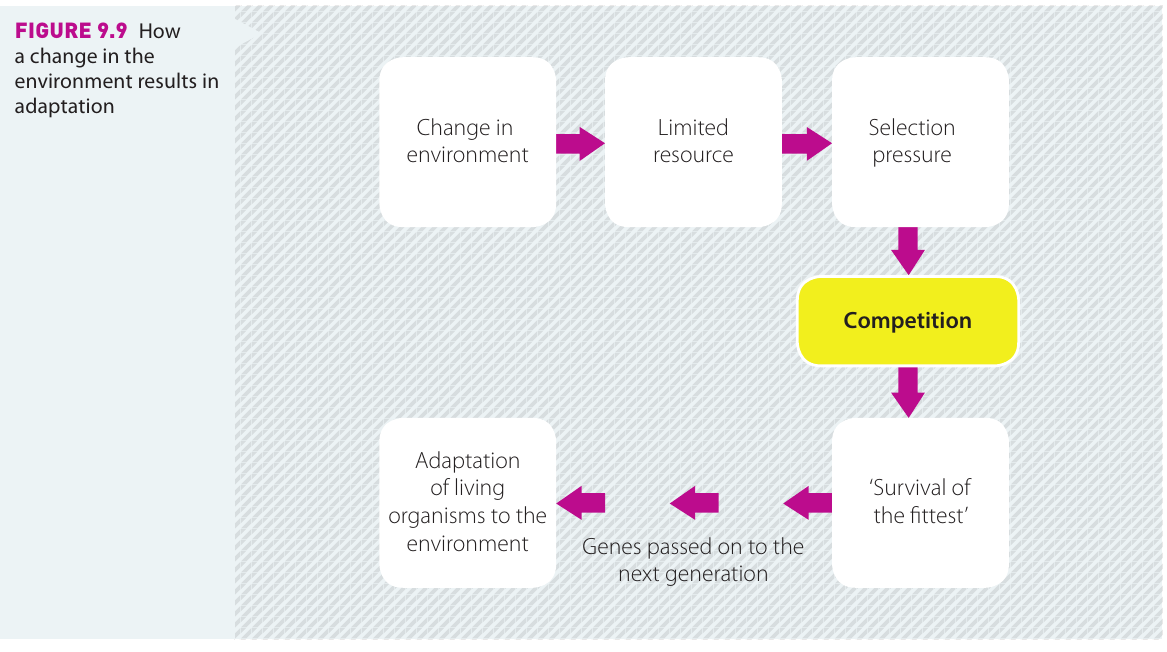
The diagram above shows how environmental change leads to adaptation through natural selection. The cycle begins with environmental change, creating limited resources and selection pressure, which leads to competition. The organisms best suited to survive ("survival of the fittest") pass their genes to the next generation, resulting in adaptation to the environment.
Microevolution versus macroevolution
Evolution operates on different timescales and produces different outcomes.
Microevolution
Microevolution involves:
- Changes occurring over shorter time periods
- Changes within populations (groups of organisms sharing the same gene pool and able to interbreed)
- Development of new varieties or races within a species
- Does not generally produce entirely new species
Example
Example: Dog Breeds
Different dog breeds all belong to the same species despite their varied appearances. From tiny Chihuahuas to massive Great Danes, all dogs can potentially interbreed because they share the same gene pool - this is microevolution in action.
Macroevolution
Macroevolution involves:
- Changes occurring over millions of years (geological time)
- Development of new species and even larger groups (families, orders)
- Major evolutionary transitions
Important
Key Distinction: Small microevolutionary changes can accumulate over long periods to produce macroevolution. For example, small changes in a dog-sized ancestor gradually led to the modern horse over approximately $50 million years.
Mechanisms of evolutionary change
Three main mechanisms drive major evolutionary changes:
- Mutations - changes in genetic material that create heritable characteristics
- Migration - movement of organisms between populations
- Natural selection - differential survival and reproduction based on advantageous traits
Evolution of the horse
Why study horse evolution?
The horse provides an excellent case study for evolution because:
- It has one of the most complete fossil records of any organism
- The fossil evidence shows a branching pattern rather than simple linear progression
- We can trace clear changes in anatomy over million years
Note
The horse is a mammal in the family Equidae. It shares a common ancestry with tapirs and rhinoceruses.
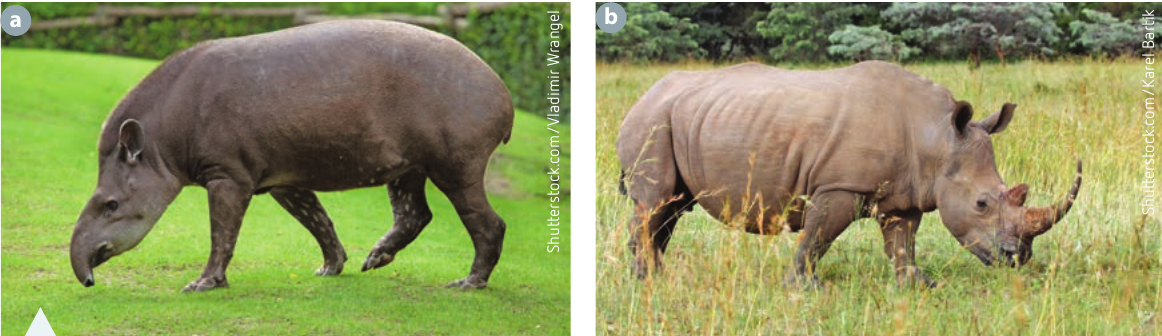
Overview of horse evolution
The horse evolved from a small, dog-sized, forest-dwelling animal called Hyracotherium to the modern horse Equus over approximately million years.
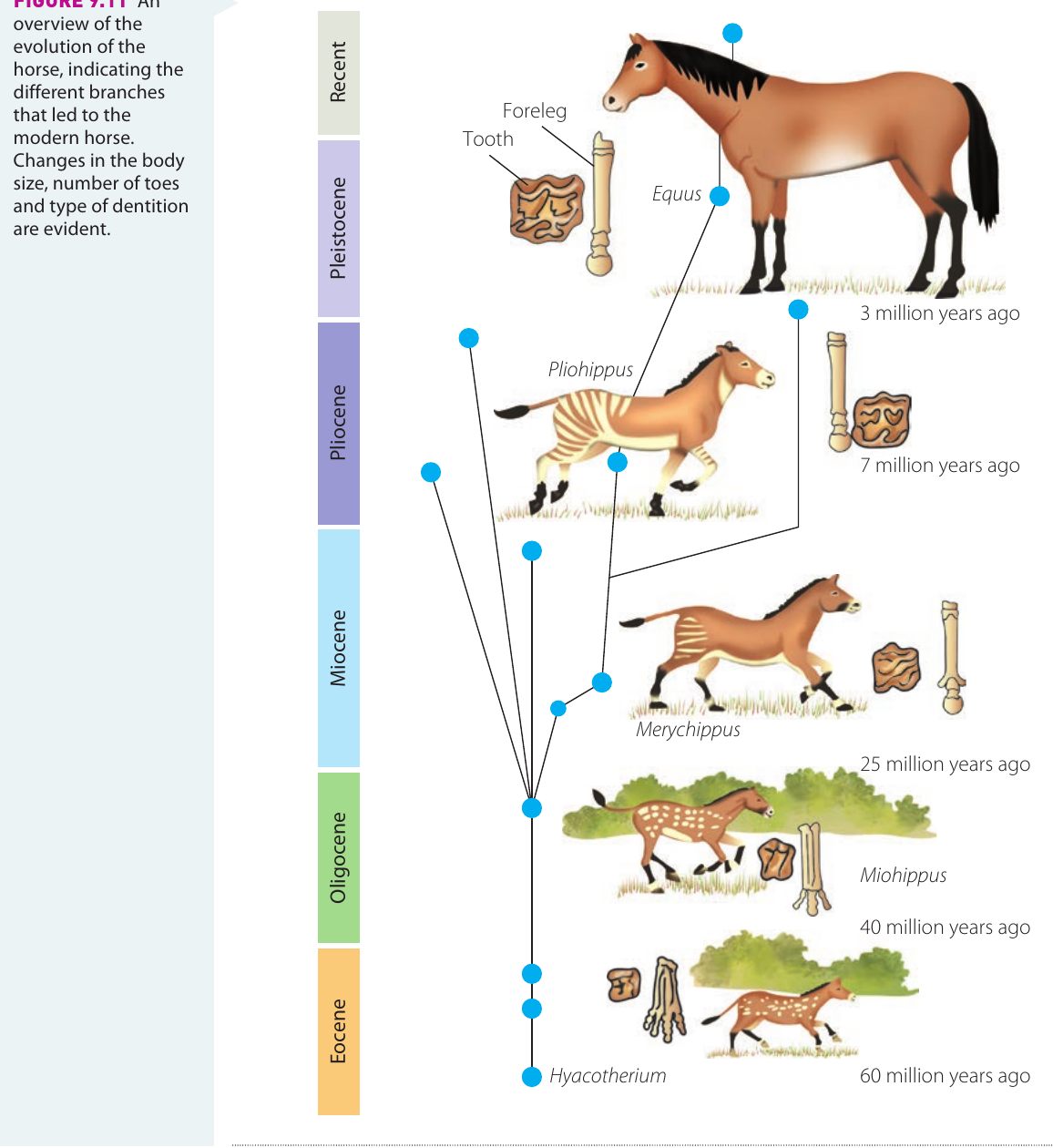
The diagram shows the evolutionary timeline of horses from the Eocene epoch ( million years ago) to the present. Note the branching nature of evolution - multiple horse species existed at the same time, and evolution did not follow a simple straight line.
Note
Key Observable Trends in Horse Evolution:
- Changes in body size (generally increasing)
- Reduction in number of toes (from four to one)
- Changes in dentition (teeth structure and function)
- Development of grinding tooth surfaces
Small horses of the Eocene epoch ( mya)
The first horse, Hyracotherium, looked more like a dog than a modern horse:
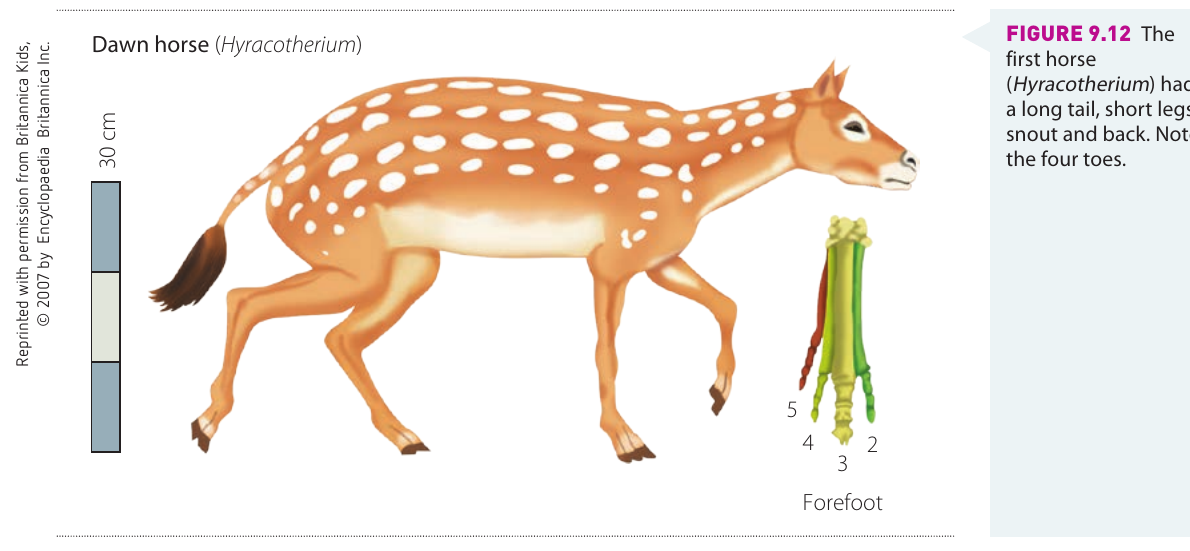
Characteristics of Hyracotherium:
- Height: approximately cm
- Had a long tail
- Short legs, snout, and back
- Four toes on the forefoot (numbered , , , )
- Diet: fruits and soft plant materials
- Short face with eye sockets positioned in the middle
- Low-crowned teeth with ridges
- Short diastema (space between front teeth and cheek teeth)
Important
As the environment changed, selection pressures favoured horses that were:
- Larger in size
- Had fewer toes
- Possessed teeth with grinding surfaces for tougher plant material
Medium-sized horses of the late Eocene and Oligocene ( mya)
During this period, the climate became drier, forests shrank, and grasses became more prevalent. This created selection pressure for:
- Eating tougher plant materials
- Increased body size
- Faster movement through grasslands
Key species from this period include Miohippus and Mesohippus.
Note
Around mya, the Mesohippus group began to radiate - meaning the group diversified rapidly from an ancestral species, allowing populations to occupy various available ecological niches.
Horses of the Miocene moving onto the plains ( mya)
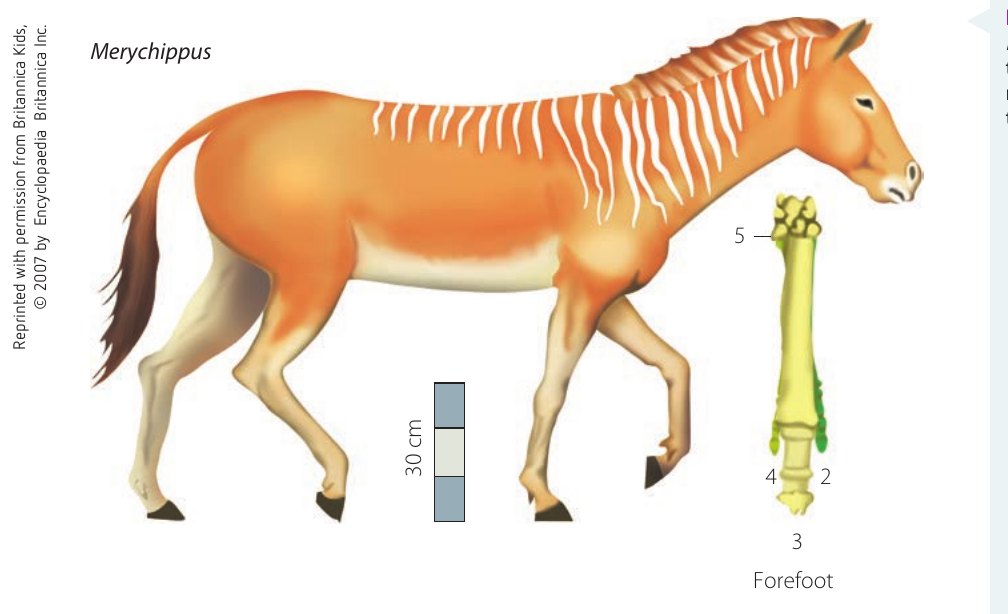
About mya, horses underwent several important changes:
Example
Example: Adaptations in Merychippus
Changes in Merychippus and related species demonstrate natural selection in response to grassland environments:
- Gradual increase in tooth crown height - better suited for grinding tough grasses
- Better running ability - escape from predators in open plains
- Increased body size and leg length - greater speed and endurance
- Fused leg bones allowing horses to stand on toe tips (adaptation for running)
- Three toes with shortened side toes
- Longer muzzle with eyes positioned on either side of the face
Horses of the late Miocene, Pliocene and Pleistocene ($5 mya onwards)
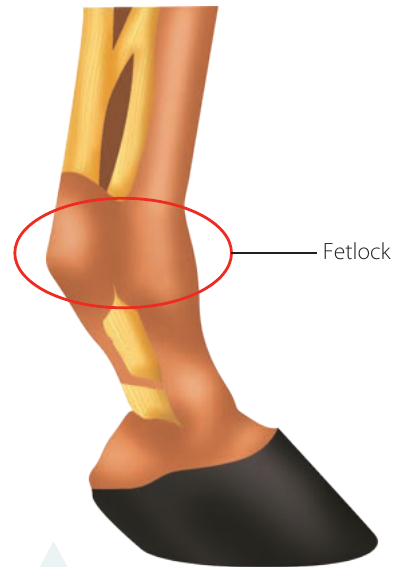
Pliohippus was the "grandfather" of modern horses and part of the merychippine line. This group led to the "true equines" - two groups that independently lost their side toes.
Important development: Side ligaments developed around the fetlock (ankle joint), stabilising the central toe for running.
Key species from this period:
- Pliohippus
- Astrohippus
- Dinohippus
- Equus (modern horses, asses, and zebras)
About mya, some species crossed from the Americas to Africa, Asia, and the Middle East via land bridges. Dinohippus is believed to be the closest relative to Equus.
Note
Equus is the only surviving genus in the horse family and has existed for the last million years. Fossils have been found on all continents except Australia and Antarctica.
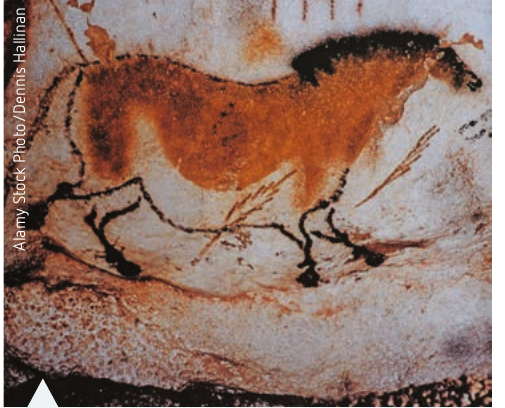
This cave painting provides additional evidence of horse evolution, supporting the fossil record.
How microevolution explains horse evolution
Modern theories explain horse evolution through microevolutionary changes in genes that drove speciation over time.
Genetic variation arises from:
- Mutations (changes to genetic material)
- Natural selection
- Genetic drift (variation in gene frequencies in small populations)
- Speciation (formation of new distinct species)
The process works as follows:
- Mutations occur: Random changes in genetic material create new variations
- Gene frequency changes: The mutation changes the frequency of specific genes in the population
- Genetic drift: In small populations, chance events can significantly change gene frequencies
- Population isolation: If a population becomes separated from the main group, it develops independently
- Selection pressure: Different environments select for different favourable genes
- Increased frequency of beneficial genes: Organisms with advantageous mutations breed and pass on these genes
- Speciation: The isolated population becomes so different that it can no longer interbreed with the original population, forming a new species
Example
Worked Example: Toe Reduction in Horses
A smaller population with a mutation for reduced toe number becomes isolated from the main horse population.
Step 1: Initial mutation The mutation occurs, creating horses with fewer, stronger toes in the isolated population.
Step 2: Selection pressure If this trait increases running speed on grasslands, these horses survive better and breed more successfully.
Step 3: Gene frequency increase The gene frequency for reduced toe number increases in this isolated population over many generations.
Step 4: Speciation Eventually, this population becomes different enough to form a new species that can no longer interbreed with the original population.
Evolution of the platypus
Australian mammals - a unique story
Australia is unusual because it has:
- An abundance of marsupials (pouched mammals like kangaroos and koalas)
- Monotremes (egg-laying mammals like the platypus and echidna)
- Very few placental mammals (mammals that nourish young via a placenta inside the mother's body)
Note
Understanding Mammal Types:
Marsupials: Give birth to live young at a very early developmental stage. Young continue development and receive nourishment in pouches.
Monotremes: Young develop and are nourished as eggs before hatching. Native only to Australia and New Guinea.
Placental mammals: Young develop inside the mother's body and receive nourishment through a placenta.
The puzzling platypus
The platypus is a monotreme native to eastern Australian rivers. It displays an unusual combination of features:
- Bird-like features: bill and webbed feet (similar to a duck)
- Reptile-like features: venom glands, egg-laying
- Mammal features: hair on body, suckle their young
This combination initially confused scientists. When the first platypus specimen arrived at the British Museum in , scientists examined it for stitching, thinking someone had sewn a duck's bill onto a mammal's body! Eventually, careful examination confirmed it was genuine.
Note
The platypus was originally named Platypus anatinus (Greek: platypous = flat-footed; Latin: anatinus = duck-like) in by Dr George Shaw. The name was later changed to Ornithorhyncus anatinus when scientists discovered the name "platypus" had already been given to a beetle (Greek: ornitho = bird-like; rhyncus = snout).
Evolutionary relationships
The platypus fossil record is very poor compared to the horse. However, genetic and fossil evidence provides important clues about its evolution.
Ancient reptiles called cynodonts are believed to be the earliest ancestors of all mammals.
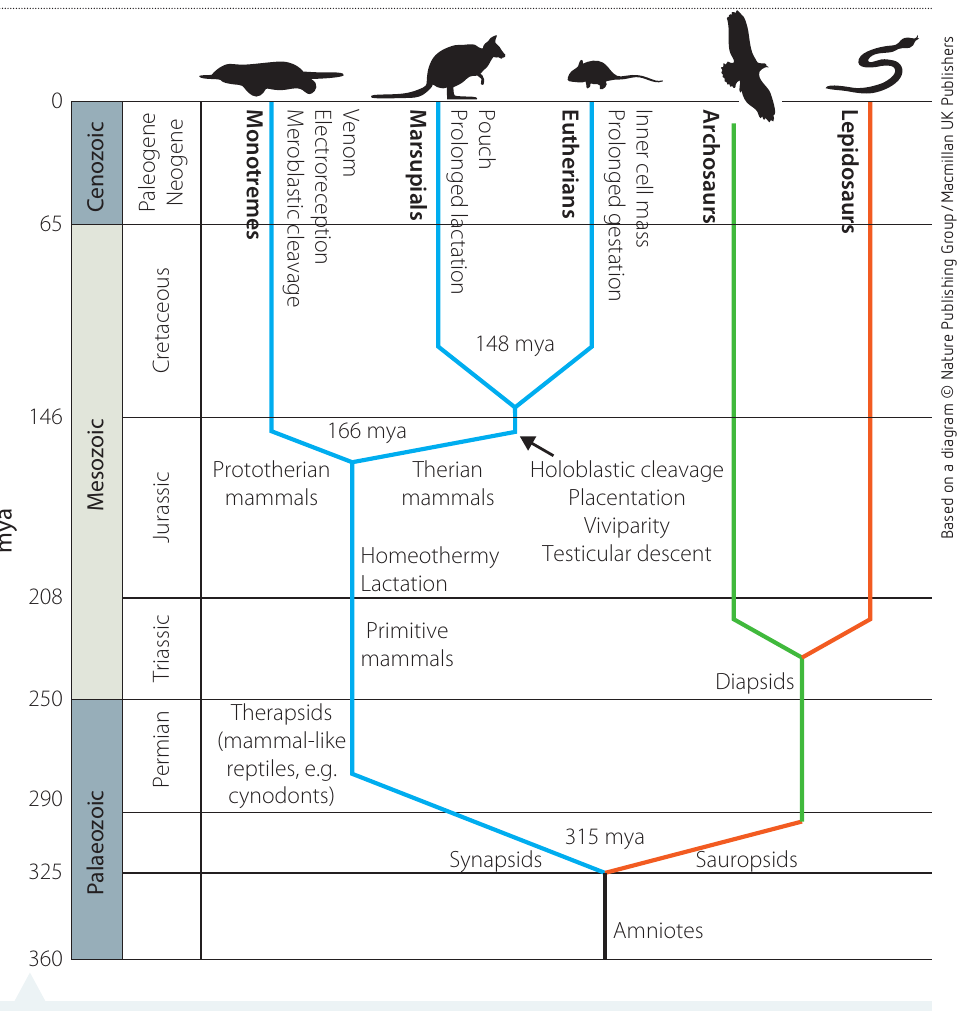
This cladogram shows the evolutionary relationships between major vertebrate groups. Key points to understand from the diagram:
Major divergence points:
- Synapsids (mammal line) and Sauropsids (reptile/bird line) split million years ago
- Monotremes split off first around mya
- Marsupials and placentals diverged around mya
Note
Important Evolutionary Innovations:
The cladogram shows key adaptations that arose at different points:
- Homeothermy (maintaining constant body temperature)
- Lactation (milk production)
- Viviparity (live birth)
- Placentation (placenta development)
- Testicular descent
The platypus and echidna share a common ancestor that lived approximately mya, based on DNA analysis and fossil evidence.
Genetic evidence
Comparing the genomes of platypus, marsupial, and placental mammals reveals that approximately of genes are common to all groups.
Key genetic findings:
Yolk production: The platypus has a gene for yolk protein production (absent in humans) because it lays eggs with yolk.
Lactation: All three groups (monotremes, marsupials, placentals) have genes related to tooth production and milk protein production. This tells us that milk production ability arose before the Jurassic period, before these groups diverged.
Important
Venom production: Both platypus and some reptiles produce venom, but genetic studies show these abilities arose independently. They result from different mutations (duplications) of the same gene in separate lineages, not from a common venomous ancestor.
Why monotremes survived in Australia
Fossil evidence shows monotremes once lived in South America (a fossilised tooth found in Argentina, dated mya), and placental mammals once lived in Australia (fossilised tooth from mya).
Why did monotremes survive in Australia but not South America, while placental mammals disappeared from Australia?
Note
Natural Selection Explanation:
- As Australia drifted northward, the continent became drier and hotter
- Marsupials and monotremes have lower resting metabolic rates than similar-sized placental mammals
- They could survive using less energy in harsh conditions
- Australia had only three carnivorous mammal species (marsupial lion, thylacine, carnivorous kangaroo) compared to $60 predator species in South America
- Fewer predators meant better survival chances for monotremes and marsupials in Australia
Fossil evidence for platypus evolution
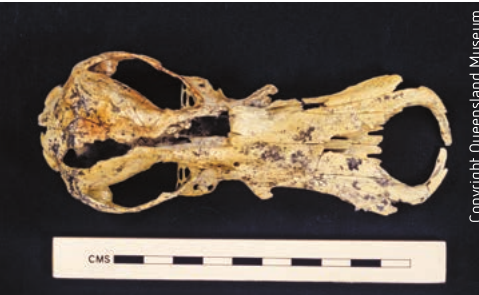
Four extinct platypus-related species have been found in Australia:
Modern platypus compared to ancestors:
- No longer has teeth (has horny pads instead)
- Highly evolved electroreception system in the bill for detecting prey in murky water
- More restricted distribution (now only found in eastern Australian river systems)
Example
Example: Obdurodon dicksoni (Miocene epoch)
This fossil species shows how the modern platypus evolved to become more specialised:
- Much larger than modern platypus
- Had functional teeth
- Ate small frogs
- Bill was considerably bigger than modern species
These differences show that the modern platypus lost teeth and developed specialised feeding adaptations over time.
Other fossil species:
Steropodon galmani:
- Found in New South Wales
- One of the oldest Australian mammals ( mya, Cretaceous period)
- Jaw fragments show significant differences from modern platypus
Important
The fossil evidence indicates the modern platypus is more specialised than its ancestors, not a "primitive" survivor as once thought. It is a highly evolved form.
Macroevolution in the platypus
The evolution of the platypus represents macroevolution because it:
- Occurred over a very long time period (more than million years)
- Resulted in the evolution of new species
- Shows major anatomical and physiological changes
Central question: Is macroevolution simply an accumulation of many microevolutionary changes over a long period? Scientists continue to study this question using genetic and fossil evidence.
Remember!
Summary
Key Points to Remember:
-
Microevolution involves small-scale changes within populations over shorter time periods and generally does not produce new species.
-
Macroevolution occurs over millions of years and results in new species and larger groups (families, orders).
-
The main mechanisms driving evolution are mutations, natural selection, genetic drift, and migration.
-
Selection pressures (environmental change, competition, predation, disease) determine which organisms survive and reproduce.
-
The horse provides an excellent example of evolution because of its complete fossil record showing branching evolution over million years, with clear changes in body size, toe number, and teeth structure.
-
The platypus demonstrates macroevolution and shows that modern species can be more specialised than their ancestors, not simply "primitive" survivors.
-
Genetic evidence combined with fossil evidence helps us understand evolutionary relationships and the timing of species divergence.