Population Genetics – Mutation, Gene Flow, and Genetic Drift (HSC SSCE Biology): Revision Notes
📚Revision Notes
Population Genetics – Mutation, Gene Flow, and Genetic Drift
Introduction to population genetics
The genetic diversity we see in plant and animal populations today has arisen through two main processes: populations spreading across the globe and adapting to their local environments. As organisms colonise new areas, they face different environmental challenges and opportunities, leading to genetic changes over time.
Note
New alleles (different versions of genes) can enter a population in two ways:
- Mutation: Random changes in DNA create entirely new alleles
- Gene flow: Movement of individuals between populations through immigration (arrival of new individuals) and emigration (departure of existing individuals)
Genetic diversity is the result of a large number of variants (different alleles) that may be present for each gene and a large number of genes that may be present for each trait (polygenic traits).
Understanding polygenic traits
Many traits in organisms are not simple "either/or" characteristics. Unlike Mendel's pea plants that were either tall or short, many traits are polygenic, meaning they are controlled by multiple genes, each with multiple alleles.
Human height provides an excellent example of a polygenic trait. Because many genes contribute to height, and each gene has different possible alleles, there are numerous possible genotypes and phenotypes. This creates a continuous distribution of heights rather than distinct categories.
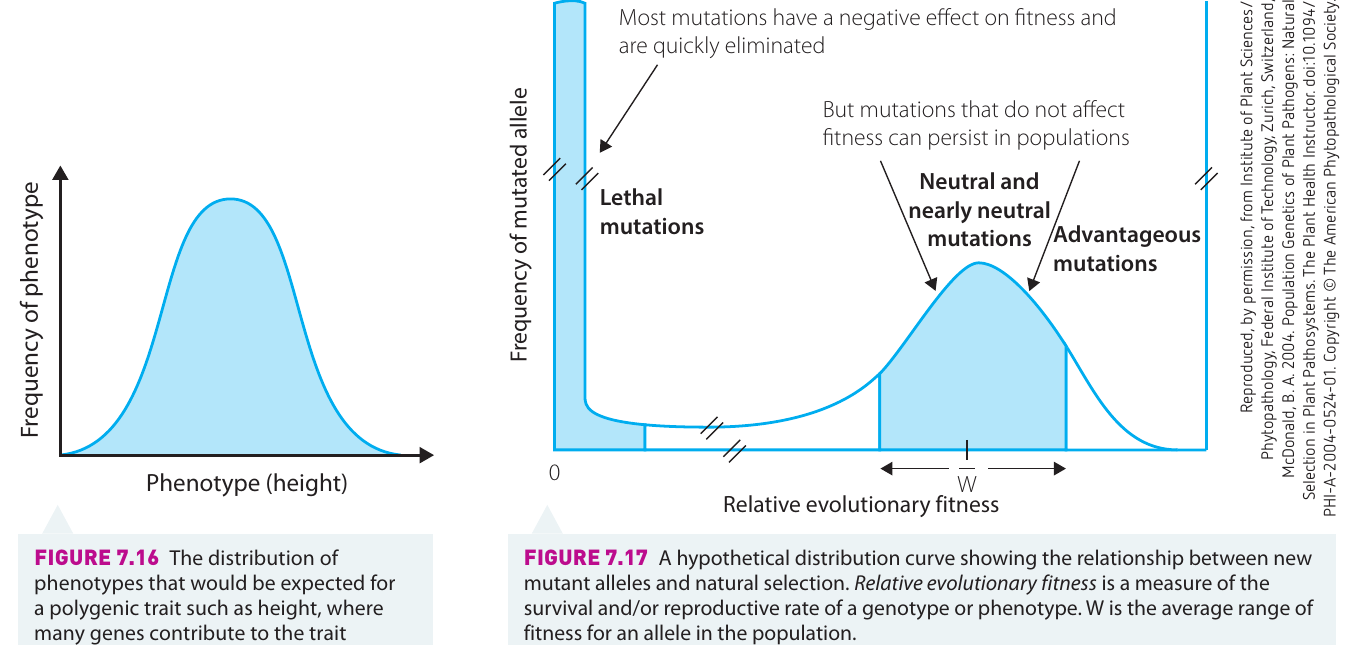
When you measure the height of many individuals in a population and plot the frequency of each height, the resulting graph shows a characteristic bell-shaped curve called a normal distribution curve. Most individuals cluster around the average height, with fewer individuals at the extremes (very tall or very short).
Note
Understanding the Bell Curve:
The normal distribution curve is a fundamental pattern in nature. For polygenic traits, most individuals have intermediate phenotypes (the tall central peak), while extreme phenotypes become increasingly rare as you move toward either end of the distribution. This pattern emerges naturally when multiple genes contribute to a single trait.
Mutations and their effects on fitness
Mutation is one of the primary sources of genetic variation, affecting the phenotype (observable characteristics) that natural selection acts upon. However, not all mutations are equally beneficial.
The graph above illustrates how different mutations affect relative evolutionary fitness (a measure of the survival and/or reproductive rate of a genotype or phenotype). Mutations fall into three main categories:
- Lethal or highly detrimental mutations: These have such negative effects on fitness that they are quickly eliminated from the population. They represent the tallest, narrowest peak near zero fitness on the graph.
- Neutral and nearly neutral mutations: These mutations have little or no effect on an individual's fitness. They can persist in populations and represent an evolutionary "backup" – providing variation that might become useful if the environment changes suddenly.
- Advantageous mutations: These are rare but increase fitness. They are selected for and become more frequent in the population over time.
Important
Critical Concept: Mutation Effects
Most mutations have a negative effect on fitness and are quickly eliminated from the population. The majority of mutations that persist are neutral or nearly neutral – they don't significantly harm the organism. Only a small fraction of mutations are actually beneficial, but these are the ones that drive adaptive evolution.
What is population genetics?
Population genetics is the study of how a population changes over time, leading to species evolving. It involves quantitative analysis (examining numerical data) to understand how genetic variation is distributed within a population.
A population is a group of individuals of a species that live in a common area and are interbreeding.
Allele frequency is a measure of how often an allele occurs in a population.
Population geneticists study the factors that cause increases or decreases in allele frequency within populations. Importantly, natural selection is not the only mechanism driving these changes.
Note
Sometimes individuals survive and reproduce simply by chance rather than because they possess advantageous traits. This random element is just as important to evolution as natural selection itself.
Factors causing changes in allele frequency
Five main factors influence how allele frequencies change within populations over time. Understanding these factors is crucial for predicting evolutionary changes.
1. Selective pressure (natural selection)
Selective pressure causes changes in allele frequency because variations that make individuals better suited to their environment become more common. This is Darwin's concept of natural selection – the primary driving force for evolution.
When an allele confers an advantage (making an individual more likely to survive to reproductive age and successfully reproduce), that allele increases in frequency in the population. Conversely, alleles that reduce survival or reproductive success decrease in frequency or are eliminated.
2. Sexual selection
Sexual selection changes allele frequency through non-random mating. Not all individuals in a population have equal mating success. Some individuals possess traits that make them more attractive to potential mates or more successful at competing for mating opportunities.
The genes of the most successful maters remain in the gene pool at higher frequencies, even if these traits don't necessarily improve survival. This is why some organisms have elaborate features (like peacock tails) that might seem disadvantageous for survival but are advantageous for reproduction.
3. Mutation
Mutation leads to the formation of new alleles through changes or "errors" in DNA that occur during gametogenesis (the production of sex cells through meiosis). During fertilisation, these new alleles – whether beneficial, neutral, or harmful – are passed to the next generation.
Mutations that prove useful (beneficial) will tend to increase in frequency through natural selection, while harmful mutations are typically eliminated. Neutral mutations may persist without being selected for or against.
Note
The Role of Neutral Mutations:
Neutral mutations are often overlooked, but they serve as an important reservoir of genetic variation. If environmental conditions change dramatically, a previously neutral mutation might suddenly become advantageous, giving the population the raw material for rapid adaptation.
4. Genetic drift
Genetic drift causes changes in allele frequency due to random chance rather than genetic fitness. This means individuals may differ from one another not because they are more successful, but simply due to luck.
Genetic drift can occur through:
- Bottleneck effect: A natural disaster or event dramatically reduces population size. The survivors may not represent the original population's genetic diversity, and their alleles become more frequent simply because they happened to survive.
- Founder effect: A few individuals become geographically isolated from the original population and establish a new population. These founding individuals may carry alleles at different frequencies than the original population.
Important
Population Size Matters:
The effect of genetic drift is greater in smaller populations, where random events have a more significant impact on allele frequencies. In a small population, the loss of even a few individuals can dramatically alter the genetic composition of the entire group.
5. Gene flow
Gene flow changes allele frequency through the mixing of new individuals into a population. When individuals immigrate (enter a population), they bring different alleles that spread through interbreeding. Similarly, when individuals emigrate (leave a population), their alleles may be lost.
Important
Gene Flow and Population Size:
Like genetic drift, gene flow has a more noticeable effect in smaller populations. The arrival or departure of just a few individuals can significantly shift allele frequencies in a small population, while the same movement might have minimal impact in a larger population.
Fixed alleles
Sometimes an allele may become fixed in a population, meaning it becomes the only remaining allele for that gene, having outcompeted all other variants. This is unusual because most genetic variations provide only small benefits or no benefit at all. When an allele is fixed, all individuals in the population carry that allele.
Note
Why Fixed Alleles Are Rare:
Fixation typically requires either very strong selective pressure favoring one allele or random drift in a small population. Most genes maintain multiple alleles because different variants may be advantageous under different conditions, or because the variations don't significantly affect fitness.
Historical foundations of population genetics
Progress in population genetics builds on the work of earlier scientists, particularly Mendel and Darwin. Modern population geneticists use mathematical models that incorporate their findings to make predictions about how populations will change.
Mendel's contributions
Mendel's laws of inheritance established that:
- Each parent donates one allele for every gene to their offspring; therefore, offspring have two alleles for every gene
- Some alleles are dominant and expressed whether present in one or two copies
- Other alleles are recessive and only expressed when not paired with a dominant allele
Darwin's contributions
Darwin's theory of natural selection established that:
- Natural selection is the primary driving force for evolution
- If a gene confers an advantage, it is more likely to be passed to the next generation
These fundamental principles allow scientists to predict how genetic composition will change when populations face evolutionary selective pressures.
Human genetic variation
Although all humans are genetically very similar, no two humans (except identical twins at birth) are genetically identical. In terms of DNA sequences:
- All humans are $99.9%$ similar to each other
- We share $99%$ of our genes with chimpanzees
- We share $60%$ with chickens
Even the difference between individual humans represents hundreds of thousands of base pairs. The human genome consists of approximately (3 billion) base pairs, meaning about (6 million) base pairs differ between individuals.
Note
Studying Human Genetic Variation:
Scientists often study SNPs (single nucleotide polymorphisms) – single base pair variations – rather than sequencing entire genomes. SNP studies help identify variations associated with particular traits, disease susceptibility, and responses to medications. This approach is more efficient and cost-effective than full genome sequencing.
Summary of factors affecting allele frequency
| Factor | What it is | Change in alleles is due to | Effect on the next generation |
|---|---|---|---|
| Selective pressure | The main selective pressure is natural selection | Variations that are passed on because they make individuals more likely to survive and reproduce | Alleles that make individuals 'fitter' (more likely to survive to reproductive age) become most frequent |
| Sexual selection | Certain individuals are more attractive to mates and therefore more likely to breed | Non-random mating (some individuals mate more than others) | Alleles of individuals who are most successful at mating are more common in the gene pool |
| Mutation | New genes arise due to 'errors' in DNA replication during meiosis; mutations may be beneficial, neutral, or harmful | New alleles arising during gametogenesis being introduced into a population | New alleles that are beneficial become more frequent in the population |
| Genetic drift (more obvious in smaller populations) | Random events (e.g. a natural disaster) lead to a change in gene frequency because some individuals are eliminated | Random chance (non-selective; does not depend on genetic make-up) | Causes individuals within a population to be different (not necessarily more successful) due to random chance |
| Gene flow (more obvious in smaller populations) | Individuals with different genes enter or leave a population and spread their alleles | Mixing with new genetically different individuals (e.g. immigration, emigration) | Allele frequency in the population changes |
Summary
Key Points to Remember:
-
Population genetics studies how populations change over time through changes in allele frequencies, leading to evolution.
-
Five main factors affect allele frequency: selective pressure (natural selection), sexual selection, mutation, genetic drift, and gene flow. The first three act in all populations, while genetic drift and gene flow have greater effects in smaller populations.
-
Most mutations are harmful and are quickly eliminated. Neutral mutations can persist as an evolutionary "backup," while rare beneficial mutations increase in frequency.
-
Polygenic traits (controlled by many genes with multiple alleles) show continuous variation, typically producing a normal distribution curve when graphed.
-
Although natural selection is the primary driver of evolution, random chance (genetic drift) and movement of individuals (gene flow) also significantly influence which alleles persist in populations over time.