Types of Mutations (HSC SSCE Biology): Revision Notes
📚Revision Notes
Types of Mutations
Introduction to mutations
Genes work because their base pairs are arranged in a specific order, just like words get their meaning from letters being in the right sequence. When this sequence changes, we call it a mutation - any change in the DNA sequence.
Note
The analogy of letters forming words helps us understand mutations: just as changing one letter can change a word's meaning (or make it nonsense), changing DNA bases can alter how genes function.
Mutations can be classified using five different criteria, which helps us understand what type of change has occurred and what effects it might have.
Classification of mutations
Understanding mutations involves looking at them from five different perspectives. Each perspective tells us something important about the mutation.
By origin
Mutations arise in two main ways:
Spontaneous mutations happen randomly during normal cell processes. They occur naturally when errors are made during DNA replication, even though cells have proofreading mechanisms. These are like typos that slip through when copying a document.
Induced mutations are caused by environmental factors that increase the chance of DNA changes. These environmental agents can be chemicals (like those in tobacco smoke) or radiation (like UV rays from the sun or X-rays). These agents interfere with DNA structure and make mutations more likely to occur.
By amount of genetic material changed
Mutations can affect tiny sections of DNA or massive chunks of chromosomes:
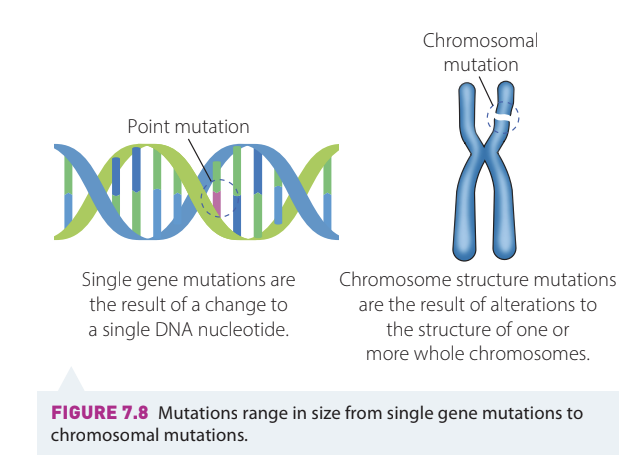
Point mutations (also called gene mutations) change just a single base pair in the DNA sequence. Despite being small, they can significantly affect the organism because they alter the instructions for making proteins. Think of changing one letter in a word - sometimes it completely changes the meaning.
Chromosomal mutations are much larger changes that move whole blocks of genes around. These can shift genes to different parts of the same chromosome or even to completely different chromosomes. The scale is like moving entire paragraphs around in a document rather than changing single letters.
Note
Frameshift mutations can result from either point mutations or chromosomal mutations. They affect how the genetic code is read and can impact single genes or sequences of genes.
By effect on DNA structure
When we look at what actually happens to the DNA, mutations change the sequence in three main ways:
A substitution swaps one nucleotide base for another. For example, a cytosine () might be replaced by thymine (), guanine (), or adenine ().
An insertion adds extra nucleotide bases into the sequence.
A deletion removes nucleotide bases from the sequence.
These changes affect which amino acids get incorporated into proteins during translation. Sometimes the change results in a different amino acid, but occasionally the new triplet code still produces the same amino acid as before.
By effect on phenotype
The impact on an organism's characteristics (phenotype) varies greatly:
Silent mutations cause no change in the phenotype. The DNA sequence changes, but the organism shows no difference in traits or characteristics.
Mutations can also cause small variations or large changes in phenotype. The size of the change depends on which amino acid gets substituted and where it occurs in the protein.
Important
Most mutations that change phenotype are harmful. They reduce the organism's chances of survival because they disrupt normal protein function. Mutations in genes coding for essential proteins are usually extremely severe - many are potentially lethal.
Rarely, mutations can be neutral (no real advantage or disadvantage) or even beneficial (improving survival chances). Beneficial mutations are very uncommon but important for evolution.
By heritability
Whether a mutation passes to future generations depends on where it occurs:
Somatic mutations occur in body cells (non-reproductive cells). These affect only the individual organism and cannot be inherited by offspring. For example, many cancers result from somatic mutations.
Germline mutations occur in reproductive cells (egg or sperm cells). These can be passed from parents to children and affect all cells in the offspring's body.
Note
Mutations in non-coding DNA may or may not cause severe effects, depending on whether that DNA sequence helps regulate gene expression.
Point mutations
What is a point mutation?
A point mutation is a single nucleotide variation - just one "letter" in the genetic code changes. Although this seems small, point mutations can have significant effects on an organism's characteristics. This is especially true when they occur within the exon (coding region) of a gene or in an intron where they affect how the gene is expressed.
Base substitution
Base substitution happens when one nucleotide base is swapped for a different base. For instance, might be replaced by , , or . This type of change usually results in a different amino acid being inserted into the polypeptide chain during protein synthesis.
Example
The Word Analogy for Base Substitution
Think of it like changing one letter in a word. If the word "TAG" becomes "GAG", the sentence containing that word will have a different meaning. Similarly, changing one amino acid in a protein can alter how that protein functions.
A well-known example is the sickle cell mutation in human red blood cells. The DNA triplet changes to (and the complementary strand changes from to ). This single change swaps the amino acid glutamate for valine, which alters the shape of the haemoglobin molecule. This causes red blood cells to become sickle-shaped instead of round, leading to sickle cell anaemia.
Frameshift mutations
A frameshift mutation occurs when a single nucleotide pair is inserted into or deleted from the DNA sequence. This shifts the entire "reading frame" of the genetic code.
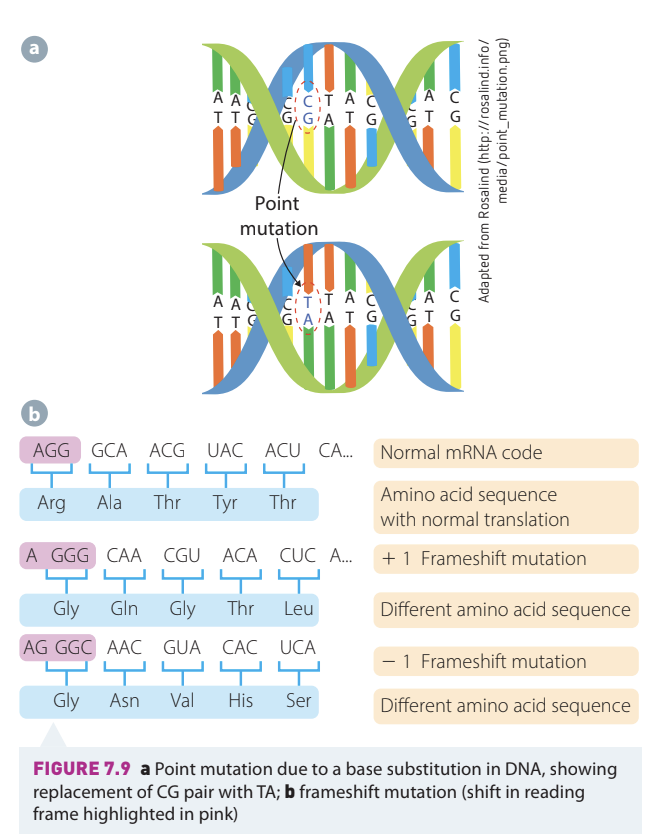
Understanding frameshift mutations requires knowing that mRNA bases are read in groups of three (triplets called codons). Each codon codes for one amino acid. When a single base is added or removed, it shifts how the triplets are grouped. Every codon beyond that point becomes different, leading to a completely different sequence of amino acids and usually producing a non-functional protein.
Example
Understanding Reading Frames: The Sentence Analogy
Imagine triplets in mRNA as three-letter words in a sentence:
Original: "THE DOG SAW THE CAT"
If we insert one extra letter at the start:
Result: "TTH EDO GSA WTH ECA T"
Complete nonsense! This is exactly what happens in a frameshift mutation - one small insertion or deletion changes everything that follows.
Important
Frameshift mutations can also arise when multiple bases are inserted or deleted, particularly if the number isn't a multiple of three. Any insertion or deletion that isn't in multiples of three will shift the reading frame.
Effects on proteins due to point mutations
Point mutations are also classified by their effect on the final protein product:
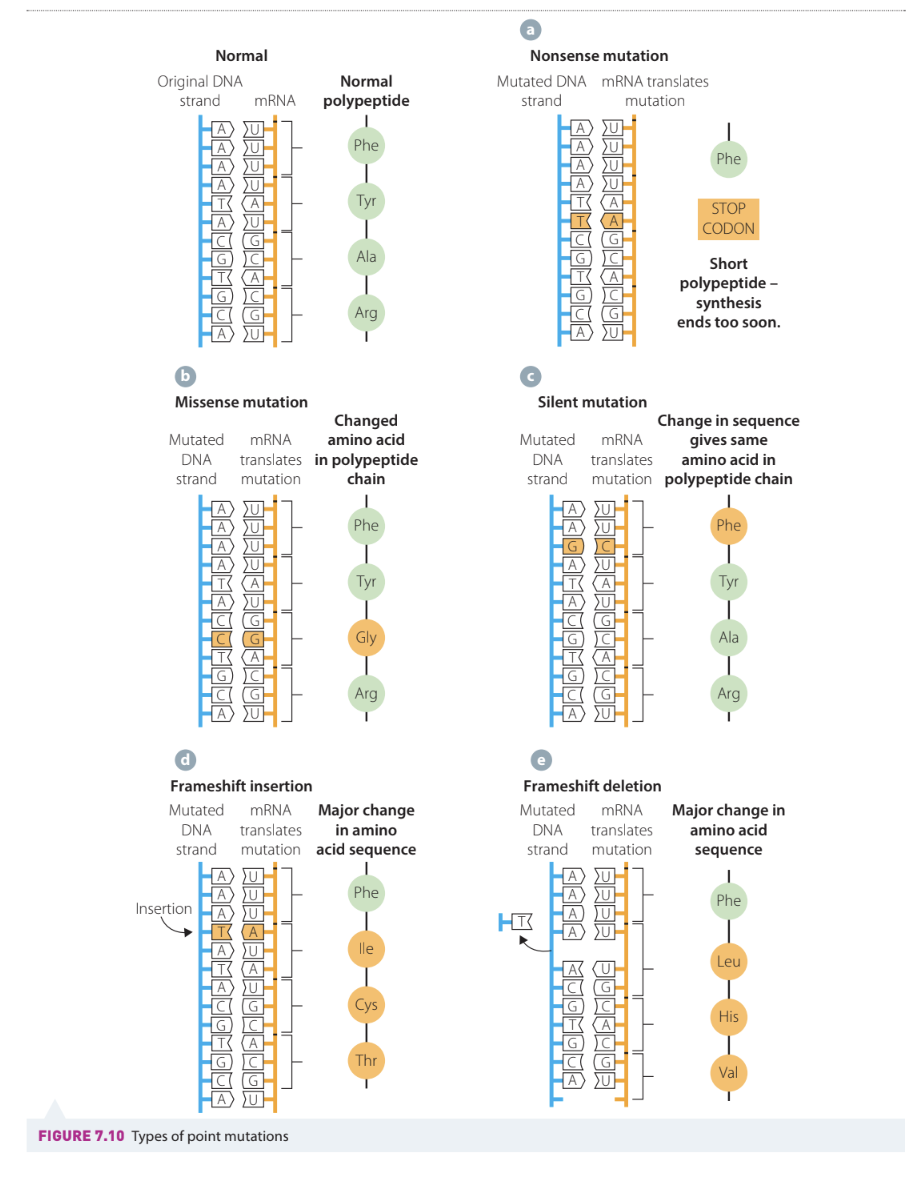
Nonsense mutations change an amino acid codon into a stop codon. This cuts the protein short, ending its synthesis too early. The resulting protein is usually completely non-functional because it's incomplete. This has a major effect on the organism's phenotype because the cell cannot make a working version of that protein.
Missense mutations result in one amino acid being swapped for a different amino acid. Whether this matters depends on the replacement amino acid. If it's chemically similar to the original, the protein might still function reasonably well. If it's very different, the protein's function can be severely disrupted. The sickle cell mutation described earlier is a missense mutation because the protein's "meaning" or function is changed.
Silent mutations change the DNA sequence but don't change the amino acid produced. This happens because the genetic code is redundant - multiple codons can code for the same amino acid. For example, both and code for the amino acid valine. If a mutation changes the third base from to , the same amino acid is still produced. Silent mutations have no noticeable effect on the protein or the organism's phenotype.
Neutral mutations change the DNA and result in a different amino acid, but the new amino acid is chemically similar to the original one. Because the amino acids have similar properties, the protein's structure isn't significantly affected, and it can still function normally.
Chromosomal mutations
What are chromosomal mutations?
Chromosomal mutations (also called chromosomal aberrations) are large-scale changes affecting entire sections of chromosomes. Unlike point mutations that change individual bases, chromosomal mutations can alter the overall structure of a chromosome or change the total number of chromosomes in a cell.
These mutations involve changes to a series of bases within a chromosome, not just single bases. This means they can affect multiple genes at once.
Changes in chromosome structure
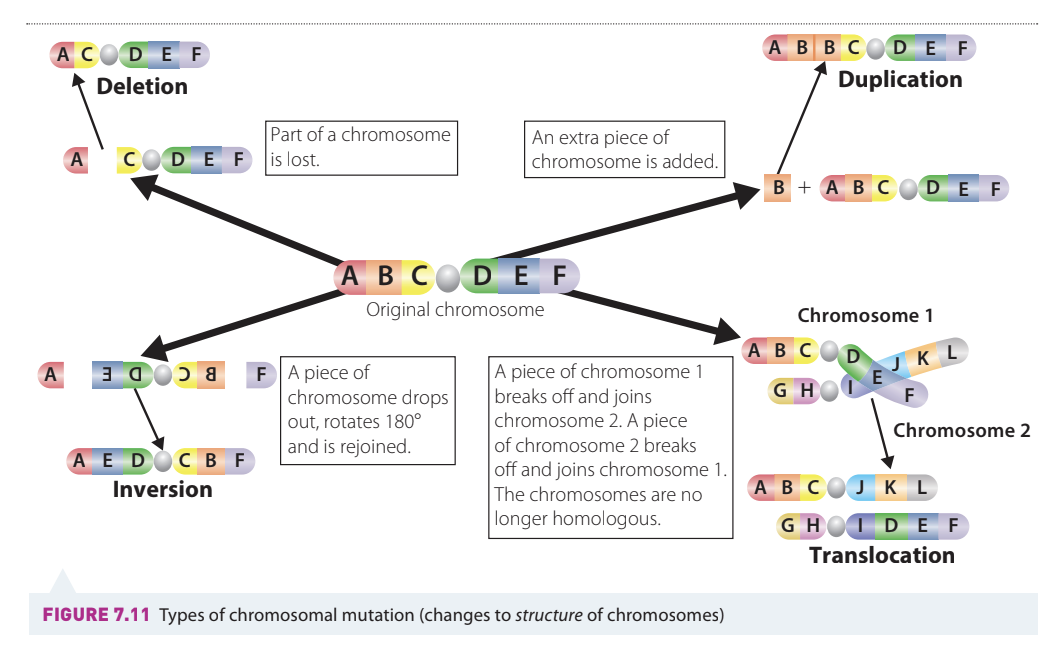
There are four main types of structural chromosomal mutations, each changing how genetic material is organized on chromosomes.
Note
Memory Aid: The Four Structural Changes
Remember "DDIT" for the four types:
- Deletion
- Duplication (Insertion)
- Inversion
- Translocation
Chromosomal deletion
Chromosomal deletion occurs when a section of DNA is removed and not replaced. This permanently reduces the number of genes on that chromosome. The missing genetic material means important instructions for making proteins are lost.
Deletions often result from exposure to harmful environmental factors like high heat, viruses, or radiation. These agents can break chromosomes, and if the broken piece is lost, a deletion occurs.
Chromosomal insertion (duplication)
Chromosomal insertion, also called duplication, happens when a portion of DNA is copied and the extra copy is inserted into the chromosome. This increases the number of genes on the chromosome because there are now multiple copies of certain genetic instructions.
The effect of a duplication depends on several factors:
- The size of the duplicated section
- Where the duplication occurs (in a coding region or non-coding region)
- How many times the sequence is repeated
Note
Sometimes the position matters more than the duplication itself. If the duplication occurs in an intron (non-coding region), it might have no effect. But if it's in an exon (coding region), it can significantly affect the protein produced.
Copy number variations occur when a DNA section is copied multiple times. Interestingly, the number of copies can determine whether the mutation has any effect. Some genetic conditions only appear when the number of repeats exceeds a certain threshold. Diseases like Huntington's chorea and fragile X syndrome are linked to having too many copies of certain DNA sequences.
Chromosomal inversion
Chromosomal inversion happens when a section of DNA is removed, rotated 180 degrees (turned back to front), and then reinserted into the chromosome. The bases end up in reverse order compared to the original sequence.
Inversions can vary greatly in size, ranging from a few hundred bases to five megabases (one megabase equals one million base pairs).
Example
Real-World Example: Haemophilia A
A well-known example is haemophilia A, which is caused by an inversion mutation in the factor VIII gene on the X chromosome. This mutation affects blood clotting and is inherited in an X-linked pattern.
Chromosomal translocation
Chromosomal translocation occurs when a section of DNA moves from one chromosome to a completely different (non-homologous) chromosome. This rearrangement can cause gene fusion, where the translocated region joins two genes that are normally separate.
Note
This is like cutting a paragraph from one page and pasting it into a different page - the content hasn't changed, but it's now in the wrong place and might combine with unrelated information.
Some scientists believe that ancient transposable elements (sometimes called "jumping genes") may be responsible for much of the non-coding DNA in our genomes today.
Changes in chromosome number: aneuploidy
Aneuploidy represents a different type of chromosomal mutation - instead of changing chromosome structure, it changes the total number of chromosomes in a cell.
Aneuploidy occurs when an entire extra chromosome is added or when an entire chromosome is missing. This leads to an abnormal chromosome count. In humans, who normally have 46 chromosomes, aneuploidy might result in 45 or 47 chromosomes.
Example
Down Syndrome: A Common Aneuploidy
Down syndrome is a well-known example of aneuploidy. Individuals with Down syndrome have an extra copy of chromosome 21, giving them 47 chromosomes instead of 46. This single extra chromosome affects many aspects of development and physiology.
Remember!
Summary
Key Points to Remember:
-
Mutations are changes in DNA that can be classified by five criteria: origin (spontaneous or induced), amount of genetic material affected, effect on DNA structure, effect on phenotype, and heritability
-
Point mutations change single nucleotide base pairs and include base substitutions and frameshift mutations, which can have major effects despite their small scale
-
Point mutations affect proteins differently: nonsense mutations create stop codons, missense mutations change amino acids, silent mutations have no effect, and neutral mutations cause minimal changes
-
Chromosomal mutations are large-scale changes including deletions (loss of DNA), duplications (extra DNA copies), inversions (DNA reversed), and translocations (DNA moved between chromosomes)
-
Aneuploidy changes the total number of chromosomes in a cell, like in Down syndrome where there's an extra chromosome 21