DNA Replication: The Watson and Crick Model (HSC SSCE Biology): Revision Notes
📚Revision Notes
DNA Replication: The Watson and Crick Model
What is DNA replication?
DNA replication is the process by which a cell creates two identical copies of its DNA from a single original molecule. This happens during interphase, before a cell divides through mitosis. The result is that each new cell receives an exact copy of the genetic instructions needed to control its basic life functions.
When a DNA molecule replicates, it produces two double-stranded DNA molecules from one original double helix. Each of these new molecules is identical to the original, ensuring genetic information is passed on accurately.
Note
The accuracy of DNA replication is crucial for maintaining genetic stability across generations of cells. Any errors that aren't corrected can lead to mutations that may affect cell function.
The Watson and Crick model of semi-conservative replication
After Watson and Crick discovered the double helix structure of DNA in 1953, they recognised that their model suggested how DNA could copy itself. They proposed that the two strands of DNA could separate, and each strand could serve as a template to build a new complementary strand.
This mechanism is called semi-conservative replication because each new DNA molecule contains one original ("conserved") strand and one newly synthesised strand. Think of it like keeping half of the old and making half new - hence "semi" (half) conservative.
Note
The semi-conservative model was later tested and validated by scientists Matthew Meselson and Franklin Stahl in 1958, who used special nitrogen isotopes to track old and new DNA strands. Their experiments confirmed that Watson and Crick's proposal was correct.
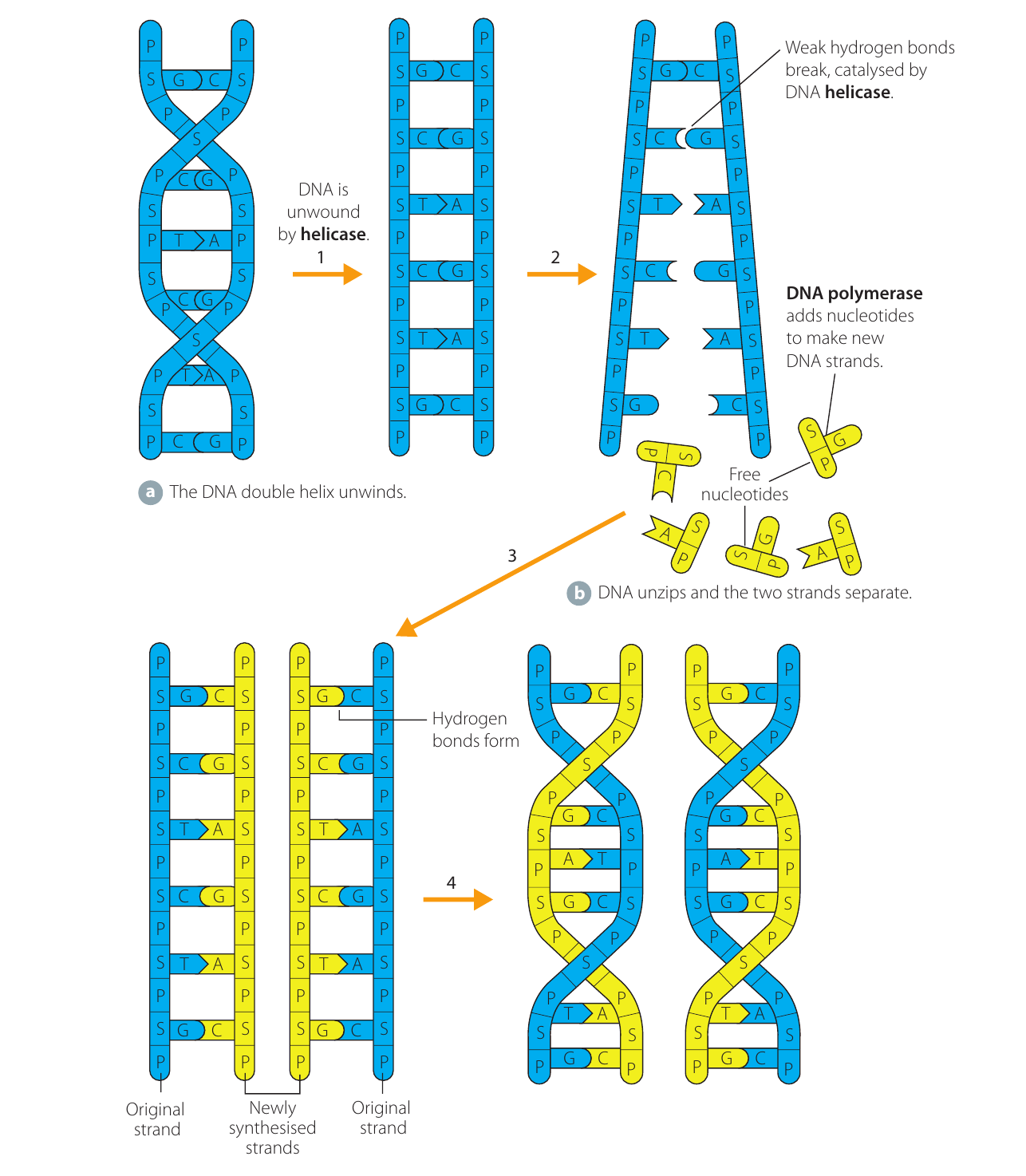
Why DNA replication is complex
Whilst the basic idea of DNA replication seems straightforward, the actual process is quite sophisticated. Several features add complexity:
DNA must unwind first - The DNA double helix has a spiral structure, so it must be unwound before the strands can separate.
Many simultaneous reactions - During replication, numerous physical and chemical reactions occur at the same time, each controlled by specific enzymes.
Important
Antiparallel strands - The two DNA strands run in opposite directions (one goes to , the other to ). Nucleotides can only be added in one direction - onto the free end. This antiparallel nature is why the two new strands must be built differently during replication.
Error correction needed - Occasionally mistakes happen during replication, and these need to be identified and fixed.
The four main steps of DNA replication
Step 1: The DNA double helix unwinds
The first stage involves unwinding the tightly coiled DNA structure. An enzyme called helicase causes the DNA helix to progressively unwind. This is essential because the strands cannot separate whilst they are still twisted around each other.
Step 2: DNA unzips and the two strands separate
Once unwound, the DNA strands need to separate. Helicase uses ATP (cellular energy) to break the weak hydrogen bonds that hold the complementary bases together. Think of DNA as a ladder - each "rung" splits down the middle, starting at one end of the molecule and creating a replication fork where the DNA is still joined further along.
Note
Special proteins called single-stranded binding proteins (SSBs) attach to the separated strands to keep them apart and prevent them from rejoining. This ensures the template strands remain accessible for the synthesis of new complementary strands.
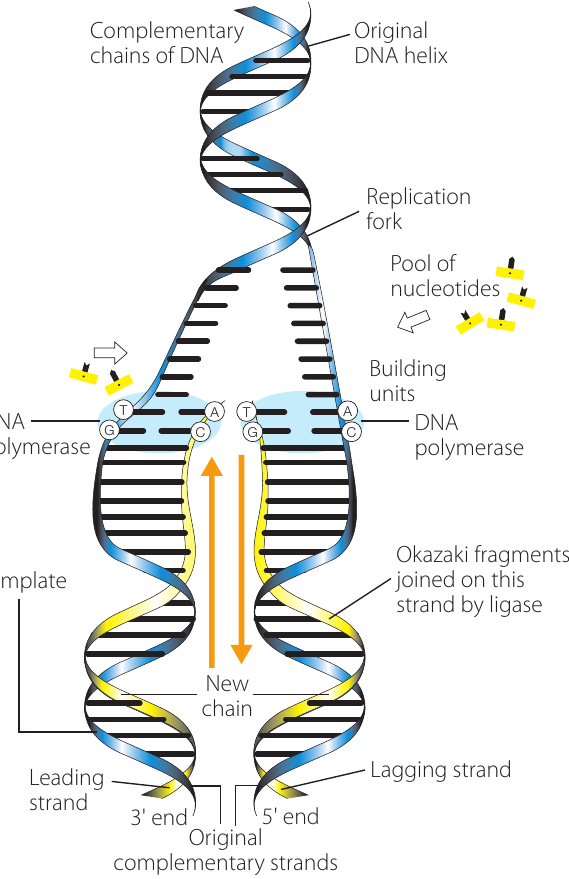
Step 3: Nucleotides are added alongside each single strand
Each separated strand now acts as a template for building a new complementary strand. This is where the actual copying happens.
Starting synthesis - Before DNA can be built, a short piece of RNA called a primer must be attached to the DNA strand. This primer is made by an enzyme called primase.
Adding nucleotides - The enzyme DNA polymerase III then adds DNA nucleotides one by one. It picks up free nucleotide units (each made of sugar-phosphate-base) from the surrounding nuclear fluid and places them opposite their complementary partner on the template strand.
Note
The base pairing rules are always followed:
- Adenine (A) pairs with thymine (T)
- Guanine (G) pairs with cytosine (C)
These complementary base pairs are held together by hydrogen bonds, ensuring accurate replication of the genetic code.
The leading and lagging strands - Because DNA strands are antiparallel and nucleotides can only be added onto the end, the two new strands are built differently:
- Leading strand: Nucleotides are added continuously in one long chain, moving in the same direction as the replication fork opens up. This is straightforward and efficient.
- Lagging strand: Nucleotides must be added in short segments called Okazaki fragments (about - nucleotides long), working backwards from the replication fork. This strand is built discontinuously in pieces.
Important
The enzyme ligase then joins the Okazaki fragments together to form one continuous strand on the lagging side. Without ligase, the lagging strand would remain as disconnected fragments rather than a complete DNA strand.
Step 4: Replication errors are identified and corrected
DNA replication includes built-in quality control mechanisms to ensure accuracy.
Proofreading - DNA polymerase I can move backwards along the new strand to "proofread" what has been built. If it finds an incorrect base, it removes the mistake and replaces it with the correct nucleotide.
Final checking - After the strands are sealed by ligase, another DNA polymerase enzyme performs a final check, looking for any remaining base pairing errors (mismatch repairs).
Note
Despite these careful checking mechanisms, a small number of errors still occur - approximately one mistake in every ten billion base pairs. When incorrect base pairing happens, this creates a change in the DNA sequence called a mutation.
Cells may pause the cell cycle during the phase to allow time for DNA repair to be completed before division occurs.
The final result - Each new DNA molecule contains one strand from the original DNA and one newly made strand. The two molecules rewind into the double helix shape, creating two identical copies of the original DNA.
Enzymes involved in DNA replication
DNA replication requires a team of enzymes working together, each with a specific role. Most errors in DNA are temporary because repair enzymes correct them immediately.
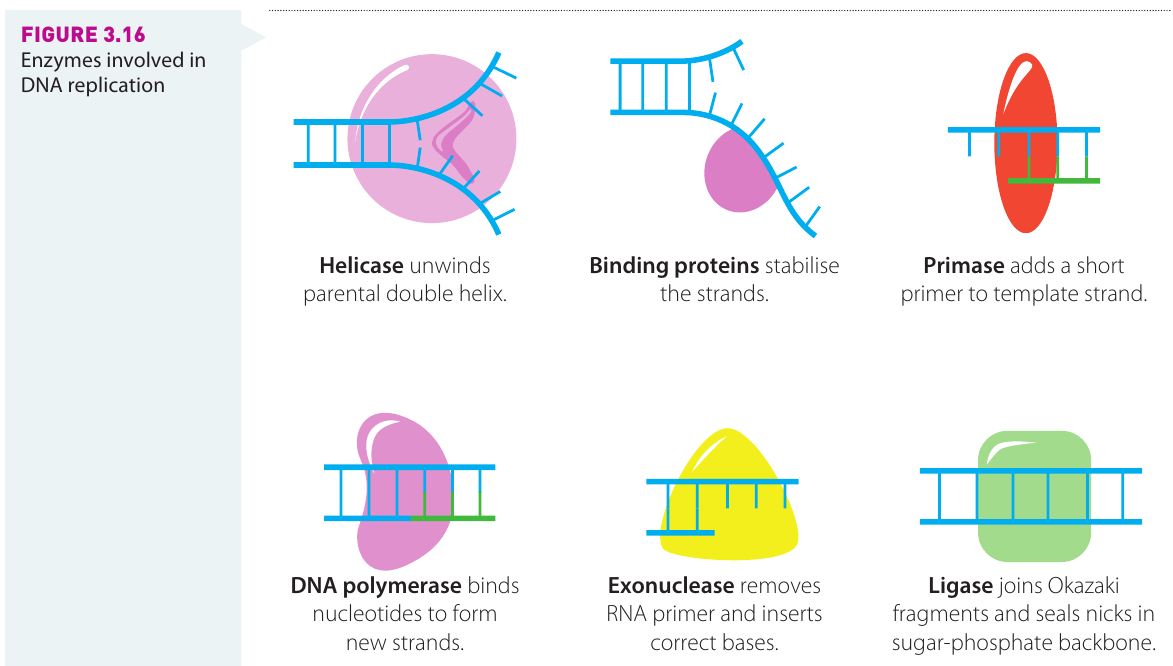
| Enzyme | Function in DNA replication |
|---|---|
| Topoisomerase (e.g. gyrase) | Relaxes the DNA from its supercoiled state, always working ahead of the replication fork |
| Helicase | Follows topoisomerase and unwinds the double helix by breaking hydrogen bonds between bases, causing the strands to separate and creating a replication fork |
| Primase | Attaches an RNA primer to the strand to initiate DNA replication; synthesises a short complementary RNA molecule that binds to DNA, serving as the starting point for DNA synthesis |
| DNA polymerase III | Builds new DNA strands using existing strands as templates; nucleotides are added to the growing strand from the end; joins phosphate groups to create phosphodiester bonds that form the sugar-phosphate backbone |
| DNA polymerase I | Mainly performs 'editing' - recognises and repairs base pairing errors (exonuclease activity); also removes primers ahead of the main synthesising enzyme |
| DNA polymerase II | Has an editing function but no exonuclease activity |
| Ligase | Connects and seals the two strands of the DNA molecule; joins Okazaki fragments together |
Exam tips
Note
Key Exam Points:
-
Remember the direction: DNA synthesis always occurs in the to direction, with nucleotides being added to the end.
-
Leading vs lagging: The leading strand is synthesised continuously, whilst the lagging strand is made in fragments. A good way to remember: "Leading is Long and continuous, Lagging has Lots of Little pieces (Okazaki fragments)."
-
Semi-conservative means half old, half new: Each new DNA molecule has one original strand and one new strand.
-
Enzyme sequence: Topoisomerase relaxes the DNA, then helicase unwinds it, primase adds primers, DNA polymerase III builds new strands, DNA polymerase I proofreads and removes primers, and ligase seals everything together.
Remember!
Summary
Key Points to Remember:
-
DNA replication produces two identical double-stranded DNA molecules from one original molecule, with each new molecule containing one old strand and one new strand (semi-conservative replication).
-
The process occurs in four main steps: unwinding the helix, separating the strands, adding nucleotides to form new complementary strands, and correcting errors.
-
Multiple enzymes work together in DNA replication, with helicase unwinding DNA, primase adding primers, DNA polymerase III synthesising new strands, and ligase joining fragments.
-
The leading strand is synthesised continuously, whilst the lagging strand is built in short Okazaki fragments that are later joined together.
-
Built-in proofreading mechanisms ensure accuracy, but approximately one error occurs per ten billion base pairs, which can result in mutations.