DNA in Prokaryotes and Eukaryotes (HSC SSCE Biology): Revision Notes
📚Revision Notes
DNA in Prokaryotes and Eukaryotes
Introduction to DNA across cell types
All living organisms share fundamental principles of molecular biology and genetics. The genetic code is universal, meaning the same nucleotide base-pairing code instructs protein synthesis in all living things, from simple bacteria to complex humans. This universal code provides strong evidence that all present-day cells evolved from a common ancestor.
Both prokaryotic and eukaryotic cells use similar mechanisms to translate information from DNA into polypeptides and proteins. However, whilst the basic principles are the same, important differences exist in how DNA is structured, packaged, and expressed in these two cell types.
Note
The fundamental unity of life's molecular machinery—using the same genetic code across all organisms—is one of the strongest pieces of evidence supporting evolutionary theory. This shared biochemistry suggests that all life on Earth descended from a common ancestor that used this same code billions of years ago.
Model organisms in molecular biology
Scientists have developed a common model system for studying molecular biology. Simple cells like the bacterium E. coli serve as excellent research models because they:
- Grow easily in laboratory conditions
- Divide rapidly (every minutes at )
- Model the same type of translation as eukaryotic cells
- Have precisely regulated metabolism
The main differences between bacterial and eukaryotic genetics occur at the level of gene expression (how DNA instructions are converted into products such as proteins).
Prokaryotic DNA
The term 'prokaryote' comes from Greek, meaning 'before nucleus'. These primitive cells have a much simpler structure than eukaryotic cells.
Location and structure of prokaryotic DNA
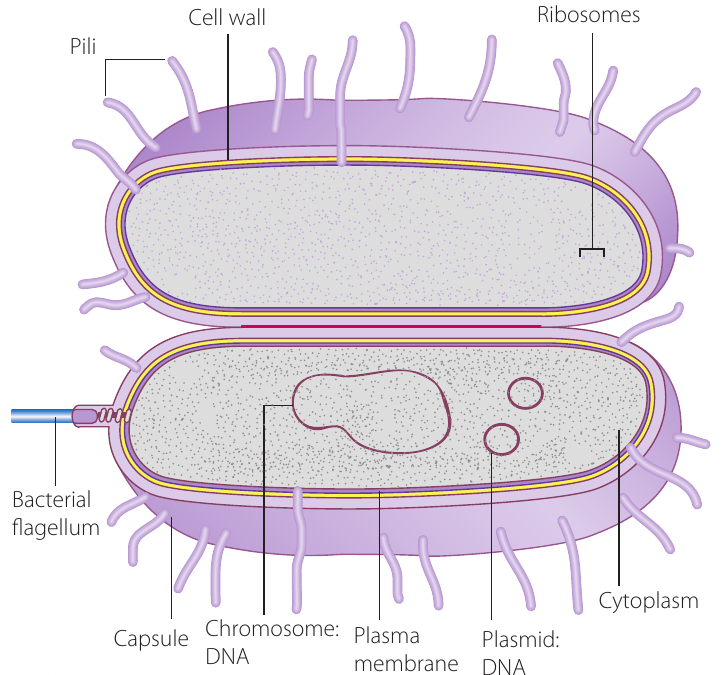
Prokaryotic cells contain a single chromosome in the form of a circular strand of DNA. This chromosome lacks a surrounding membrane and floats freely in the cytoplasm, in a dense region called the nucleoid. The DNA codes for proteins that will be synthesized on ribosomes in the surrounding cytoplasm.
Note
The circular prokaryotic DNA is double-stranded but not helical. Instead, it consists of two circles of single-stranded DNA twisted around each other, similar to two pieces of string where each joins at its own ends. The direction and number of twists contribute to the coiling and supercoiling of the circular DNA.
Non-chromosomal DNA: plasmids
In addition to their main chromosome, prokaryotic cells may contain one or more small rings of DNA called plasmids. These plasmids:
- Float separately in the cytoplasm
- Carry genes for non-essential features
- Often provide selective advantages (such as antibiotic resistance)
- Replicate independently of the main chromosome
Important
Plasmids are particularly important in genetic engineering and biotechnology applications. Their ability to replicate independently and carry specific genes makes them invaluable tools for inserting new genetic material into organisms.
Packaging of prokaryotic DNA
Prokaryotic DNA must fit into an extremely small space. For example, the circular chromosomal DNA of E. coli is approximately in length but must fit into a cell only about long.
Example
Worked Example: DNA Packaging in Prokaryotes
To understand the challenge of DNA packaging:
- DNA length in E. coli: = mm
- Cell length: = mm
- Ratio:
This means the DNA is approximately 433 times longer than the cell itself! Imagine fitting a 433-meter rope into a 1-meter box—that's the scale of the packaging challenge.
To achieve this compact packaging, the circular DNA becomes supercoiled and forms loops around a central protein scaffold to form the nucleoid. This dense protein differs from the histone proteins found in eukaryotic cells. The supercoiling and looping allow the large DNA molecule to fit efficiently into the small prokaryotic cell.
Gene regulation in prokaryotes
Through millions of years of evolution, prokaryotes have been exposed to varied selective pressures. Scientists believe this has led to the evolution of a highly refined mechanism for regulating gene expression called the operon system. This system allows prokaryotes to respond rapidly to environmental changes by switching genes on or off as needed.
Eukaryotic DNA
The term 'eukaryote' means 'true nucleus' in Greek, reflecting the presence of a membrane-bound nucleus containing the DNA.
Location and structure of eukaryotic DNA
Eukaryotic DNA is located in a membrane-bound nucleus within the cell. Individual DNA molecules are arranged into multiple separate chromosomes, and each chromosome is larger and more complex than the single prokaryotic chromosome.
Note
To illustrate the scale: the DNA of a single chromosome in the fruit fly Drosophila is in length, whilst each human cell contains approximately 2 metres of DNA arranged as chromosomes.
Chromosome numbers in eukaryotes
Interestingly, the number of chromosomes does not correlate with organism complexity. The table below shows the diploid chromosome number () for various eukaryotic organisms:
| Organism | Number of chromosomes () |
|---|---|
| Fruit fly (Drosophila melanogaster) | |
| Eastern grey kangaroo | |
| Earthworm | |
| Cat | |
| Peanut | |
| Human | |
| Orangutan | |
| Platypus | |
| Sheep | |
| Chinese giant salamander | |
| Horse | |
| Black mulberry |
Important
Note that the Chinese giant salamander has chromosomes but is less complex than a human with only chromosomes. This demonstrates that organism complexity is not determined by chromosome number but rather by other factors such as gene regulation and the complexity of genetic interactions.
Coding and non-coding DNA
A significant proportion of eukaryotic DNA is non-coding DNA—DNA sequences that are not directly used to make proteins or RNA. These non-coding sequences are called introns.
In humans, only approximately 3% of DNA is coding DNA. The coding sequences in DNA are called exons. The remaining 97% consists of introns and other non-coding sequences.
Note
Key definitions:
- Exons: DNA sequences that code for products such as proteins or RNA
- Introns: Non-coding DNA sequences
The exact function of non-coding DNA is still being researched, but scientists believe it plays important roles in:
- Spatial organisation of genes
- Control of gene expression
Important
Introns are almost never found in prokaryotes. Scientists have two main theories about this difference:
- Introns may have accumulated during eukaryotic evolution
- Introns may have been lost from prokaryotes as they evolved, simplifying their genome to allow rapid cell division
Packaging of eukaryotic DNA
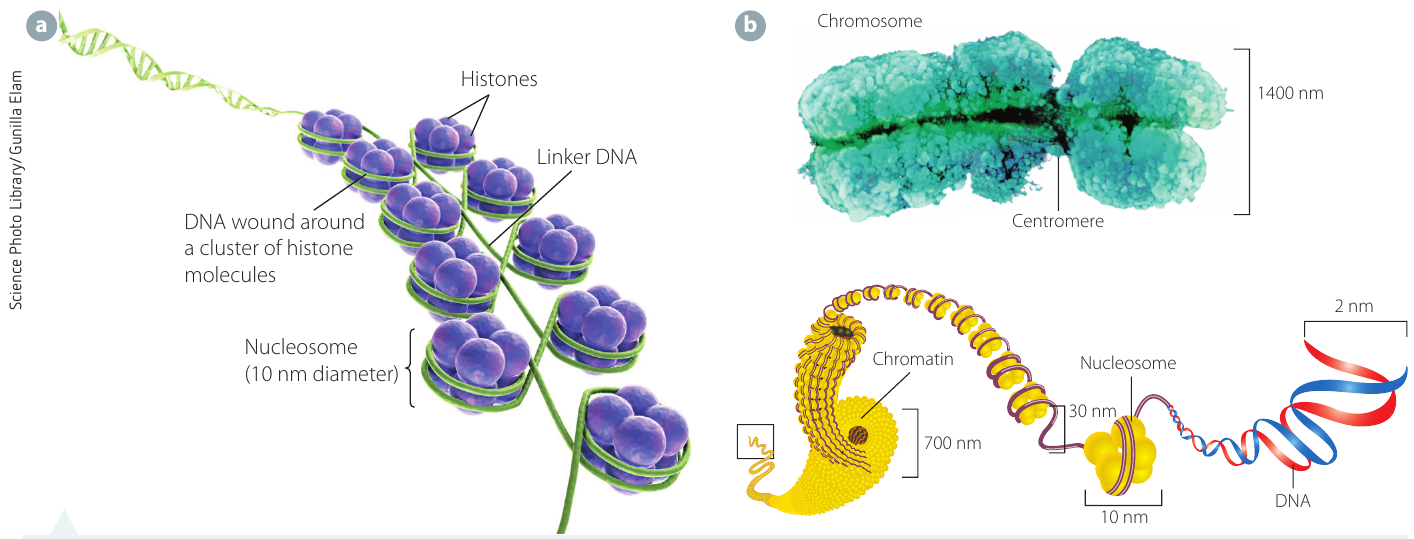
Eukaryotic DNA is linear (not circular) and winds tightly around proteins called histones. Unlike prokaryotic DNA, it does not supercoil. Instead, it coils in a way that forms nucleosomes—bead-like structures made up of long DNA sequences wrapped around eight histone protein cores.
Note
Think of nucleosomes like cotton wrapped around a cotton reel. The DNA wraps around the histone proteins in a similar manner. This elegant packaging solution allows eukaryotic cells to fit enormous amounts of DNA into the tiny space of the nucleus.
Key features of histone packaging:
- There are five main types of histones in eukaryotic cells
- All histones play a role in packaging DNA
- Histones contain many positively charged amino acids
- These positive charges allow binding to the negatively charged phosphate groups of DNA
- The nature of chromatin changes as cells progress through the cell cycle
- These changes are linked to histone binding
This packaging system is much more complex than the simple scaffold protein system in prokaryotes.
Non-nuclear DNA in eukaryotes
Mitochondrial DNA (mtDNA)
Mitochondria and chloroplasts are organelles in eukaryotic cells that contain their own DNA. This DNA, referred to as non-nuclear DNA, is inherited independently of nuclear (chromosomal) DNA.
Mitochondrial DNA (mtDNA) is found in the respiratory organelles (mitochondria) of all eukaryotic cells. The discovery of mtDNA has proved extremely useful in studies of evolutionary relatedness.
Maternal inheritance of mtDNA
During sexual reproduction, the egg and sperm each contribute half the zygote's nuclear DNA. However, sperm cells have very little cytoplasm, whilst the larger egg cell contributes all the cytoplasm and the organelles within it, including mitochondria.
Important
Because mitochondria have their own mtDNA and replicate independently of the nucleus, all mitochondria in a female lineage possess identical mtDNA (unless a mutation occurs). This allows scientists to trace maternal inheritance through generations.
Structure and characteristics of mtDNA
Mitochondrial DNA has distinctive features:
Size and structure:
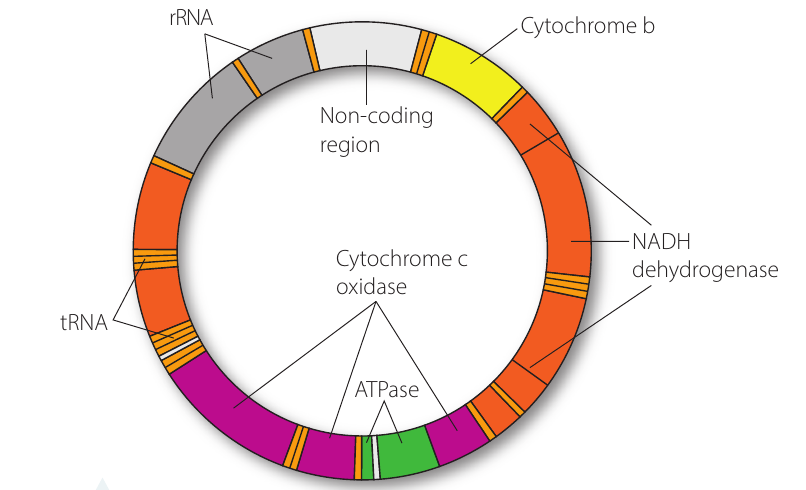
- Very small circular molecule ( in diameter)
- Only 37 genes (compared to approximately in human nuclear DNA)
- base pairs in humans (compared to approximately billion base pairs in human nuclear DNA)
Gene content:
- genes make proteins for the electron transport chain during cellular respiration
- genes make transfer RNA (tRNA)
- genes make ribosomal RNA (rRNA)
Abundance:
- Each mitochondrion contains approximately 5-10 circular DNA molecules
- Each cell has between 100 and 1000 mitochondria
- Therefore, small tissue samples yield large amounts of mtDNA
Advantages of mtDNA for research
The rate of mutation of mtDNA is approximately ten times that of nuclear DNA. This higher mutation rate, combined with other features, makes mtDNA particularly useful for:
Evolutionary studies:
- Tracing evolutionary relatedness
- Constructing evolutionary trees
- Determining human ancestral lines
Forensic science:
- Human identification
- Identity testing when nuclear DNA is degraded
Medical genetics:
- Family relatedness testing
- Investigating mitochondrial diseases
Why mtDNA is advantageous for research
Mitochondria offer several advantages for genetic studies:
Note
1. Maternal inheritance only - allows tracing of a direct genetic line without mixing paternal and maternal genes
This unique inheritance pattern makes it possible to track lineages through maternal lines across many generations without the complication of genetic recombination.
Note
2. No genetic recombination - unlike nuclear DNA, mtDNA does not combine paternal and maternal genes during gamete formation and fertilisation
This means mtDNA is passed down virtually unchanged from mother to offspring, making it an excellent molecular clock for evolutionary studies.
Note
3. High abundance - mitochondria occur in large numbers in every cell, making them easy to access and sample
Even when nuclear DNA is degraded or difficult to obtain, mtDNA can often still be successfully extracted and analyzed from small or damaged tissue samples.
Note
4. Rapid evolution - mtDNA lacks repair enzymes, so mutations arise frequently during replication, making it easier to distinguish between closely related individuals
This higher mutation rate provides more genetic markers for distinguishing between individuals and populations.
Mitochondrial mutations and disease
You might wonder how mitochondria can function if mtDNA undergoes so many mutations. Most changes in mtDNA occur in sequences that do not code for proteins, so these mutations are usually not harmful.
Important
However, when mutations occur in DNA sequences that code for respiratory proteins, mitochondrial disease may result. These diseases affect cellular respiration and energy production, often impacting tissues with high energy demands such as muscles and the nervous system.
Comparing prokaryotic and eukaryotic genomes
The table below compares different genomes used as models for studying molecular genetic mechanisms:
| Feature | mtDNA (Human) | Prokaryote (E. coli) | Yeast (S. cerevisiae) | Eukaryote (Human) |
|---|---|---|---|---|
| Genome size (base pairs) | million | million | billion | |
| Number of genes | ||||
| Types of proteins encoded | (and RNAs) | |||
| Number of chromosomes | ||||
| Significance for study | Maternal inheritance allows study of direct lineages. High mutation rate makes it easier to distinguish between individuals | Small size makes analysis easy | Three times larger than E. coli, but much simpler than humans | Complex and large amounts of non-coding DNA make it more difficult to study |
Note
Notice the dramatic differences in genome size and complexity. Despite having only 37 genes, mtDNA plays crucial roles in cellular respiration. In contrast, the human nuclear genome contains approximately 20,000 genes but produces over 100,000 different proteins through alternative splicing and post-translational modifications.
Summary of key differences
Chromosomal structure
- Prokaryotes: Single, circular, double-stranded DNA molecule
- Eukaryotes: Multiple, linear, double-stranded DNA molecules (chromosomes)
Location
- Prokaryotes: DNA floats freely in cytoplasm in the nucleoid region (no membrane)
- Eukaryotes: DNA enclosed within a membrane-bound nucleus
Packaging
- Prokaryotes: Supercoiled DNA forms loops around a central protein scaffold
- Eukaryotes: Linear DNA winds around histone proteins to form nucleosomes, which further condense into chromatin
Additional DNA
- Prokaryotes: May contain plasmids (small circular DNA) in cytoplasm
- Eukaryotes: Contain mtDNA in mitochondria (and chloroplast DNA in plants)
Coding DNA
- Prokaryotes: Most DNA codes for proteins; introns are rare
- Eukaryotes: Only approximately 3% codes for proteins; contain many introns (non-coding sequences)
Gene regulation
- Prokaryotes: Use operon system for efficient gene regulation
- Eukaryotes: More complex gene regulation mechanisms
Remember!
Summary
Key Points to Remember:
- The genetic code is universal across all living organisms, providing evidence for common ancestry
- Prokaryotic DNA is circular, located in the nucleoid, and supercoiled around a protein scaffold
- Eukaryotic DNA is linear, located in a membrane-bound nucleus, and wrapped around histone proteins to form nucleosomes
- Plasmids in prokaryotes carry non-essential genes and can provide selective advantages
- mtDNA is maternally inherited, has a high mutation rate, and is valuable for evolutionary and forensic studies
- The number of chromosomes does not determine organism complexity
- Introns (non-coding DNA) are common in eukaryotes but rare in prokaryotes
- Only approximately 3% of human DNA codes for proteins; the remaining 97% consists of introns and regulatory sequences
- The operon system in prokaryotes allows rapid response to environmental changes
- Nucleosomes are the basic packaging units in eukaryotes, consisting of DNA wrapped around histone proteins