Genetics and Human Evolution: Large-Scale Data (HSC SSCE Biology): Revision Notes
📚Revision Notes
Genetics and Human Evolution: Large-Scale Data
Introduction to anthropological genetics
Anthropological genetics is an exciting new field of science that brings together several different approaches to understand where humans came from and how we evolved. This field combines:
- DNA analysis (studying genetic material)
- Historical records and evidence
- Archaeological findings (studying ancient remains and artifacts)
- Linguistic evidence (studying languages)
All of these sources help scientists determine the pathways humans took as they spread across the world.
The main goal of anthropological genetics is to explain why human populations are so diverse today. This diversity exists because of several evolutionary forces:
- Mutation: Random changes in DNA that create new genetic variations
- Natural selection: When certain traits help individuals survive and reproduce better than others
- Genetic drift: Random changes in how common certain genes are in a population
- Gene flow: The movement of genes between populations through migration and interbreeding
Note
Scientists measure genetic diversity in two main ways:
- The number of different alleles (gene variants) in a population
- How common each allele is (allele frequency)
Understanding these measurements is essential for interpreting genetic data about human populations.
Why study genetics instead of just fossils?
Traditionally, scientists studied human evolution by comparing fossil remains, such as ancient skulls. While fossils are valuable, they have limitations:
Important
Key limitations of fossil evidence:
- Fossils are incomplete (we only find small fragments of past populations)
- Interpreting fossils can be subjective
- Fossils can't tell us about genetic relationships between populations
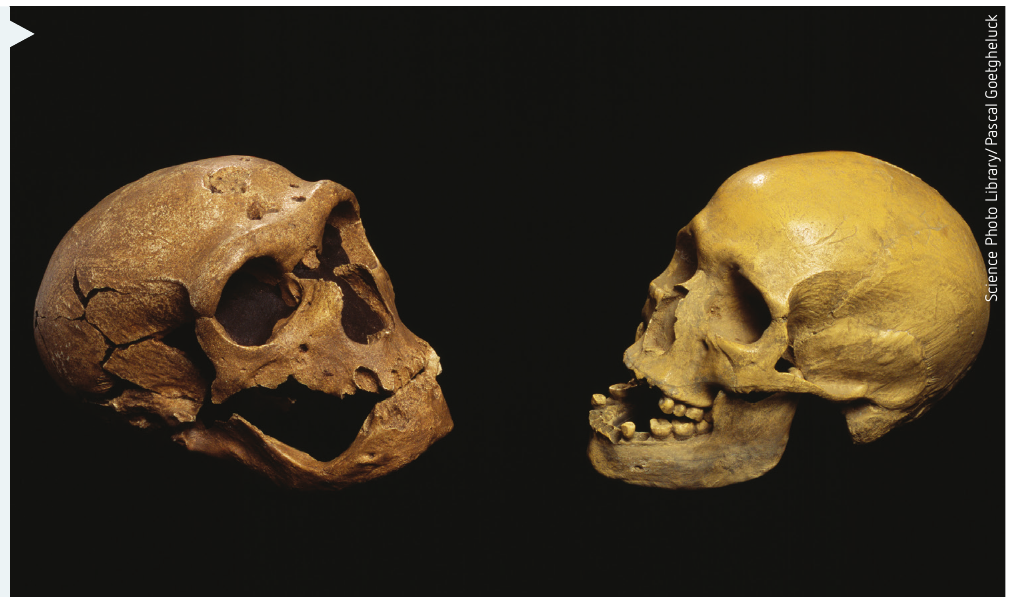
Studying the human genome (all of our genetic material) has dramatically changed our understanding of human evolution. Genetic data can reveal relationships between populations that fossils alone cannot show.
Human migration theories
Scientists have debated two main theories about how modern humans spread across the world from Africa.
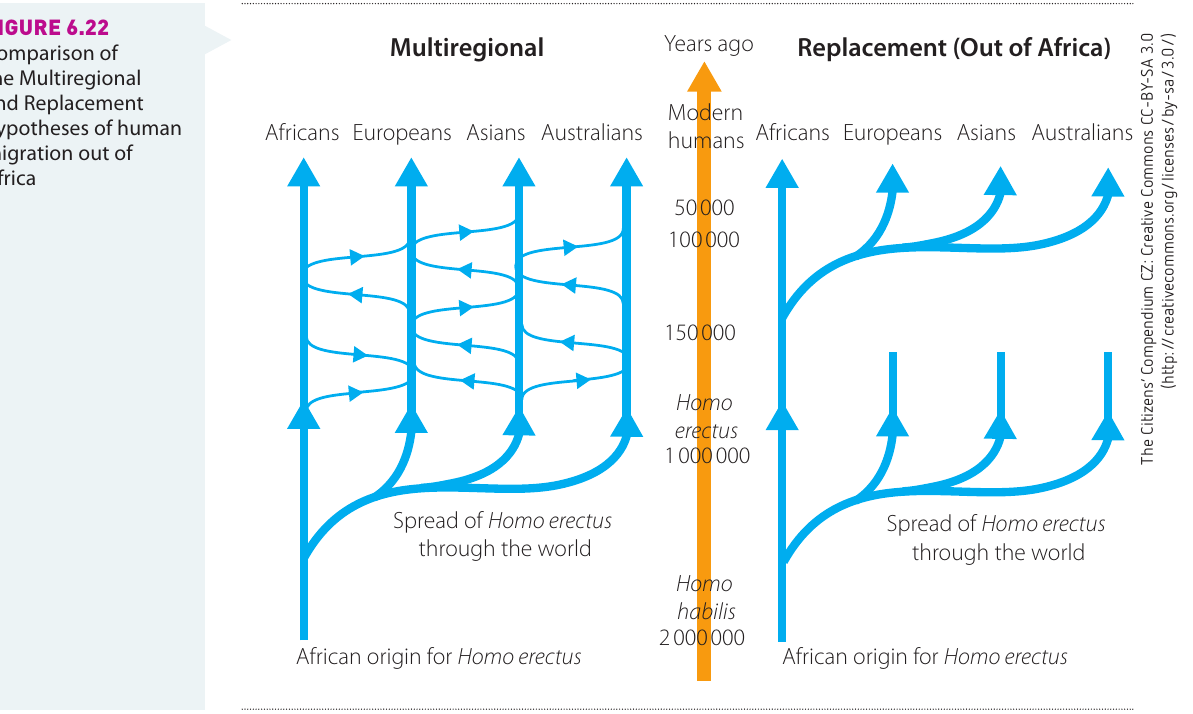
Multiregional hypothesis (MRE)
The Multiregional hypothesis relies mostly on fossil evidence. It suggests that:
- All modern human populations can be traced back to when Homo erectus first left Africa about million years ago
- These early humans spread to different parts of the world
- There was genetic exchange between neighbouring populations (gene flow)
- Modern humans slowly evolved in multiple regions simultaneously
- If this were true, different regions would have unique ancient alleles
Note
The Multiregional hypothesis predicts that we would find ancient alleles unique to different geographic regions, as human populations would have evolved independently in multiple locations over millions of years.
Replacement hypothesis (Out of Africa or Eve hypothesis)
The Replacement hypothesis, also called the Out of Africa or Eve hypothesis, proposes a different story:
- Archaic Homo sapiens left Africa initially
- A second, more important migration happened about years ago
- These modern humans of African origin spread across the world
- They replaced archaic human groups by interbreeding with them and out-competing them for resources
- Modern humans outside Africa all descend from this relatively recent African population
Note
The key difference between these theories is the timeframe: the Multiregional hypothesis traces modern humans back million years to Homo erectus, while the Replacement hypothesis suggests a much more recent origin of just years ago.
Genetic evidence supporting the Out of Africa theory
Modern genetic studies have provided strong evidence for which theory is correct. Researchers have sequenced over 18,000 complete human mitochondrial DNA (mtDNA) genomes from people worldwide.
Why use mitochondrial DNA?
Mitochondrial DNA is ideal for studying human evolution because:
Note
Advantages of mtDNA for evolutionary studies:
- It is inherited only through the maternal line (from mother to child)
- It is not mixed through recombination like nuclear DNA
- Each human cell contains molecules of mtDNA
- All mtDNA molecules within a person are usually identical
- The mean rate of mtDNA divergence (change) is per million years
- This provides a "molecular clock" to estimate when populations split apart
What are haplogroups?
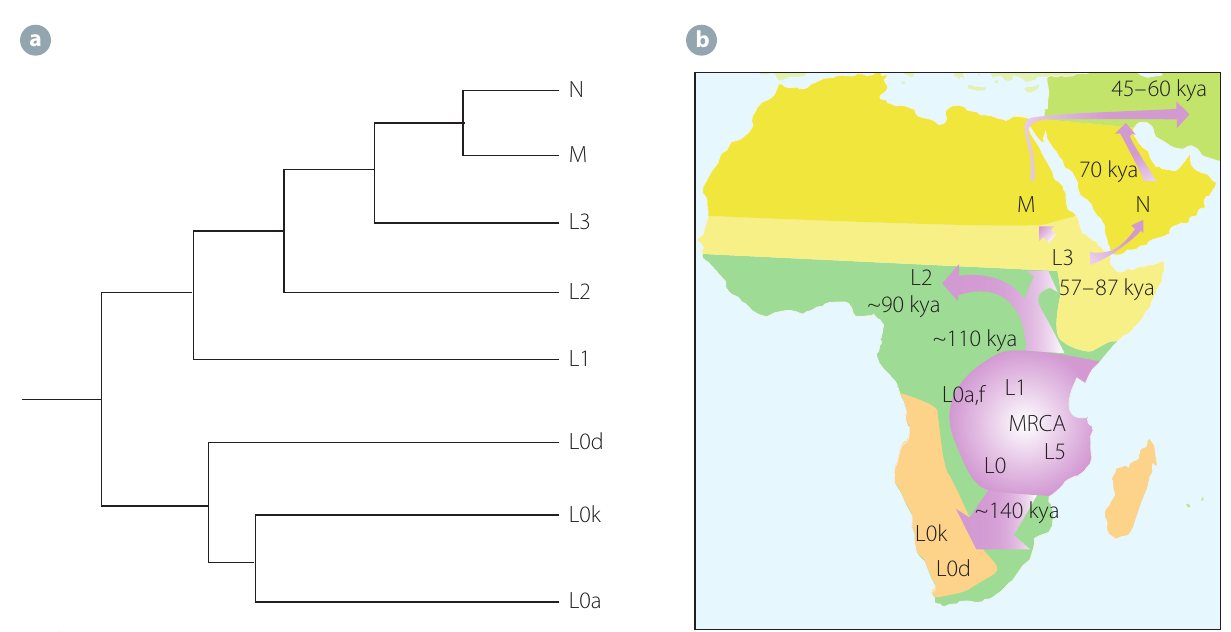
When studying global populations, scientists grouped people according to specific mutations in their mtDNA. People who share the same mutations must be descendants of a common ancestor. These groups are called haplogroups.
By comparing mtDNA sequences, scientists created phylogenetic trees (family trees showing evolutionary relationships) from the mtDNA haplogroups.
Key findings from mtDNA studies
The research revealed several important patterns:
Example
Major Findings from Global mtDNA Analysis:
Finding 1: African populations show the most genetic diversity
- Among modern humans, African populations (L haplogroups) have much more variation in their mtDNA sequences than any other population
- This indicates Africa is the origin of modern humans
Finding 2: Non-African populations show less diversity
- The mtDNA of Europeans, Asians, and Indigenous peoples of Australia, the Americas, and Pacific islands represent just a small subset of total human mtDNA diversity (M and N haplogroups)
- This suggests more recent population origins outside Africa
Finding 3: All non-African groups trace back to Africa
- Only the M and N haplogroups are found in indigenous populations outside Africa
- Both M and N are closely related to the African L3 group
- This demonstrates a clear African ancestry for all human populations
Important
This evidence strongly supports the Replacement (Out of Africa) hypothesis. If the Multiregional hypothesis were correct, modern populations would contain ancient alleles scattered across different regions of the world. Instead, all genetic diversity outside Africa represents just a branch of African genetic diversity.
Timeline of human migration
Using the molecular clock (the rate at which mtDNA changes over time), scientists estimate:
- Diverse populations of modern humans evolved over years in Africa
- The haplogroups that migrated out of Africa diverged about 70,000 years ago
- These migrating groups were located in north-east Africa, nearest to the Middle East
- This location makes sense as a starting point for migration into other continents
Out of Africa: Meeting other human species
When our ancestors first migrated out of Africa, they were not alone. At least two other species of humans were already living in Eurasia (Europe and Asia):
- Neanderthals (Homo neanderthalensis)
- Denisovans
Neanderthals
Neanderthal remains have been found in:
- Western, central, eastern, and Mediterranean Europe
- South-west, central, and northern Asia
- As far east as the Altai Mountains in Siberia
Denisovans
Denisovans were a subspecies of humans, genetically different from both Neanderthals and modern humans. A -year-old finger bone found in a cave in the Altai Mountains in Siberia provided the first evidence of this group. The caves had been inhabited by both Neanderthals and Denisovans, possibly even at overlapping times.
Interbreeding with archaic humans
As modern humans migrated through Eurasia, they encountered and interbred with these other human species. This interbreeding introduced small amounts of Neanderthal and Denisovan DNA into the modern human genome.
Note
Key findings about archaic DNA in modern populations:
- Most Europeans and Asians have about 2% Neanderthal DNA
- Indigenous Australians have about 5% combined archaic DNA (both Neanderthal and Denisovan)
- Eurasians and people from North and South America have about 2.5% Neanderthal DNA
- Sub-Saharan Africans do not have Neanderthal DNA because their ancestors never left Africa and therefore never encountered Neanderthals
Interesting example: Genetic analysis of Ötzi the iceman, Europe's oldest mummy (who lived around BCE), shows an even higher percentage of Neanderthal DNA than most modern Europeans.
Investigation 6.4: Using genetic evidence to map human migration
This investigation uses real data from a worldwide survey of mtDNA to determine the route our ancestors took when migrating out of Africa.
The data
Researchers collected mtDNA from people from five geographic regions:
- Sub-Saharan Africa ()
- Asian populations from China, Vietnam, Laos, the Philippines, Indonesia, and Tonga ()
- Australian Aborigines ()
- Caucasians from Europe, North Africa, and the Middle East ()
- Aboriginal New Guineans ()
The table below shows the mtDNA sequence divergence (difference) within and between these five populations:
| Population | African | Asian | Australian | Caucasian | New Guinean |
|---|---|---|---|---|---|
| African | - | - | - | - | |
| Asian | - | - | - | ||
| Australian | - | - | |||
| Caucasian | - | ||||
| New Guinean |
Note
Understanding the table:
- The diagonal shows divergence within each population
- Other cells show divergence between different populations
- Higher divergence percentages indicate more genetic differences
Key observations from the data
Example
Data Analysis and Interpretation:
Observation 1: African populations show the highest divergence within the population ()
- This indicates that African populations are the oldest
- More time = more mutations = more divergence
Observation 2: Caucasian populations show the least divergence within the population ()
- This suggests this population is relatively young
- Less time = fewer mutations = less divergence
Observation 3: Divergence patterns support migration from Africa
- All non-African populations show less internal diversity than African populations
- This pattern is exactly what we would expect if humans originated in Africa and then spread to other continents
What does this tell us about sub-Saharan Africans and Neanderthal DNA?
Important
Sub-Saharan Africans do not have any Neanderthal DNA in their genome because:
- Their ancestors remained in Africa
- Neanderthals lived only in Eurasia
- Without contact, there could be no interbreeding
- Only populations that migrated out of Africa and into Eurasia encountered and interbred with Neanderthals
Remember!
Summary
Key Points to Remember:
-
Anthropological genetics combines DNA analysis with historical, archaeological, and linguistic evidence to understand human evolution and diversity
-
The Replacement (Out of Africa) hypothesis is strongly supported by genetic evidence, showing that modern humans evolved in Africa and migrated outward about years ago
-
Mitochondrial DNA is ideal for tracing human evolution because it is inherited only through the maternal line and provides a molecular clock for dating evolutionary events
-
Haplogroups are groups of people who share specific mtDNA mutations, indicating descent from a common ancestor. African populations have the most haplogroup diversity (L groups), while non-African populations have only M and N haplogroups
-
Modern humans interbred with Neanderthals and Denisovans, leaving about Neanderthal DNA in most Europeans and Asians, and up to archaic DNA in Indigenous Australians
-
Greater genetic diversity in African populations indicates they are older, supporting the theory that humans originated in Africa before spreading to other continents