Asexual Reproduction (HSC SSCE Biology): Revision Notes
📚Revision Notes
Asexual Reproduction
What is asexual reproduction?
Asexual reproduction is a form of reproduction that does not involve sex cells (gametes). Unlike sexual reproduction, which requires two parents, asexual reproduction needs only a single parent organism. All genetic material in the offspring comes from this one parent, meaning the offspring are genetically identical to both the parent and to each other. This type of reproduction is sometimes called cloning, because the offspring are exact genetic copies.
Note
Key Features of Asexual Reproduction:
The defining characteristics that distinguish asexual reproduction from sexual reproduction include:
- Only one parent is required
- No production or fusion of gametes (sex cells)
- No mixing of genetic information
- Offspring are genetically identical to the parent
- No genetic variation is introduced
In unicellular organisms, asexual reproduction is the main form of reproduction. For multicellular organisms, sexual reproduction is more common, though many plants and some animals can reproduce asexually.
Advantages of asexual reproduction
Asexual reproduction offers several important advantages for organisms:
Speed and efficiency
Organisms can reproduce quickly without needing to find a mating partner. This is particularly important for plants, which cannot move around to search for mates. A bacterial cell, for example, can double in number every twenty minutes under favourable conditions.
Energy conservation
Asexual reproduction uses less energy than sexual reproduction. The organism doesn't need to produce specialised sex cells or invest energy in finding and attracting a mate.
Preservation of successful traits
When organisms are well-adapted to their environment, being genetically identical can provide a competitive advantage. If the parent thrives in certain conditions, the offspring will too.
Success in harsh environments
Asexual reproduction is more common in harsh environments where organisms are highly specialised. When favourable conditions arise suddenly (such as after rainfall in a desert), organisms can reproduce quickly and effectively to take advantage of the opportunity.
Note
Selective Pressures Favouring Asexual Reproduction:
Certain environmental conditions make asexual reproduction particularly advantageous:
- Shortage of food or other resources
- Small mating populations
- Time constraints on finding a mate
- Harsh environmental conditions requiring rapid response
Disadvantages of asexual reproduction
The main disadvantage of asexual reproduction is the lack of genetic variation in the population. With little or no variation, the whole group or species becomes vulnerable to sudden environmental changes. These changes might include:
- Drought or flooding
- New diseases
- New parasites or predators
- Climate change
Important
Vulnerability of Genetically Identical Populations
If all individuals are genetically identical, a disease or environmental change that affects one individual will likely affect all of them. This can result in the survival of few, if any, individuals. This is why genetic diversity is crucial for species survival.
Asexual reproduction in plants
Plants have evolved various methods of asexual reproduction. These methods often involve specialised structures that allow plants to survive harsh conditions and reproduce when the opportunity arises.
Vegetative propagation
Vegetative propagation is the process by which new plants arise from portions of roots, stems, leaves, or buds of adult plants. The offspring are genetically identical to their parent. This is similar to cloning an adult plant.
Many plants produce special underground organs called perennating organs. The word perennating comes from 'perennial', meaning returning year after year. These organs contain stored food that sustains the plant in a dormant state from one season to the next. They allow plants to survive extreme cold in winter or drought in summer. Even if the parts above ground die, the underground organs can develop buds that grow when favourable conditions return.
Note
When separated, perennating organs can give rise to new plants, making them an important form of asexual reproduction. Gardeners often take advantage of this by splitting bulbs, cutting up rhizomes, or taking cuttings from stems.
Runners (modified stems)
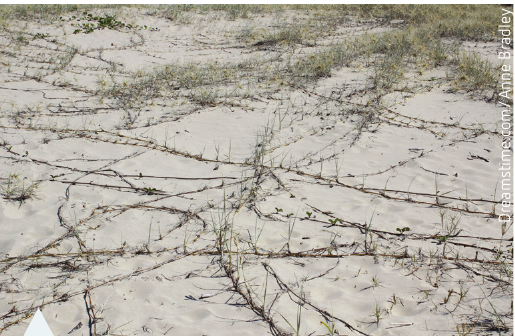
Runners, also called stolons, are long, thin stems that grow along the surface of the soil. At certain points along the runner (called nodes), the plant produces leaves and roots. These can develop into new, independent plants.
Example
Example: Spinifex grass
Spinifex is a grass that grows in harsh coastal dune environments. It has long stems that grow horizontally along the soil surface. At each node, the plant produces leaves and roots, creating new plants. This adaptation helps spinifex survive in harsh conditions with high wind erosion, high salinity, and high temperatures. The runners can be divided at the nodes to create separate plants.
| Example | Asexual reproduction mechanism | Why it is an advantage |
|---|---|---|
| Spinifex grass | Stem runners put out leaves and roots at nodes along the ground | Enables reproduction in harsh conditions, requires less energy to reproduce by runner, and is very rapid |
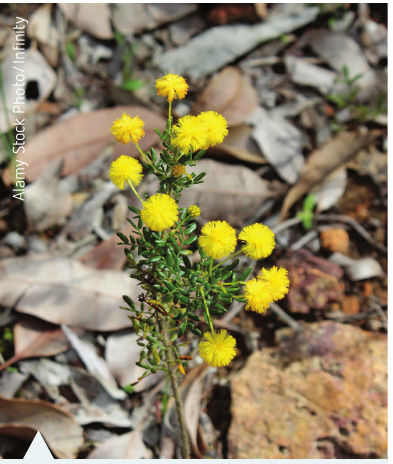
| Colony wattle | Shoots grow from outer roots (suckers) and develop into separate plants | Rapid, and large numbers can be reproduced quickly, an advantage when rapid recovery is needed after a decline in numbers (e.g. fire or drought) |
Rhizomes (modified stems)
Rhizomes are underground horizontal stems. They can give rise to a new shoot at each node. Plants with rhizomes include ginger, bracken fern, and many grasses. Gardeners often propagate ferns by splitting the rhizomes at the nodes.
Suckers (modified roots)
Some plants produce modified roots called suckers or sprouts, which give rise to new plants. Trees and shrubs that produce suckers, such as reeds, wattles, and blackberries, can spread quickly into vacant areas after disturbance.
Example
Example: Colony wattle
The colony wattle (Acacia murrayana) sends up shoots from its outer roots. These shoots grow into separate plants if the parent shrub dies. This allows for rapid regrowth after a bushfire or drought when numbers have declined.
Tubers (modified stems)
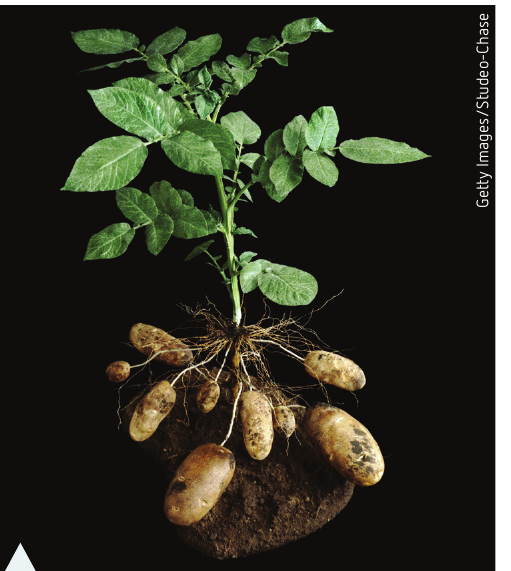
Tubers are swollen regions of underground stems where the plant stores food. Potatoes are a common example of tubers. The 'eyes' on a potato are actually buds that can develop into new plants. If you plant a potato or even just a piece containing an eye, it can grow into a new potato plant.
Bulbs (modified stems)
A bulb consists of a very short stem (called a basal plate) with fleshy leaves attached. The leaves store food for the plant. Roots grow from the lower surface of the stem, and leaves grow from the upper surface.
Example
Example: Onion
An onion is a stem bulb with fleshy scale leaves. The stem is reduced to a short disc called the basal plate. Axillary buds form where the leaves attach to the stem. These buds can develop into new bulbs. If you plant an onion bulb, within a year or two there will be several bulbs in that location. These can be separated and replanted to produce new plants.
Apomixis
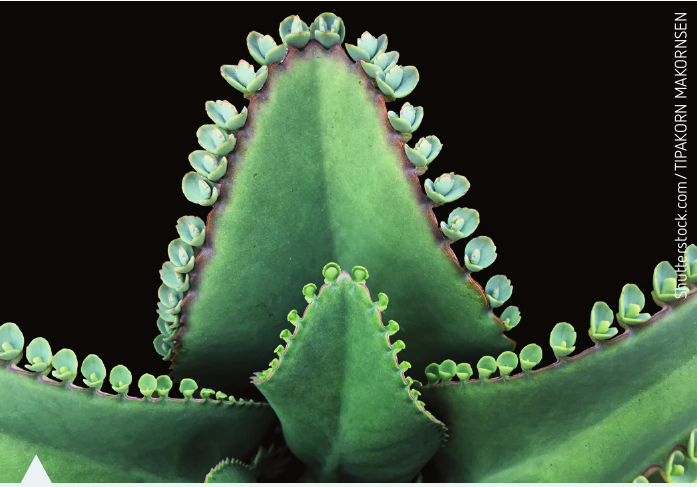
Apomixis is a form of reproduction where plants produce offspring from special tissues without fertilisation or seed production. This 'generative tissue' may be gametes (such as unfertilised ovules) or non-reproductive tissue (such as leaf tissue). The tissue gives rise to plantlets that can produce asexual seeds.
Example
Example: Kalanchoe
Some plants, like Kalanchoe, produce tiny plantlets along the edges of their leaves. These plantlets are genetically identical to the parent. They can fall off and grow into new individuals, or they can produce seeds.
Plants that show apomixis include kangaroo grass, lemon and orange trees, dandelions, and Kalanchoe.
Note
Advantages of apomixis:
- Multiplication is rapid
- Plantlets can produce seeds, which increases dispersal
Disadvantage of apomixis:
- Lack of variation, as is typical when only one parent is involved
Asexual reproduction in other organisms
Asexual reproduction is not limited to plants. Many other organisms, including fungi, protists, and even some animals, reproduce asexually.
Budding
In budding, an adult organism produces a small bud that separates from the parent and grows into a new individual.
Budding in yeast
Yeast are microscopic, single-celled fungi. When environmental conditions are favourable, a small outgrowth (bud) develops on the parent cell. As the bud grows, the parent cell copies its DNA, and the nucleus divides. One copy of the genetic material moves into the bud. When the bud reaches a certain size, it detaches from the parent and continues growing until it can bud in turn.
Note
Yeast can replicate every minutes, and their numbers increase exponentially. Sometimes buds don't break away from the parent, forming chains of cells.
Yeast can also reproduce sexually when nutrients are scarce. This flexibility makes yeast very useful for scientific research.
Budding in multicellular organisms
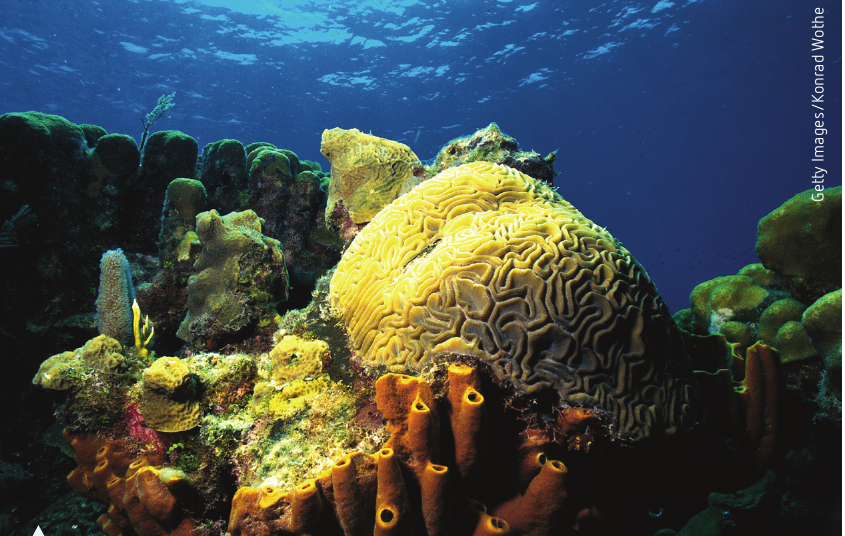
Budding also occurs in some multicellular organisms, including jellyfish, hydra, and grooved brain coral. When conditions are favourable, cells of the parent divide by mitosis and grow into a multicellular outgrowth. This develops into a smaller but identical individual that detaches from the parent and grows into a reproductive adult.
Note
Advantages of budding:
- If the environment is stable, identical offspring will always be well-adapted and survive successfully
- Rapid reproduction when conditions are favourable
Disadvantages of budding:
- If the environment changes (for example, if a new disease enters), the entire species may rapidly decline
Binary fission
Binary fission means splitting (fission) into two (binary). This is the main method of asexual reproduction in unicellular organisms such as bacteria (prokaryotes) and protists (unicellular eukaryotes).
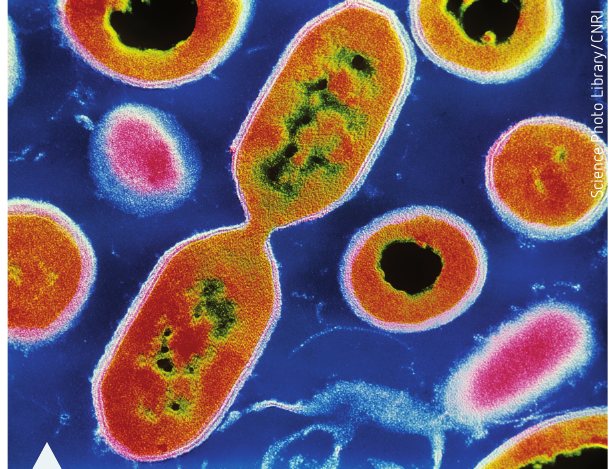
The process involves:
- The cell grows to twice its size
- The cell replicates its genetic material (DNA)
- The cell splits into two cells with identical genetic material
Binary fission in bacteria
Bacterial cells can double in number every twenty minutes under favourable conditions, ensuring rapid population growth.
The bacterial cell grows to full size, then replicates its single DNA molecule. Each DNA copy attaches to opposite ends of the cell membrane. Proteins accumulate at the centre of the cell and help pinch off the cytoplasm without damaging the DNA. A new cell wall forms in the area where the cell divides. The new cells grow to full size before dividing again.
Binary fission in protists
Protists are single-celled eukaryotes that reproduce asexually through binary fission. This process involves mitosis and the formation of a spindle to distribute chromosomes equally.
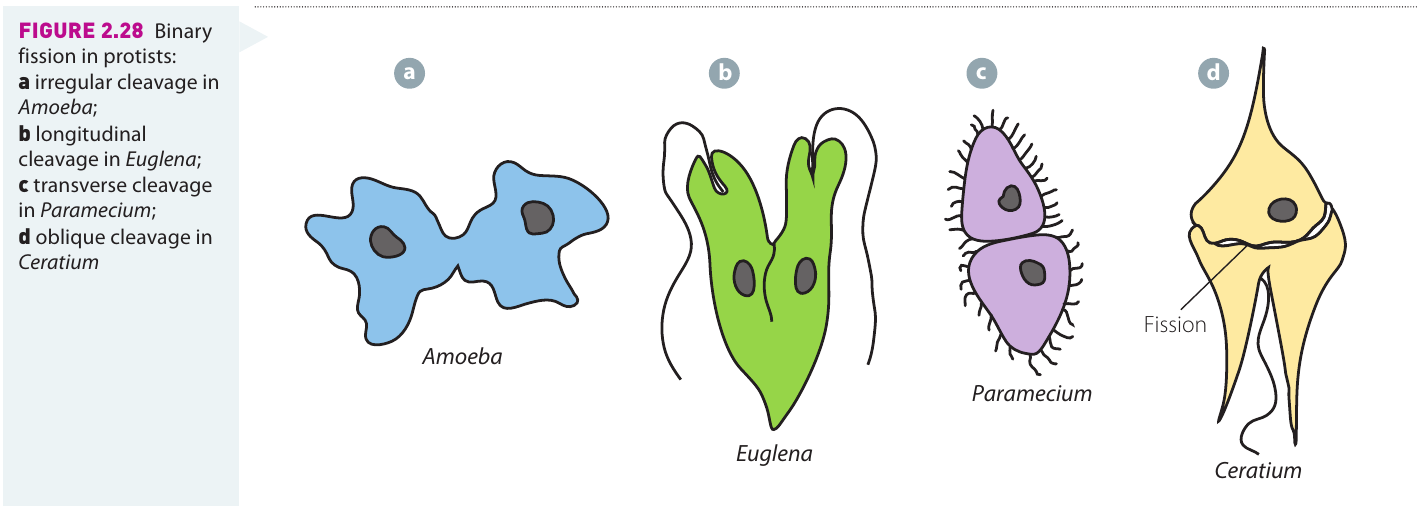
There are different types of binary fission in protists, depending on the plane along which the cell divides:
| Type of binary fission | Cleavage plane | Example of protist |
|---|---|---|
| Longitudinal | Lengthwise | Flagellate forms, e.g. Euglena |
| Transverse | Crosswise | Ciliate forms, e.g. Paramecium |
| Oblique | At an oblique angle | Ceratium |
| Irregular | Along any plane | Amoeba |
Note
Amoeba is a single-celled organism that moves by flowing its cytoplasm into extensions called pseudopodia. Binary fission in Amoeba is termed 'irregular' because the cell is asymmetrical and division can occur along any plane.
Note
Advantages of binary fission:
- Rapid population growth over a short period
- Only one parent required
Disadvantages of binary fission:
- No genetic diversity is generated
- Vulnerability to environmental changes
Spores
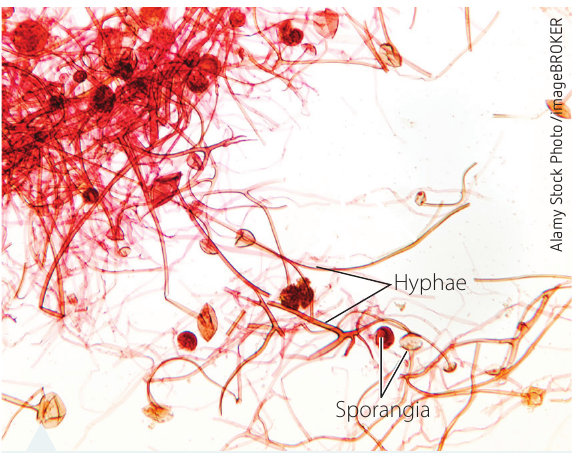
Spores are tiny, single-celled reproductive structures produced in very large numbers by organisms such as fungi and some plants (mosses and ferns). Structures called sporangia produce the spores.
Note
Characteristics of spores:
- Very light and easily dispersed by wind
- Can travel long distances
- Can colonise new environments
- Unlike gametes, spores don't need to fuse with another cell
- Unlike seeds, spores are single cells with no embryo or food supply
Spore formation in fungi
Fungi are made up of thread-like structures called hyphae. These branching, interconnected threads form the main fungal body, called the mycelium. Hyphae may grow underground or in dead and decaying matter. Unlike plants, fungi cannot photosynthesise, so they can grow in the dark.
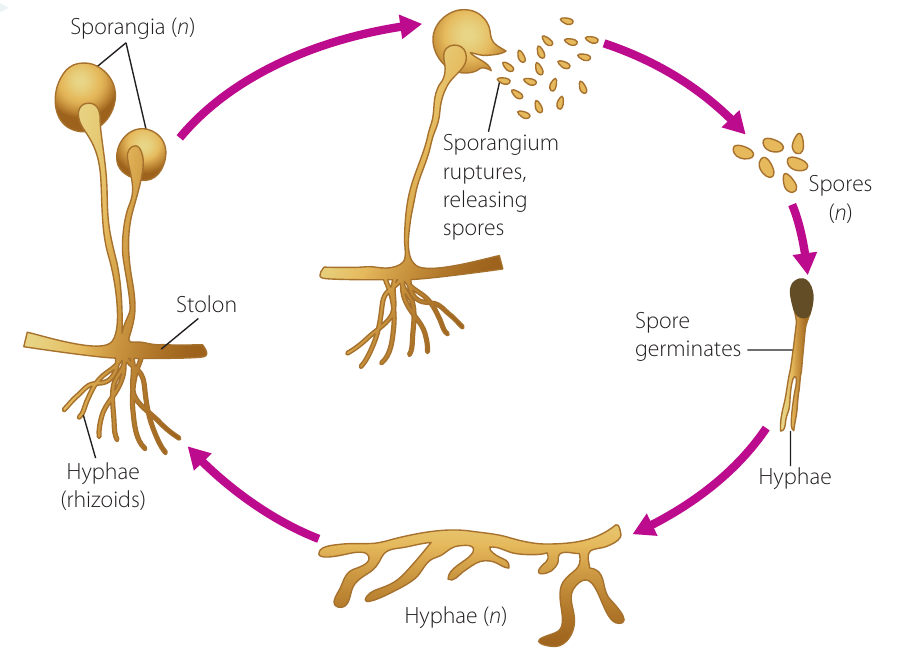
When environmental conditions are favourable, fungi reproduce asexually:
- The fungus develops large numbers of spore-producing structures (sporangia) that grow upwards
- Sporangia develop as specialised tips of hyphal threads
- Each sporangium contains numerous haploid nuclei that develop into microscopic spores
- Spores are produced in enormous numbers
- When mature, sporangia release the spores
- Spores are dispersed by wind
- Under favourable conditions, spores germinate
- The spore absorbs water, activating the cytoplasm to grow
- Nuclear divisions occur, producing more cytoplasm
- The spore grows into a new mycelium
Example
Example: Bread mould (Rhizopus)
When you see grey-green mould on bread, you're looking at the sporangia. Spores are white at first, then turn black as they ripen. Each spore contains several nuclei and some cytoplasm, surrounded by a protective wall. The spores carry genetic material identical to the parent.
Note
Advantages of spore formation:
- Rapid reproduction and colonisation of wide areas
- Organisms that are well-adapted to their habitat can preserve their genome without introducing changes
- Requires fewer nutrients and less energy than sexual reproduction
- Ensures continuity of the species
Disadvantages of spore formation:
- Lack of genetic variation
- Vulnerability if the environment changes
Important
When environmental changes occur, many fungi switch to sexual reproduction, where hyphae of different mating types fuse to create spores with different genetic combinations. This flexibility allows fungi to adapt to changing conditions.
Remember!
Summary
Key Points to Remember:
- Asexual reproduction requires only one parent and produces genetically identical offspring (clones).
- The main advantage is rapid reproduction without needing a mate, which is especially useful in harsh or changing environments.
- The main disadvantage is lack of genetic variation, making populations vulnerable to sudden environmental changes.
- In plants, asexual reproduction occurs through vegetative propagation using structures like runners, rhizomes, suckers, tubers, and bulbs.
- In other organisms, asexual reproduction occurs through budding (yeast, hydra, coral), binary fission (bacteria, protists), and spore formation (fungi, mosses, ferns).
- Many organisms can switch between sexual and asexual reproduction depending on environmental conditions, giving them the benefits of both strategies.