Pathogen Adaptations (HSC SSCE Biology): Revision Notes
📚Revision Notes
Pathogen Adaptations
For a pathogen to successfully cause an infectious disease, it must overcome multiple challenges. Think of it like breaking into a highly secure building - the pathogen needs to get in, avoid detection, and establish itself inside. Understanding how pathogens achieve this helps us understand how diseases spread and how to prevent them.
Note
The "secure building" analogy is particularly useful: just as breaking into a building requires multiple steps (approaching, getting through security, avoiding detection, and establishing a position), pathogens must navigate similar challenges to successfully infect a host.
Steps required for infection
Important
The Four Essential Steps for Infection
For any organism to cause disease, it must complete four essential steps:
- Enter the host - gain access to the body
- Multiply in host tissues - reproduce and increase numbers
- Resist or evade host defence mechanisms - avoid being destroyed by the immune system
- Damage the host - cause harm to tissues or body systems
Mnemonic: Think "Every Mighty Ranger Defends" to remember: Enter, Multiply, Resist defenses, Damage
Just like in movies where adhesion (sticking to the building) comes before invasion (getting inside), pathogens must first adhere to host cells before they can invade tissues.
Virulence factors
Virulence factors are the strategies or adaptations that enable pathogens to adhere to, gain entry into, and persist in their hosts. Think of them as a pathogen's "toolkit" for successful infection. Each pathogen has its own unique set of virulence factors.
Note
The Evolutionary Arms Race
The evolutionary strategies of pathogens are thought to be just slightly ahead of host resistance strategies. The two have evolved side by side throughout the history of life, in a constant biological "arms race." This ongoing competition drives the continuous evolution of both pathogen virulence and host immunity.
Adaptations for adhesion and invasion
Different types of pathogens have evolved different mechanisms to stick to and enter host cells. Here's how each major group achieves this:
Prions
Prions are unusual infectious agents made of misfolded proteins. They use the host's own immune cells to spread:
- Host B lymphocytes (white blood cells) secrete factors like tumour necrosis factor that help prions invade follicular dendritic cells in lymphoid tissue
- From lymphoid tissue, prions travel through the autonomic nerves to reach the brain
- They may "piggyback" on other proteins like ferritin (found in meat) to move through the gut
Viruses
Viruses have sophisticated mechanisms for both adhesion and invasion.
Adhesion mechanisms:
- Viral surface proteins bind to specific receptors and co-receptors on the host cell surface
- For example, HIV uses CD4 receptors and chemokine receptors (CCR5 or CXCR4) to attach to macrophages and T cells
- Viruses must enter the nucleus of the host cell to replicate their genome
Invasion mechanisms:
Viruses use three main strategies to enter host cells:
- Receptor-mediated endocytosis - the virus is engulfed by the cell membrane and brought inside. Enveloped viruses (like influenza) are enclosed in a membrane bubble called an endosome as they enter
- Pore formation - non-enveloped viruses (like poliovirus) create a hole in the cell membrane and inject their genetic material through it
- Membrane budding - some viruses travel through the endoplasmic reticulum and Golgi body, then bud off from the cell surface
Bacteria
Bacteria use multiple strategies for both adhesion and invasion.
Adhesion mechanisms:
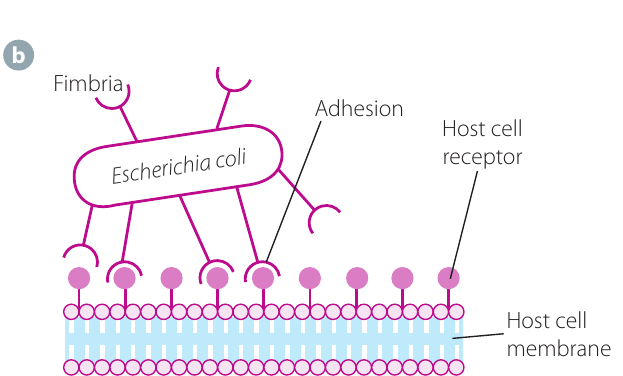
- Pili and fimbriae - hair-like projections that help bacteria stick to surfaces
- Adhesins - proteins on the bacterial surface that resist the washing action of bodily fluids like urine, mucus, and cilia
- Biofilm formation - bacteria create a protective layer that helps them stick together and to surfaces
- Some bacteria inject proteins that cause the host cell membrane to engulf them
Invasion mechanisms:
Note
Bacteria have evolved an impressive arsenal of invasion strategies, from physical barriers to chemical weapons. These multiple mechanisms help explain why bacterial infections can be so difficult to treat.
- Enzyme secretion - enzymes like collagenase, hyaluronidase, and lecithinase break down host cell contents
- Capsules - protective coatings that resist phagocytosis (being eaten by immune cells)
- Intracellular survival - some bacteria like tuberculosis survive inside macrophages and become walled off in structures called granulomas
- Chemical weapons - substances that destroy host immune defences, such as leucocidin and IgA protease
- Toxin production - both endotoxins and exotoxins damage host cells
- Membrane manipulation - Listeria monocytogenes secretes haemolysin to destroy the membrane around it after being engulfed, but without damaging the cell membrane itself
Protozoa
These single-celled parasites have clever invasion strategies:
Example
Worked Example: Protozoan Invasion Mechanisms
Toxoplasma gondii (causes toxoplasmosis):
- Step 1: Extends microtubules into the host cell to help it enter
- Step 2: Forms a protective vacuolar membrane that shields it from lysosomes (digestive organelles)
- Result: Successfully establishes infection while avoiding digestion
Trypanosoma cruzi (causes Chagas disease):
- Step 1: Uses receptor-mediated attachment to bind to host cell
- Step 2: Tricks lysosomes into fusing with the cell membrane
- Step 3: Enters in a lysosomal membrane bubble, then deactivates the digestive enzymes
- Result: Enters the cell using the host's own defences against it
Fungi
Fungi have multiple adaptations to survive in the warm environment of a host body.
Adhesion mechanisms:
- Cell wall and capsule molecules enable attachment to host cells
Invasion mechanisms:
- Thermotolerance - heat shock proteins help fungi cope with body temperatures (which are higher than environmental temperatures)
- Dimorphism - ability to switch from saprophytic mycelium (feeding on dead matter) to parasitic yeast form when exposed to heat
- Protective structures - cell walls and capsules protect against host attacks. Alpha glucan (a cell wall polysaccharide) provides protection
- Hormone receptors - receptors for 17β-oestradiol on fungal cells may explain why some fungal diseases differ in incidence between men and women
- Enzyme secretion - hydrolytic enzymes damage host cells and provide nutrients
- Immune evasion - capsule production, suppression of cytokine production, and reduced effectiveness of macrophages
- Opportunistic infection - fungi like Cryptococcus neoformans commonly infect immunosuppressed patients (such as those with HIV/AIDS, undergoing chemotherapy, or with lymphoma)
Important
Understanding Opportunistic Infections
Fungi are particularly dangerous to immunosuppressed individuals because they exploit weakened immune systems. This is why fungal infections are a major concern in:
- HIV/AIDS patients
- Cancer patients undergoing chemotherapy
- Organ transplant recipients taking immunosuppressant drugs
- Individuals with lymphoma or other immune system disorders
Macroparasites
Larger parasites like worms and ticks have specialized adaptations.
Example
Worked Example: Hookworm Invasion Process
Hookworms demonstrate a complex multi-stage invasion strategy:
Step 1: Secrete immunomodulatory proteins that reduce host immune responses
Step 2: Third larval stage (L3) invades through hair follicles
Step 3: Migrate through circulation to lungs → trachea → intestines
Step 4: Use teeth in their buccal capsule to anchor to the gut lining
Result: Successfully establish long-term infection with reduced immune response
Ticks:
Ticks have highly specialized feeding adaptations:
- Highly specialized mouthparts insert into host skin
- Anchored by "attachment cement"
- Secrete biologically active molecules in saliva to prevent vasoconstriction, blood clotting, and inflammatory responses
Adaptations for transmission between hosts
Transmission refers to the passing of a pathogen from one host to another. This can occur through:
- Direct transmission - through sneezing, coughing, or sexual contact
- Indirect transmission - by touching contaminated surfaces/objects or via a vector (like mosquitoes)
Different pathogens have evolved specific adaptations to exploit their particular transmission route.
Note
Understanding Transmission Routes
The distinction between direct and indirect transmission is crucial for understanding disease prevention. Direct transmission requires close contact between hosts, while indirect transmission can occur over greater distances and time periods, making it potentially more difficult to control.
Airborne transmission
Pathogens spread through dust and respiratory droplets have these adaptations:
- Can remain suspended in air for long periods
- Resist drying out
- Cause sneezing and coughing in the host, which ejects and transmits them to new hosts
- Aero-tolerant - able to tolerate a wide range of oxygen concentrations
Examples: Influenza viruses
Waterborne transmission
Pathogens spread through water have these features:
- Can colonise and multiply in water, creating environmental reservoirs (often from faecal material)
- Modified outer structures like fimbriae and flagella allow movement through water
- Marine organisms are halotolerant - able to tolerate high salt concentrations
- Many survive simple boiling or other water-treatment processes
Examples: Legionella, Vibrio, Giardia, Campylobacter species
Vector-borne transmission
Pathogens spread by vectors (like mosquitoes or ticks) have these adaptations:
- The vector is not harmed by the pathogen
- Form preferential reservoirs in the digestive tract or salivary glands of the vector for easier transmission
- Produce special surface proteins that allow attachment to vector tissues
- Life cycle synchronized with feeding habits of the vector
- Can change the types and numbers of vectors they use
Examples: Rickettsia felis (now uses both fleas and mosquitoes), malaria parasites, Zika virus, Hendra and lyssa viruses
Note
Vector Adaptation Example
Rickettsia felis demonstrates pathogen adaptability by evolving to use both fleas and mosquitoes as vectors. This expansion of vector range increases the pathogen's opportunities for transmission and makes it more difficult to control.
Faeco-oral transmission
Pathogens spread through contaminated food or water from faecal matter have these features:
- Very stable in varied environments, including stomach acid and the low-oxygen environment of the large intestine
- Induce vomiting and diarrhoea to increase likelihood of transmission
- May carry antimicrobial resistance genes
Examples: E. coli, Salmonella species
Important
Public Health Significance
The ability of faeco-oral pathogens to induce vomiting and diarrhoea is not accidental - it's an evolutionary adaptation that increases transmission. This is why proper sanitation and handwashing are so critical in preventing these diseases.
Soil-borne transmission
Pathogens living in soil have these adaptations:
- Form endospores to resist desiccation (drying out)
- Stable under a range of environmental conditions
- Grow mainly in the root zone (rhizosphere)
- Only a few bacteria are soil-borne pathogens of plants
Examples: Clostridium tetani, fungi, nematodes
Sexual (venereal) transmission
These pathogens share similar adaptations to vertical transmission (see below).
Examples: Chlamydia, HIV/AIDS virus, gonorrhoea, herpes simplex virus
Blood-borne transmission
Blood-borne pathogens have this key adaptation:
- Take advantage of altered features of red blood cells to facilitate growth and development
Examples: Malaria parasites (associated with sickle cell anaemia)
Vertical transmission (mother to child)
Pathogens passed from mother to offspring have these capabilities:
- Can cross the placenta where maternal and foetal cells are close together
- Capable of uterine invasion
- Transmission facilitated by unprotected sexual activity
- In animals, consumption of the placenta facilitates transmission
- May be aerosolised (spread through air) from the afterbirth
Examples: Brucella species (contagious abortion in cattle), Parvovirus, rubella virus, chickenpox virus, Listeria monocytogenes, Plasmodium falciparum
Summary
Key Points to Remember:
-
Pathogens must complete four steps to cause disease: enter the host, multiply in tissues, resist/evade defences, and damage the host.
-
Virulence factors are the "toolkit" of adaptations that help pathogens adhere to, invade, and persist in hosts.
-
Different pathogen types (prions, viruses, bacteria, protozoa, fungi, macroparasites) use different strategies for adhesion and invasion based on their structure and biology.
-
Transmission can be direct (person-to-person) or indirect (through contaminated objects or vectors).
-
Pathogens have specific adaptations matched to their transmission route:
- Airborne: Aero-tolerant, resist drying, cause sneezing/coughing
- Waterborne: Multiply in water, halotolerant, resist treatment
- Vector-borne: Don't harm vector, synchronized life cycles
- Faeco-oral: Stable in varied environments, induce vomiting/diarrhoea
- Soil-borne: Form endospores, resist desiccation
- Sexual/Blood-borne/Vertical: Exploit close contact between hosts
-
The evolutionary "arms race" between pathogens and host defences has been ongoing throughout the history of life, with pathogen strategies staying just slightly ahead of host resistance mechanisms.