Transport Systems in Plants (HSC SSCE Biology): Revision Notes
📚Revision Notes
Transport Systems in Plants
Introduction to transport systems
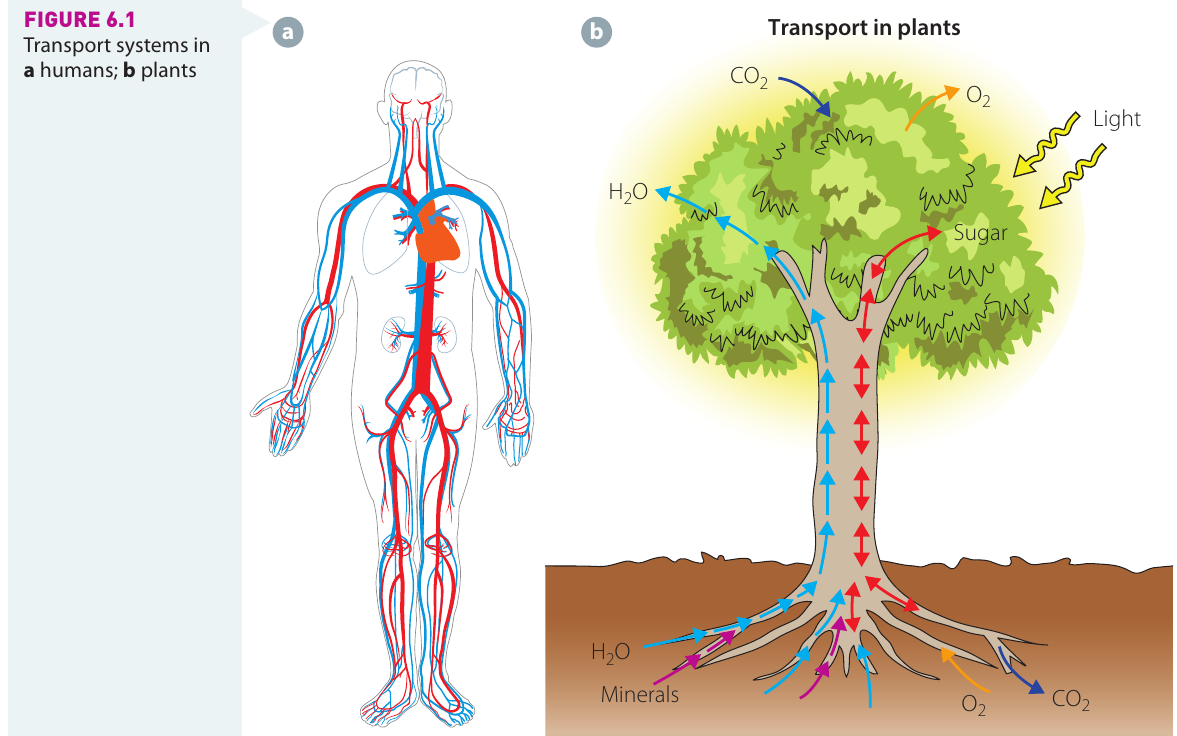
Multicellular organisms need specialised transport systems to move substances around their bodies efficiently. Simple organisms like unicellular organisms can rely on diffusion, osmosis and active transport directly across their surface. However, larger multicellular organisms require more complex systems to ensure all cells receive the nutrients and gases they need, and to remove waste products from cellular metabolism.
Note
All effective transport systems share three essential features:
- A network of vessels or tubes to carry substances
- A suitable transport fluid (liquid medium)
- A driving mechanism to move substances in the correct direction
Plant transport systems use vascular tissue arranged in vascular bundles. These bundles contain two types of tissue: xylem and phloem. Xylem carries water and mineral ions upward from the roots to the leaves. Phloem transports the products of photosynthesis to all parts of the plant where they are needed.
Xylem tissue
Structure of xylem
Xylem is specialised tissue that transports water and dissolved mineral ions from the roots to the leaves. This movement only occurs in one direction: upward from the roots.
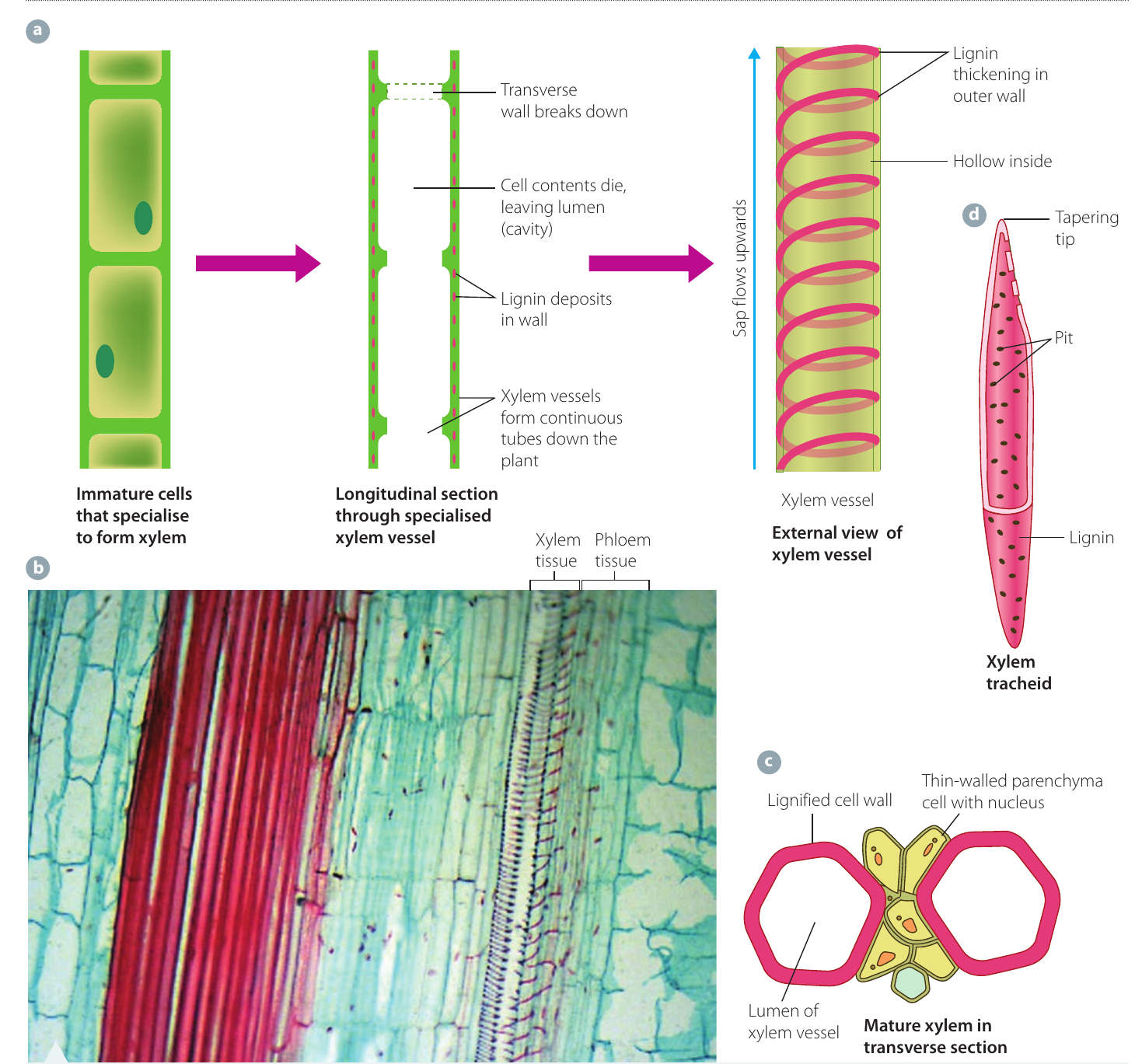
Xylem tissue consists of two main types of conducting elements:
Xylem vessels form continuous tubes for water transport. These develop when immature cells specialise:
- The cell walls at the ends break down completely
- Cells stack on top of each other to form long tubes
- The cell contents die, leaving hollow vessels
- This allows easy flow of water and dissolved minerals
Xylem tracheids are long structures with tapered ends:
- End walls come into contact and overlap
- Water and ions pass between tracheids through small holes called pits
- They are less efficient than vessels but still functional
Both vessels and tracheids have walls strengthened with lignin. This woody substance is deposited in rings, spirals or other patterns.
Note
Lignin thickenings serve two important purposes:
- Prevent the vessels from collapsing under tension
- Allow easy movement of water and dissolved substances
Xylem tissue also contains:
- Fibres: provide structural support
- Parenchyma cells: conduct materials between xylem regions and may store substances
The transpiration-cohesion-tension theory
The upward movement of water and minerals through xylem is explained by the transpiration-cohesion-tension theory.
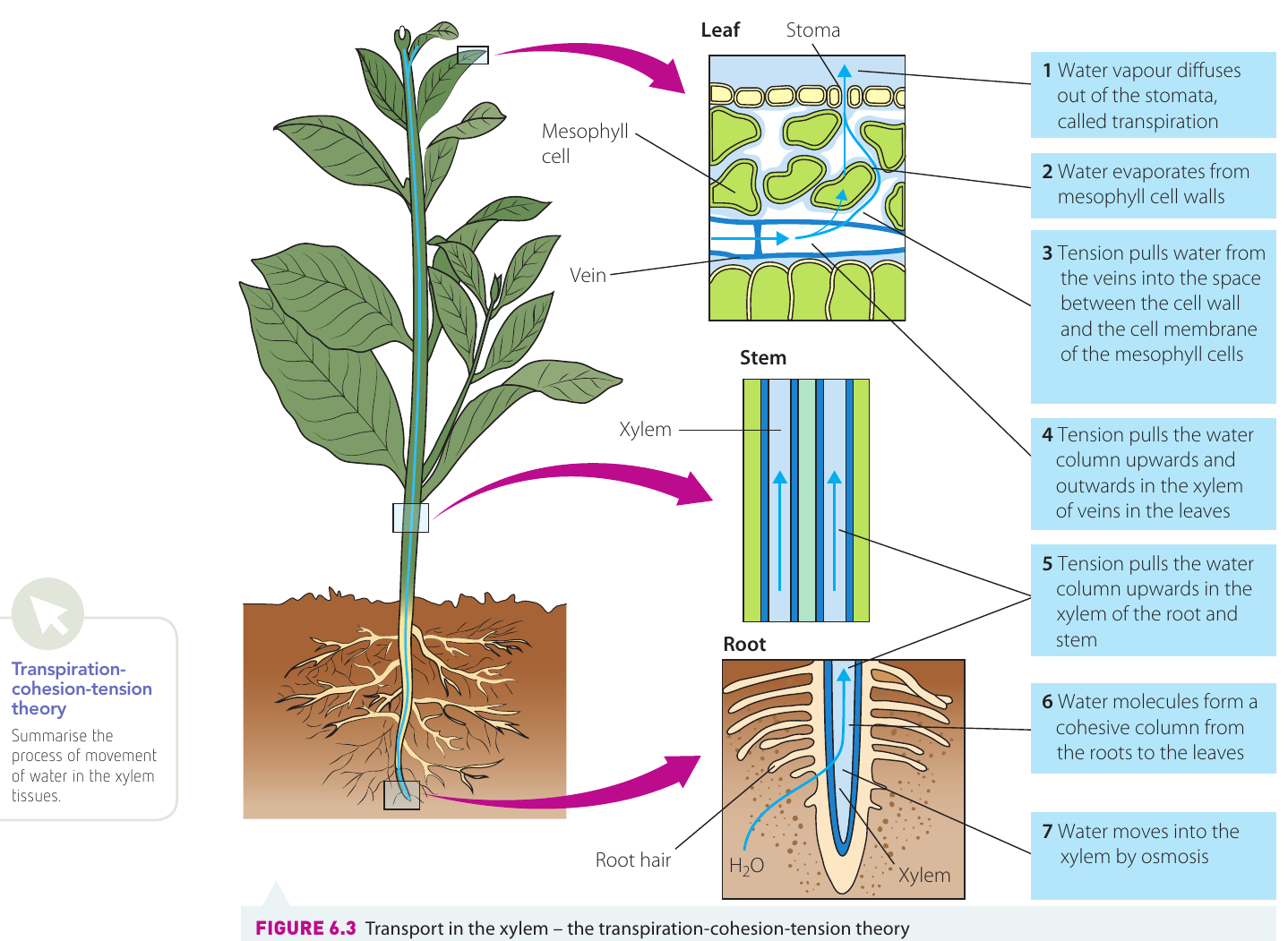
This theory centres on the evaporation of water from leaves (transpiration) creating a pulling force that draws water up from the roots. The continuous column of water moving up the stem is called the transpiration stream.
The seven-step process
Important
Understanding the transpiration-cohesion-tension mechanism is essential for explaining how water reaches the tops of tall trees, sometimes over 100 metres high, without the plant using any metabolic energy.
1. Transpiration occurs: Water vapour diffuses out of the stomata (leaf pores) because the concentration of water vapour outside the leaf is lower than inside.
2. Water evaporates from mesophyll cells: When water is lost from the air spaces inside the leaf, it is replaced by water evaporating from the surface of mesophyll cells surrounding these spaces.
3. Surface tension increases: Evaporation increases the surface tension of water on the outside of mesophyll cells.
4. Water is drawn from veins: Water moves from the xylem tissue in leaf veins to replace water lost from mesophyll cells.
5. Tension increases in the water column: This pulling action increases the tension throughout the entire column of water in the xylem.
6. Water column moves upward: The tension draws more water up from the roots through the stem.
7. Water enters roots by osmosis: Water moves into the xylem in the roots by osmosis, continuing the cycle.
Supporting factors
Several other factors assist water movement up the xylem:
Cohesion of water molecules
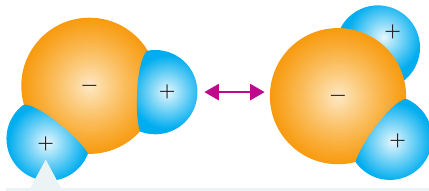
Water molecules stick together because they are polar. This means one end has a slight positive charge and the other end has a slight negative charge. Opposite charges attract, creating cohesive forces between molecules. This forms a continuous stream of water, so when some molecules are drawn up, others follow.
Adhesion to xylem walls
Adhesive forces cause water molecules to stick to the walls of xylem vessels. The narrower the vessel, the higher water can rise by adhesion. Combined with cohesion, this ensures the continuous water column moves smoothly through the xylem.
Structural properties of xylem
The narrow, thickened, lignified walls can withstand the tension in the water column while offering little resistance to water flow.
Root pressure
Once water is absorbed into roots (by osmosis) along with mineral ions (by diffusion and active transport), these substances move across the root into the xylem. The continual influx creates a small amount of root pressure, forcing the solution already in the xylem to move upwards. However, this pressure alone cannot lift water very high and is not the main driving force.
Investigation: Movement of materials in xylem
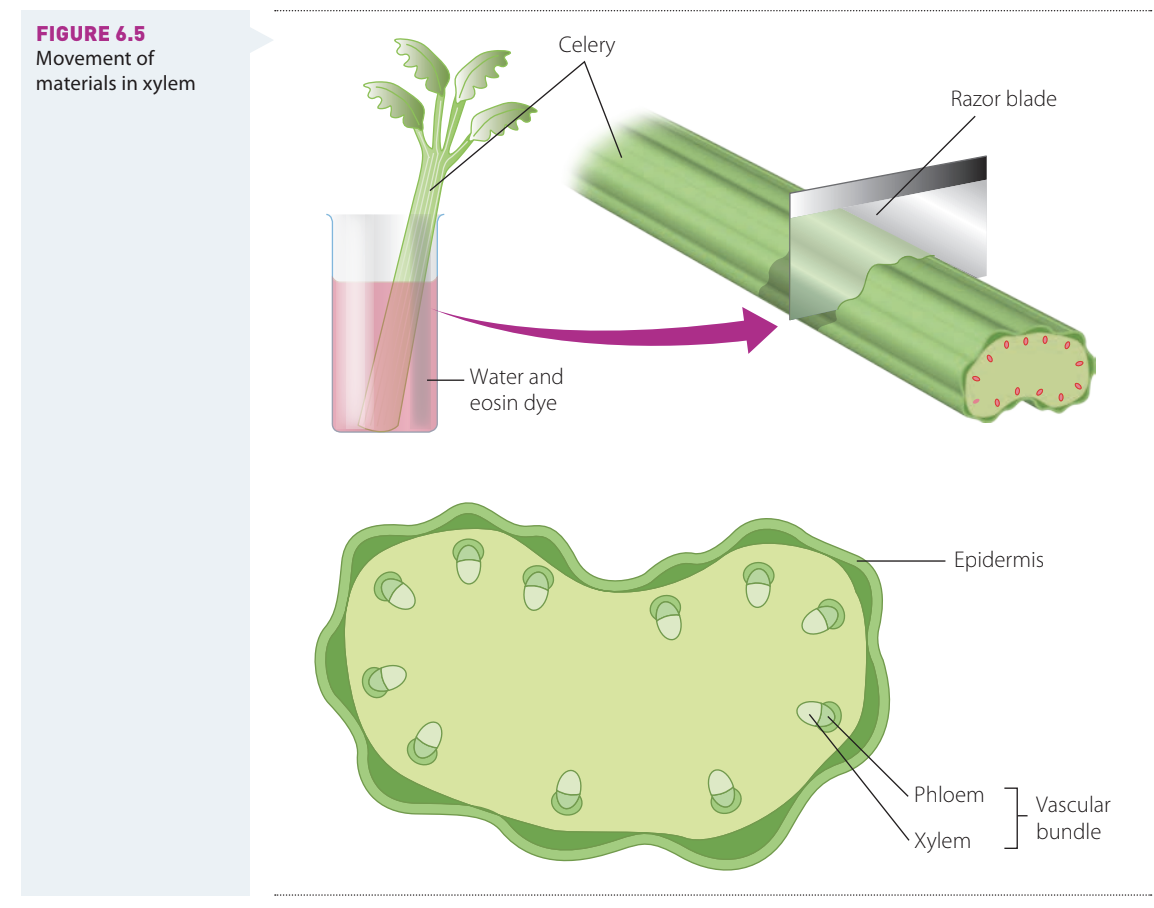
Students can investigate water transport in xylem using celery stalks placed in coloured dye solution (eosin).
Example
Practical Demonstration: Visualising Water Transport in Xylem
Method:
- Place fresh celery stalks in water containing coloured dye (eosin)
- Leave for several hours to allow dye uptake
- Cut transverse (cross) sections through the stem
- Cut longitudinal (lengthwise) sections through the stem
- Examine both types of sections under a microscope
Observations:
- The dye is drawn up through the xylem vessels
- Transverse sections show the dye concentrated in specific vascular bundles
- Longitudinal sections reveal the continuous tubes
- Microscopic examination shows the spiral lignin thickenings in xylem walls
This practical demonstration confirms that:
- Water moves through specific vascular tissue (xylem)
- The movement is upward through the plant
- Xylem forms a continuous transport system from roots to leaves
Phloem tissue
Structure of phloem
Phloem is specialised tissue that transports sugars and other products of photosynthesis from the leaves (where they are made) to all other parts of the plant where they are needed or stored.
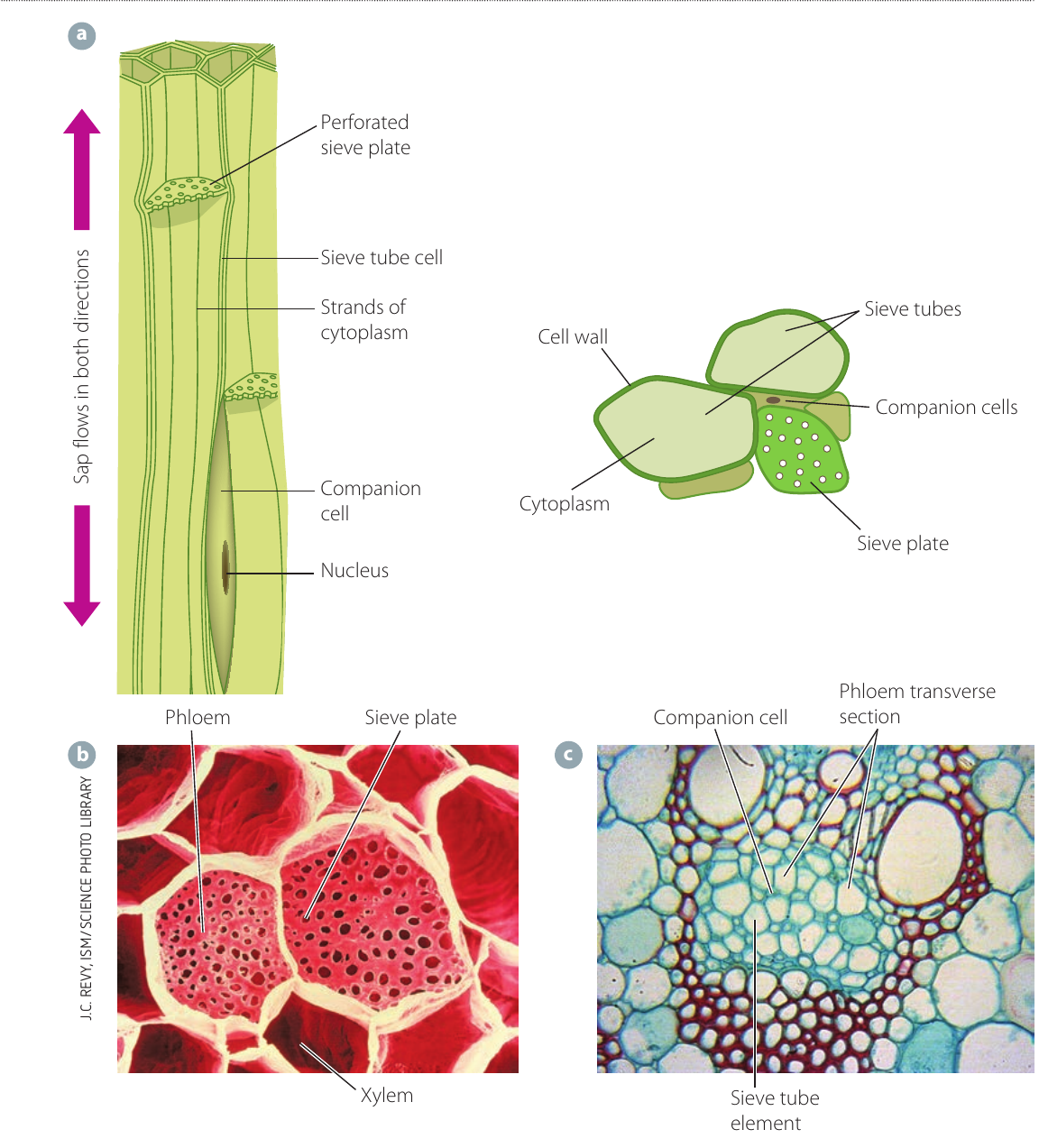
Phloem tissue contains two types of cells:
Sieve tube cells (sieve tube elements)
- Long, thin cells arranged end-to-end
- Have large pores through the cell walls at each end
- These perforated end walls are called sieve plates
- Contain some mitochondria and endoplasmic reticulum
- Lack nuclei and most other organelles
- Share cytoplasm with neighbouring cells
- Form channels through which sugars and plant products flow
Companion cells
- Found alongside sieve tubes
- Contain a nucleus and all normal cell organelles
- These organelles are absent in sieve tube cells
- Assist the effectiveness of sieve tube elements
- Provide ATP and nutrients
- Help load and unload sugars into and out of sieve tubes
Note
Key Difference from Xylem:
Unlike xylem, phloem consists of living tissue. The sieve tubes remain alive and functional, supported by their companion cells. This living nature is essential because phloem transport requires active processes that consume energy.
The source-sink theory
After glucose is produced during photosynthesis in leaves, it is either:
- Stored as starch in the leaf
- Converted to sucrose and distributed around the plant
The distribution of sucrose through phloem is called translocation. Unlike the one-way movement in xylem, substances in phloem can move in any direction depending on where they are needed.
Note
Up to of dissolved substances in phloem sap is sucrose. When sucrose reaches cells, it may be:
- Converted back to glucose for cellular respiration (energy release)
- Converted to starch for storage
How the source-sink theory works
Movement in phloem is driven by pressure differences:
- High-pressure regions form where sucrose is produced (source)
- Low-pressure regions form where sucrose is needed (sink)
- Phloem sap flows from high pressure to low pressure
At the source (typically leaves):
- Energy (ATP) is used to actively pump sugars into the phloem tissue
- This creates a highly concentrated solution
- Water moves into the phloem by osmosis from nearby xylem
- This creates a high-pressure region
At the sink (roots, flowers, fruits, storage organs):
- Energy is used to actively remove sugars from the phloem
- This creates a dilute solution
- Water leaves the phloem by osmosis and returns to the xylem
- This creates a low-pressure region
Important
Result: The pressure difference drives phloem sap from source to sink. The direction depends on where sugars are needed relative to where they are produced. Flow is continuous because sucrose is constantly added at the source and removed at the sink.
This means that phloem transport is bidirectional - unlike xylem, which only transports upward. For example, sugars can move downward from leaves to roots, or upward from storage organs to developing flowers.
Investigation: Microscopic structure of xylem and phloem
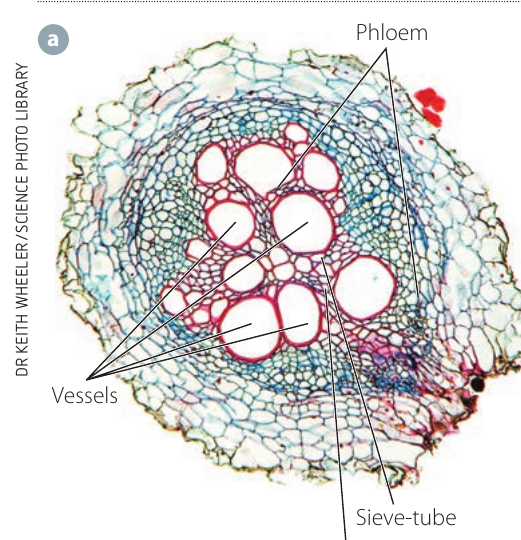
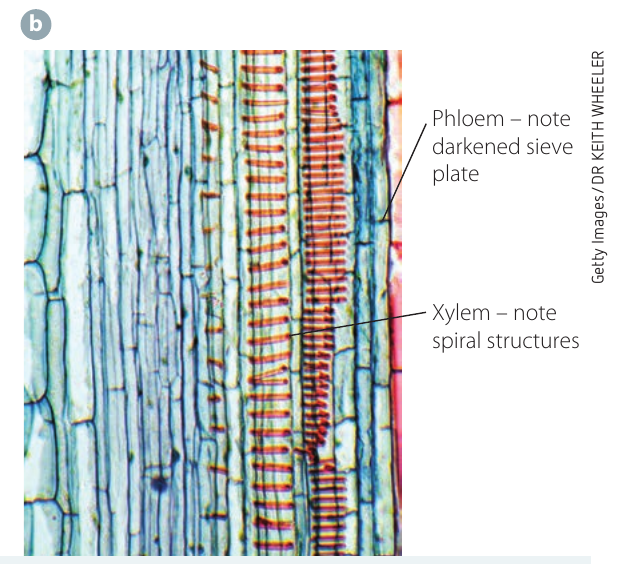
Examining prepared microscope slides reveals the structural differences between xylem and phloem tissues.
Note
Identifying Tissues Under the Microscope:
In typical stained slides:
- Xylem appears with pink/red-stained walls
- Phloem appears green or blue
Transverse (cross) sections show:
- The arrangement of vascular bundles in the stem
- Xylem vessels as large, hollow, circular structures with thick walls
- Phloem as smaller cells with visible sieve plates
- The relative positions of xylem and phloem within bundles
Longitudinal sections reveal:
- Continuous tubes of xylem with spiral or ring-like lignin thickenings
- Sieve plates as perforated walls between phloem cells
- The elongated structure of both tissue types
Key differences between xylem and phloem
| Feature | Xylem | Phloem |
|---|---|---|
| Substances transported | Water and dissolved mineral ions | Sugars (mainly sucrose), amino acids, some minerals |
| Direction of movement | One direction only: upward from roots to leaves | Any direction as required by the plant |
| Cell structure | Dead hollow tubes with lignified walls | Living cells with sieve plates and companion cells |
| Cell components | No cell contents, just empty space | Contain some organelles, shared cytoplasm |
| Driving mechanism | Transpiration pull, cohesion, adhesion, root pressure | Pressure differences between source and sink |
| Wall strengthening | Lignin thickenings in various patterns | No lignin, flexible cell walls |
Summary
Key Points to Remember:
-
Transport systems in plants use vascular tissue in bundles containing xylem and phloem.
-
Xylem transports water and minerals upward from roots to leaves through dead, hollow, lignified vessels and tracheids.
-
The transpiration-cohesion-tension theory explains xylem transport: evaporation from leaves creates tension that pulls water up, aided by cohesion between water molecules and adhesion to vessel walls.
-
Phloem transports sugars in any direction through living sieve tube cells supported by companion cells.
-
The source-sink theory explains phloem transport: pressure differences drive flow from where sugars are produced (source) to where they are needed (sink).
-
Both systems work together: water enters phloem from xylem at the source, then returns to xylem at the sink, creating a coordinated transport network throughout the plant.