Volumetric Analysis (HSC SSCE Chemistry): Revision Notes
📚Revision Notes
Volumetric Analysis
Introduction to quantitative analysis
In chemistry, there are two main types of analysis. Qualitative analysis gives us a simple 'yes or no' answer about whether a chemical reaction has occurred. However, quantitative analysis goes further by allowing chemists to measure and quantify reactions precisely.
Note
Quantitative analysis methods can be divided into two categories that help us understand different properties of chemical substances.
Physical methods measure physical properties such as:
- Solubility
- Absorption of light
- Density
- Spectroscopic properties (infrared, UV, NMR, atomic emission)
- Chromatography
Chemical methods involve using chemical reactions to form new compounds. These include:
- Volumetric analysis
- Gravimetric analysis
- Combustion analysis

What is volumetric analysis?
Volumetric analysis is a widely used chemical analysis method in industry. The term 'volumetric' means measuring volumes. This technique determines the concentration of an unknown sample by measuring how much of it reacts with a known volume of another substance that has a known concentration.
Note
The main technique used in volumetric analysis is called titration. This method allows chemists to determine unknown concentrations by carefully measuring reaction volumes.
Understanding titration and equivalence point
Titration involves determining the equivalence point of a reaction. Let's understand this with an example:
Example
Worked Example: Understanding the Equivalence Point
Consider the reaction between sodium hydroxide and sulfuric acid:
The balanced equation shows us that moles of sodium hydroxide react with mole of sulfuric acid. This mole ratio is crucial for understanding the equivalence point.
The equivalence point is reached when the reactants are present in exactly the mole ratio shown in the balanced equation. In this example, the equivalence point occurs when there are twice as many moles of sodium hydroxide as sulfuric acid.
This is because:
- mole of produces moles of hydrogen ions ()
- moles of produce moles of hydroxide ions ()
At the equivalence point, there are equal numbers of moles of hydrogen ions and hydroxide ions.
End point versus equivalence point
In many acid-base reactions, the solutions are clear both before and after the reaction. This makes it impossible to see when the equivalence point has been reached just by looking. This is where acid-base indicators become essential.
Important
Understanding the Difference:
The equivalence point is the theoretical point where reactants are present in the exact stoichiometric ratio.
The end point is the physical, visible sign that the equivalence point has been reached. In acid-base titrations, this is typically shown by a colour change of an indicator added to the solution.
For accurate results, we need to choose an indicator where the end point occurs as close as possible to the equivalence point.
Specialised glassware for volumetric analysis
Since volumetric analysis depends on accurate volume measurements, chemists use specialised glassware with precise measuring scales. The three most important pieces of equipment are:
- Volumetric flasks
- Burettes
- Pipettes
Reading measurements accurately
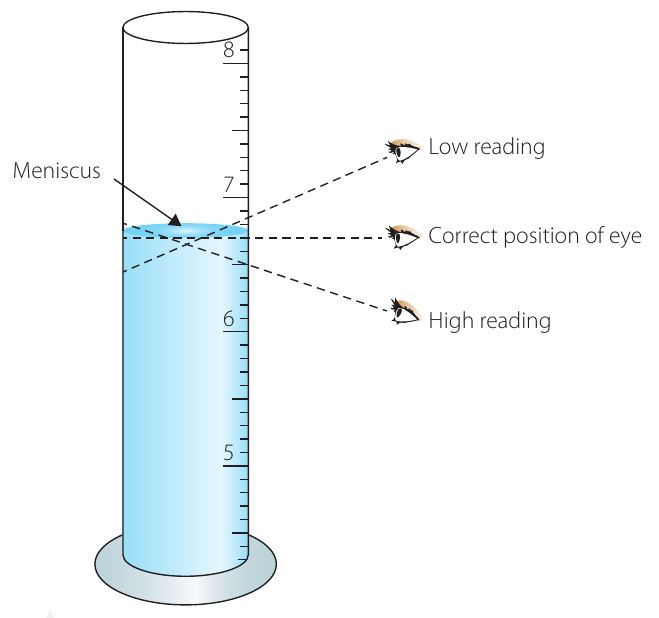
When using any measuring glassware, it's essential to minimise parallax error. This error occurs when you read a measurement from the wrong angle.
Important
To avoid parallax error:
- Position your eye level directly in line with the measuring mark
- Read the volume at the bottom of the meniscus (the curved surface of the liquid)
- Never read from above or below the meniscus level
Parallax errors can significantly affect the accuracy of your results, so proper technique is crucial.
Volumetric flask
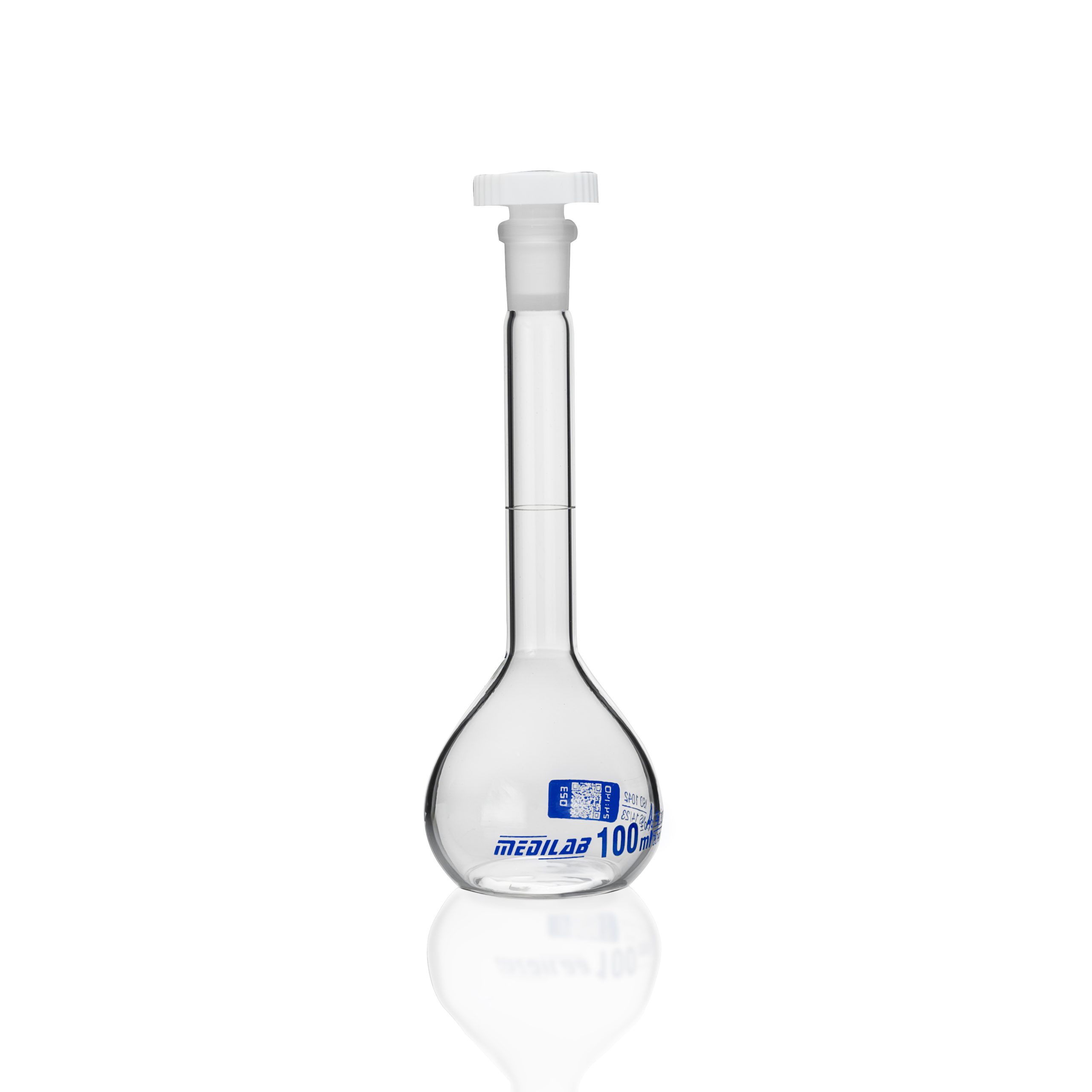
A volumetric flask is a flat-bottomed flask with a long, narrow neck. It is used for accurately diluting solutions to a specific volume.
Key features:
- Available in various sizes (commonly and in schools)
- Has a single line marked on the neck indicating the exact volume
- The narrow neck allows for very precise volume measurements
Note
How to use a volumetric flask:
- Always rinse the flask with the solvent (usually water) before use
- Pour your solution into the flask
- Add solvent carefully using a wash bottle or Pasteur pipette (a dropper with a fine tip)
- Fill until the bottom of the meniscus just touches the line on the flask
- Never overfill - if you do, you must empty the flask and start again
Important: The bottom of the meniscus must be exactly touching the line for an accurate measurement.
Burette
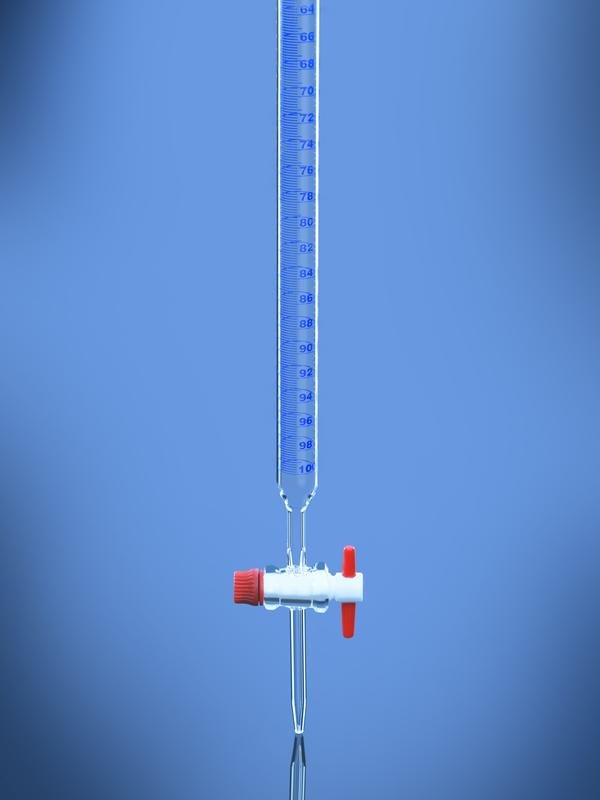
A burette is a long, narrow glass tube with a tap at the bottom. The most common size is a burette.
Key features:
- Has an inverted measuring scale
- Zero position is at the top
- mark is near the bottom
- Measures the volume of solution that flows out through the tap
Note
How to prepare a burette:
Rinsing procedure:
- Pour a small volume of your solution into the burette
- Hold the burette horizontally
- Open the tap and turn the burette slowly in your hands
- Ensure all internal surfaces are rinsed with the solution
- Empty this rinse solution
- Always rinse with the solution that will be used, not with water
Filling procedure:
- Clamp the burette vertically on a retort stand
- Close the tap
- Pour solution into the burette until it's above the zero mark
- Place a flask under the burette
- Open the tap briefly to fill the space below the tap (removing any air lock)
- Adjust the solution level so the meniscus sits exactly at the zero mark
Pipette
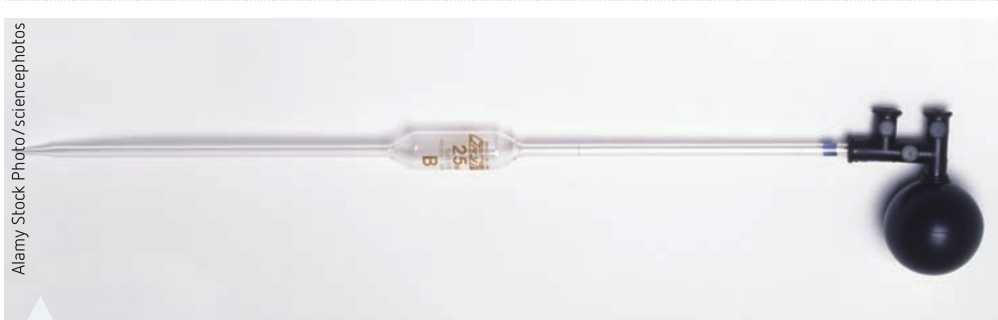
A pipette is a thin glass tube that accurately measures a fixed volume of solution. The most common sizes used in schools are and pipettes.
Key features:
- Measures one specific volume only
- Has a single line indicating the volume
- Used with a pipette filler (a rubber bulb) for safety
- Never use your mouth to draw up solution
Note
How to prepare a pipette:
Rinsing procedure:
- Use the pipette filler to draw up a small volume of your solution
- Remove the pipette filler
- Hold the pipette horizontally
- Turn the pipette in your hands to rinse all internal surfaces
- Empty this rinse solution
- Always rinse with the solution that will be used, not with water
Filling and dispensing procedure:
- Use the pipette filler to draw solution into the pipette
- Stop when the liquid level is above the line
- Slowly release solution until the bottom of the meniscus just touches the line
- Place the pipette over your receiving flask
- Remove the pipette filler and allow the pipette to empty naturally under gravity
- Tap the tip of the pipette on the inside of the flask
- Do not try to empty the small amount remaining in the tip - the pipette is calibrated to deliver the correct volume when allowed to drain naturally
Important
Safety note: Never pipette by mouth. Always use a pipette filler to draw up solutions. This prevents accidental ingestion of potentially harmful chemicals.
Laboratory safety
Important
Safety Practices for Volumetric Analysis:
When working with glassware in volumetric analysis, always remember these safety practices:
- Keep all glassware away from the edges of benches to prevent breakage
- If glassware breaks, immediately inform your teacher
- Never attempt to pick up broken glass yourself
- Wear safety goggles when working with chemicals
- Use appropriate equipment like pipette fillers rather than dangerous shortcuts
Laboratory safety is everyone's responsibility. Following proper procedures protects you and your classmates from potential harm.
Identifying the end point using indicators
During volumetric analysis, we need a way to visually determine when the equivalence point has been reached. Acid-base indicators provide this visual signal through a colour change.
How indicators work
Note
Acid-base indicators are weak acids where the acid form has a different colour from its conjugate base form. As the pH of the solution changes during titration, the indicator changes colour, showing us when we've reached the end point.
Some indicators occur naturally, while others are synthesised in laboratories. Universal indicator is a special mixture of several indicators, which is why it shows multiple colour changes across the pH range of -.
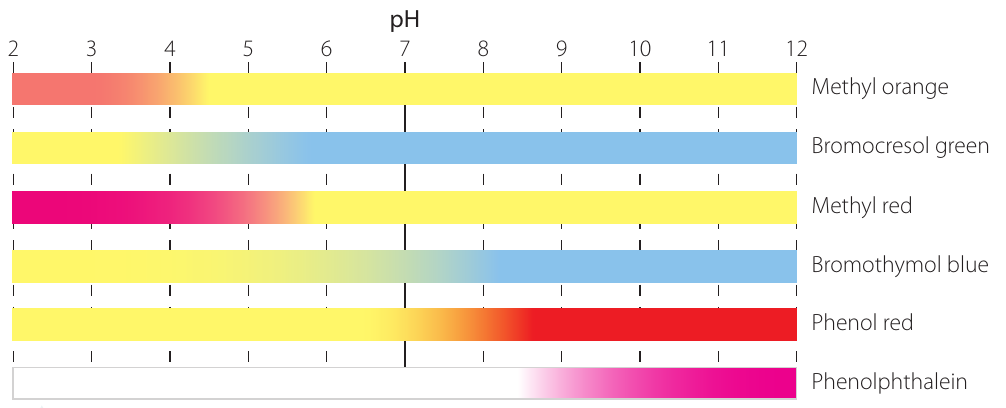
Common indicators and their properties
Different indicators change colour at different pH ranges. Choosing the right indicator depends on the type of acid-base reaction you're performing.
| Indicator | Colour change (low pH to high pH) | pH range |
|---|---|---|
| Methyl orange | Red to yellow | - |
| Bromocresol green | Yellow to blue | - |
| Methyl red | Pink to yellow | - |
| Bromothymol blue | Yellow to blue | - |
| Phenol red | Yellow to red | - |
| Phenolphthalein | Colourless to red | - |
Choosing the right indicator
The selection of an appropriate indicator is crucial for accurate titrations. Different types of acid-base reactions have different equivalence point pH values, which affects our choice of indicator.
Important
Indicator Selection Guidelines:
For strong acid-strong base titrations:
- Most indicators will work
- Phenolphthalein or methyl orange are commonly used
- The equivalence point occurs at pH
For weak acid-strong base titrations:
- Use phenolphthalein (changes in the basic range)
- The equivalence point occurs above pH
For strong acid-weak base titrations:
- Use methyl orange (changes in the acidic range)
- The equivalence point occurs below pH
Exam tip: The indicator must change colour at or very near the equivalence point of your specific reaction. Choose an indicator whose pH range includes the pH at equivalence.
Practise with glassware
Students typically learn to use volumetric glassware through practical investigations. These exercises help develop the skills needed to:
- Rinse glassware correctly
- Fill glassware to the correct level
- Read measurements accurately
- Avoid parallax errors
- Handle equipment safely
Through practice, you'll become confident in reading measurements to the appropriate number of decimal places for each piece of equipment.
Summary
Key Points to Remember:
- Volumetric analysis determines the concentration of an unknown solution by measuring volumes that react with a known solution
- The equivalence point occurs when reactants are present in the exact mole ratio shown in the balanced equation
- The end point is the visible sign (usually a colour change) that shows the equivalence point has been reached
- Parallax error is minimized by reading measurements at eye level with the bottom of the meniscus
- Volumetric flasks are rinsed with solvent (water), while burettes and pipettes are rinsed with the solution they will contain
- Different acid-base indicators change colour at different pH ranges - choose the appropriate one for your titration
- Always follow proper safety procedures when working with glassware and chemicals