Infrared Spectroscopy (HSC SSCE Chemistry): Revision Notes
📚Revision Notes
Infrared Spectroscopy
Infrared (IR) spectroscopy is an analytical technique that helps chemists identify which chemical bonds or functional groups are present or absent in a compound. This technique is relatively inexpensive and straightforward to use, making it valuable in many fields including industrial chemistry for monitoring reaction pathways, forensic science for evidence analysis, and pharmaceutical development for studying new drugs.
Principles of infrared spectroscopy
Molecular vibrations
Molecules are never completely still—they are constantly moving and vibrating. Understanding these vibrations is key to understanding how IR spectroscopy works. There are two basic types of molecular vibrations:
- Stretching vibrations: where atoms move further apart and closer together along the bond axis
- Bending vibrations: where the angle between bonds changes
The spring model
A simple diatomic molecule (a molecule with two atoms) can be thought of like two heavy spheres connected by a spring. The atoms vibrate backwards and forwards around their equilibrium (rest) position. This simple model helps us understand molecular vibrations.
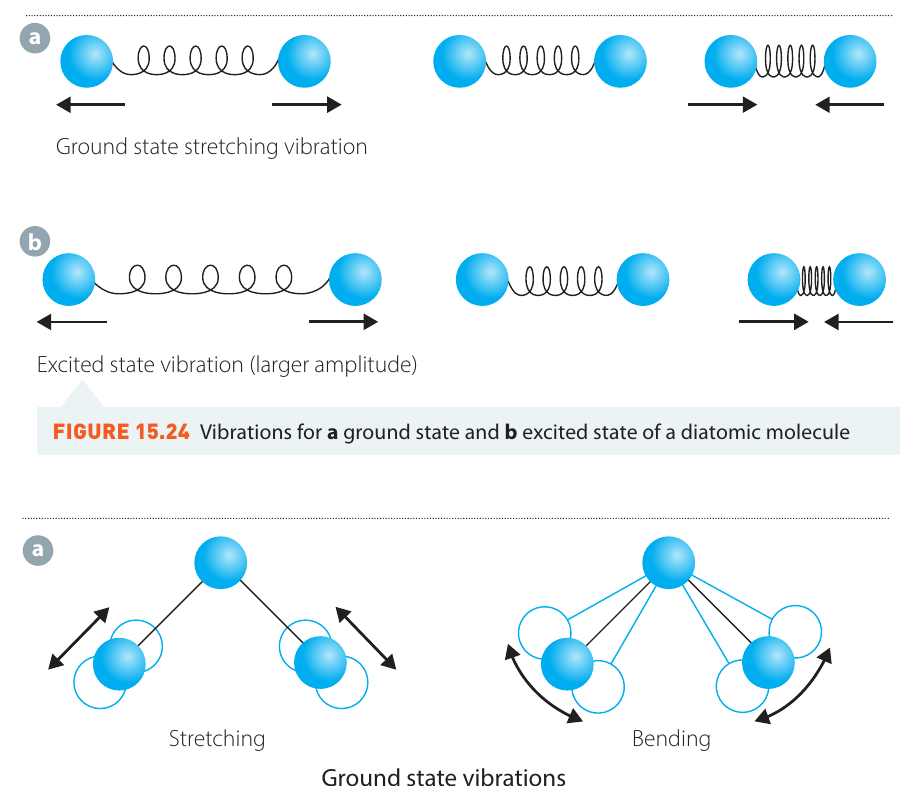
Note
In the ground state, molecules vibrate with normal energy. When they absorb infrared radiation, they enter an excited state where they vibrate with greater energy and amplitude. This means the "spring" (chemical bond) stretches longer and compresses more than it did in the ground state.
Vibrations in polyatomic molecules
Polyatomic molecules (molecules with more than two atoms) have more complex vibration patterns. For example, a triatomic molecule like water can undergo both stretching and bending vibrations.
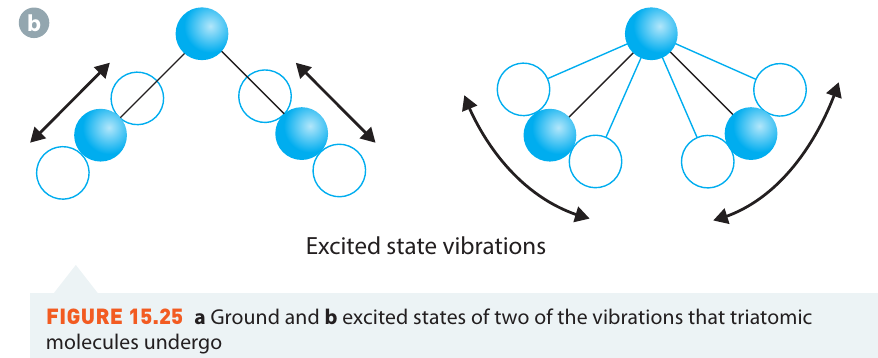
In the excited state, these vibrations occur with greater amplitude—the stretching is more pronounced, and the bending angles change more dramatically.
Important exceptions
Important
Diatomic molecules such as and cannot be detected by infrared spectroscopy. This is because they do not have the required molecular properties to absorb infrared radiation effectively.
Factors affecting energy absorption
The amount of energy a molecule absorbs depends on three main factors:
- Bond length: The distance between bonded atoms affects the vibration frequency
- Bond strength: Stronger bonds require more energy to vibrate
- Double bonds need more energy than single bonds to increase vibration
- Atom size: Heavier atoms require more energy to vibrate than lighter atoms
By measuring which frequencies of infrared radiation are absorbed, we can determine which types of bonds are present in the molecule.
How infrared spectroscopy works
The process
During IR spectroscopy, a sample is placed in a special cell positioned in a beam of infrared radiation. The infrared source produces radiation across a range of different frequencies. As the radiation passes through the sample, the molecules absorb specific frequencies that match their vibrational energy levels. The percentage of radiation transmitted (not absorbed) is recorded at each frequency.
Reading an IR spectrum
An infrared spectrum has two important axes:
The x-axis (horizontal): Shows the wavenumber measured in (reciprocal centimetres). Wavenumber is the inverse of wavelength. The scale typically ranges from 4000 to 500 , and it's important to note that the scale changes dramatically, with unequal spacing.
The y-axis (vertical): Shows the percentage transmittance. The baseline at the top represents 100% transmittance (meaning no absorption at that wavenumber). When radiation is absorbed, less is transmitted, causing the line to drop and create a trough.
Why IR spectra look "upside down"
Note
Unlike some other types of spectra, infrared spectra show troughs (downward dips) rather than peaks pointing upward. The spectrum starts at 100% transmittance (the baseline), and drops down when absorption occurs. This makes IR spectra appear "upside down" compared to other spectroscopy techniques.
Interpreting infrared spectra
Looking for key absorption bands
When interpreting an IR spectrum, you look for characteristic troughs or absorption bands. IR spectra contain many bands, but most are ignored because they don't provide useful structural information. The key area to examine is the higher wavenumber region (above about 1500 ).
The fingerprint region
Important
The region from 1500 to 500 is called the fingerprint region. This region is unique to each compound, like a molecular fingerprint.
It can be used to:
- Confirm the identity of an unknown compound by comparing its spectrum to that of a known sample
- Check if a sample is pure by comparing its fingerprint region to that of a pure standard
The intensities of troughs in the fingerprint region may differ between samples due to concentration differences, but the pattern of troughs should match.
Important functional groups and their absorption bands
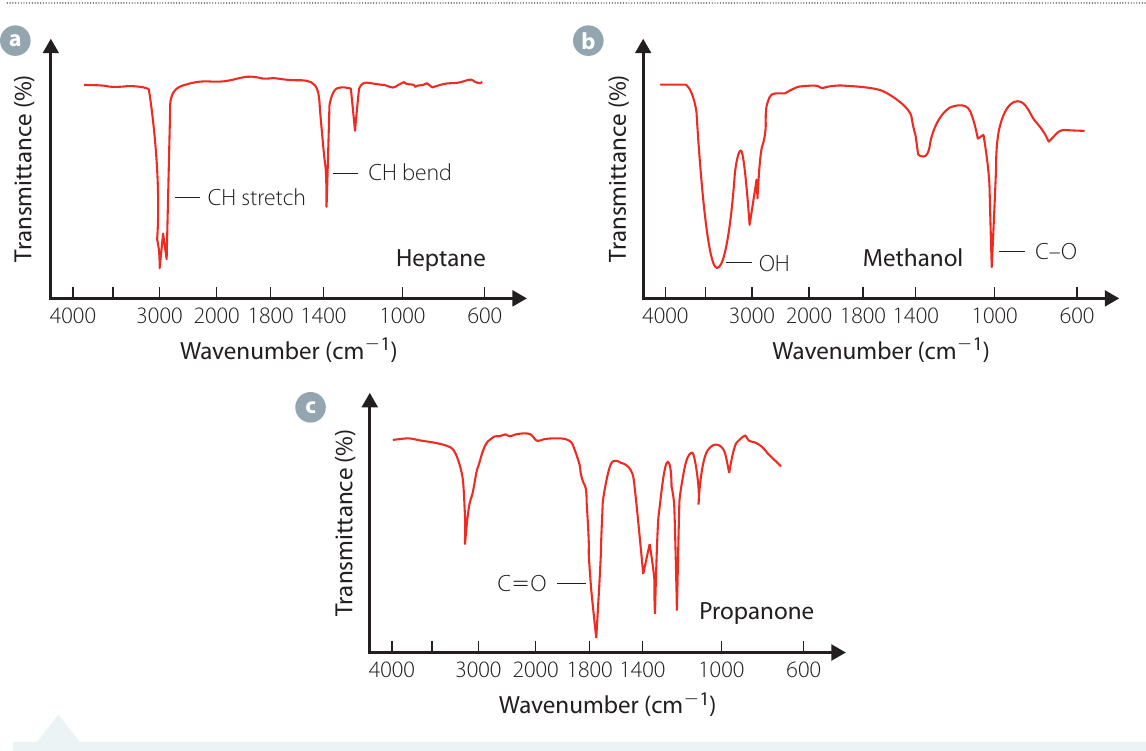
Carbon-hydrogen bonds (): Almost every organic molecule contains C—H bonds, which absorb in the range 2800-3000 . Because this is so common, this absorption doesn't provide much useful information for identification.
Hydroxyl groups in alcohols (): The O—H bond in alcohols typically absorbs at 3000-3500 . This produces a broad, strong, and very characteristic trough that is easy to identify.
Carbonyl groups (): The C=O double bond absorbs at around 1700 . This is a very useful and distinctive absorption band found in aldehydes, ketones, carboxylic acids, and esters.
Carboxylic acids (): Carboxylic acids show both a broad O—H absorption (around 3000 ) AND a C=O absorption (around 1700 ). The presence of both these bands together strongly suggests a carboxylic acid group.
Carbon-carbon bonds (): Single C—C bonds don't provide much useful information, similar to C—H bonds, because they're present in nearly all organic compounds.
Characteristic absorption frequencies
Note
The following table summarises the characteristic infrared absorption frequencies for common functional groups found in organic compounds. These ranges are essential for identifying unknown compounds in practical work.
| Class of compound and bond | Band positions () |
|---|---|
| ALKANES, ALKYL GROUPS | |
| 2850-3300 | |
| 750-1100 | |
| ALKENES | |
| 3020-3100 | |
| 1620-1680 | |
| ALKYL HALIDES | |
| 600-800 | |
| 500-600 | |
| 500 | |
| ALCOHOLS | |
| 3230-3500 (strong, broad) | |
| 1050-1150 | |
| AMINES | |
| 3310-3500 | |
| 1030-1230 | |
| CARBONYL COMPOUNDS | |
| 1670-1780 | |
| CARBOXYLIC ACIDS | |
| 2500-3100 (strong, broad) |
Example
Exam tip: Analysing IR Spectra
When analysing an IR spectrum in an exam, follow this systematic approach:
Step 1: Look for a broad peak around 3000-3500 (suggests )
Step 2: Look for a sharp peak around 1700 (suggests )
Step 3: If both are present, consider carboxylic acid as a strong possibility
Step 4: Use the fingerprint region to confirm identity if a reference spectrum is provided
Practical application: matching structures to spectra
A common application of IR spectroscopy is identifying unknown compounds by matching their spectra to possible structures. This often involves:
- Examining molecular structures and calculating their molar masses
- Using mass spectrometry data to identify the molecular mass and common fragment ions
- Looking for key functional groups in the IR spectrum
- Matching the pattern of absorption bands to the structure
Example
Identifying Functional Groups from IR Data
For example, if you see:
- A strong, broad absorption around 3300 → likely contains
- A sharp absorption around 1700 → likely contains
- Both present together → suggests carboxylic acid or possibly both alcohol and carbonyl groups in the same molecule
Summary
Key Points to Remember:
- Infrared spectroscopy identifies functional groups by detecting which frequencies of IR radiation molecules absorb
- Molecules vibrate in two main modes: stretching (along the bond axis) and bending (changing bond angles)
- Absorption depends on three factors: atom size, bond length, and bond strength—heavier atoms and stronger bonds need more energy
- IR spectra show troughs, not peaks: the baseline is at 100% transmittance, and absorption creates downward dips
- The fingerprint region (1500-500 ) is unique to each compound and can confirm identity
- Key absorptions to remember: (3000-3500, broad), (around 1700), (2800-3000)