Bond Energy (HSC SSCE Chemistry): Revision Notes
📚Revision Notes
Bond Energy
What is bond energy?
Bond energy is the amount of energy needed to break a chemical bond. When we break bonds apart, we must supply energy to overcome the forces holding the atoms together. This concept helps us understand why some compounds are more stable than others and why certain reactions release or absorb energy.
Note
The symbol commonly used for bond energy is . For example, we write for the chlorine-chlorine bond energy, for the carbon-hydrogen bond energy, and for the carbon-carbon bond energy.
Examples of bond energies:
Chlorine molecule: The bond energy is the enthalpy change when a chlorine molecule breaks into two separate chlorine atoms:
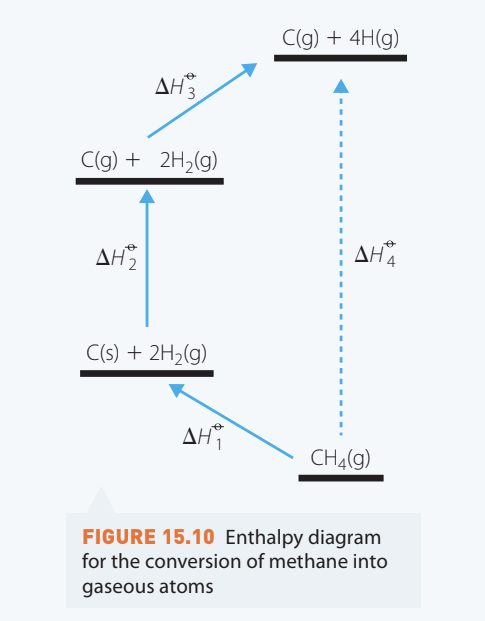
Methane molecule: The bond energy is one quarter of the enthalpy change needed to break methane into completely separated atoms. We divide by four because methane contains four bonds:
Ethane molecule: The bond energy is the enthalpy change when ethane ( or ) breaks into two fragments:
Bond energies can be calculated using standard enthalpies of formation and Hess's law. However, we sometimes need an additional quantity called the heat of atomisation.
Heat of atomisation
The heat of atomisation () of an element is the enthalpy change required to produce gaseous atoms from the element in its standard state. Standard state means the element at a pressure of and at the specified temperature (usually or ). This value is expressed per mole of atoms produced.
Example for carbon: The heat of atomisation of carbon at is the per mole for:
This represents the energy needed to convert solid carbon (graphite) into individual gaseous carbon atoms.
Example for chlorine: The heat of atomisation of chlorine at is the per mole of chlorine atoms. Since chlorine naturally exists as molecules, we use half a mole of molecules to get one mole of atoms:
Important
Important relationship: The heat of atomisation of an element equals the standard heat of formation of gaseous atoms of that element.
Table of heats of atomisation
| Atom | (kJ mol⁻¹) | Atom | (kJ mol⁻¹) | Atom | (kJ mol⁻¹) |
|---|---|---|---|---|---|
| H | 218 | Br | 112 | Ca | 177 |
| O | 249 | I | 107 | Zn | 131 |
| N | 473 | C | 717 | P | 315 |
| Cl | 122 | Na | 109 | S | 279 |
Note
Key observations from the table:
- Nitrogen has a very high heat of atomisation () because the triple bond is very strong
- Carbon also has a high value () because it must be converted from solid graphite to gaseous atoms
- Iodine has a relatively low value () because the bond is weaker than other halogen bonds
Calculating bond energies using Hess's law
We can calculate bond energies by combining standard enthalpies of formation with heats of atomisation, using Hess's law to connect different reaction pathways. The key principle is that the total enthalpy change is the same regardless of which path we take.
Example
Worked Example: Calculating the O-H bond energy in water
Let's calculate the bond energy of the bond in water using an enthalpy diagram approach.
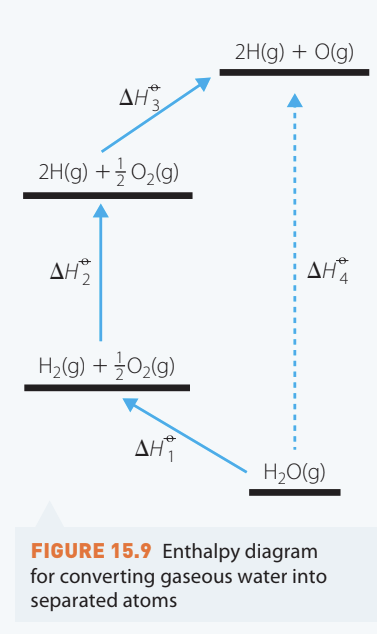
Step 1: Set up the enthalpy pathways
We have two pathways from to separated atoms :
- Direct pathway:
- Indirect pathway:
By Hess's law, these must be equal:
Step 2: Identify what each represents
- is the negative of (going backwards from water to elements)
- is twice (converting one mole of to two moles of H atoms)
- is (converting half a mole of to one mole of O atoms)
- (breaking two bonds in water)
Step 3: Substitute into equation 1
Step 4: Insert numerical values
From Table 1:
From Table 2: and
Common bond energies
The table below shows bond energies for common chemical bonds at . These values are averages measured across many different compounds containing each type of bond.
| Bond | Bond energy (kJ mol⁻¹) | Bond | Bond energy (kJ mol⁻¹) | Bond | Bond energy (kJ mol⁻¹) |
|---|---|---|---|---|---|
| H—Br | 366 | I—I | 151 | C≡O in CO₂ | 805 |
| H—Cl | 432 | N—N | 163 | C≡O in CO | 1080 |
| H—I | 299 | O—O | 146 | O=O in O₂ | 498 |
| H—O | 463 | C—C | 348 | O—O in O₃ | 302 |
| H—N | 391 | C—H | 413 | N≡N in N₂ | 945 |
| H—S | 360 | C—O | 358 | C=C in C₂H₄ | 610 |
| H—H | 436 | C—Cl | 339 | C≡C in C₂H₂ | 835 |
| Br—Br | 193 | C—Br | 285 | ||
| Cl—Cl | 242 | C—F | 485 |
Note
Key patterns to notice:
- Single bonds have lower energies than double bonds, which have lower energies than triple bonds
- For hydrogen-halogen bonds: (432) (366) (299)
- The bond is particularly strong (485 kJ mol⁻¹)
- Multiple bonds: (945) is one of the strongest bonds
Bond energy, stability and reactivity
There is a direct relationship between bond energy and the stability and reactivity of compounds: the greater the bond energy, the more stable the compound and the less reactive it is. This principle helps us predict and explain chemical behaviour.
Note
Example 1: Oxygen vs ozone
Oxygen () is a very stable gas that we breathe safely. Its allotrope ozone () is notoriously unstable - samples of liquid ozone can spontaneously explode! This dramatic difference arises from their bond energies:
- Bond energy in : 498 kJ mol⁻¹
- Bond energy in : 302 kJ mol⁻¹
The much lower bond energy in ozone makes it highly unstable and very reactive compared to normal oxygen.
Note
Example 2: Water vs hydrogen peroxide
Water () is very stable and relatively unreactive - which is fortunate since it covers most of Earth's surface! Hydrogen peroxide () is much less stable and considerably more reactive:
- bond energy in hydrogen peroxide: 146 kJ mol⁻¹
- bond energy: 463 kJ mol⁻¹
The two bonds in hydrogen peroxide have similar energies to those in water. However, the strength of the weakest bond in a molecule determines its stability and reactivity. The weak bond makes hydrogen peroxide much more prone to decomposition and chemical reactions than water.
Estimating ΔH from bond energies
We can use bond energies to estimate the enthalpy change () for a reaction. The method involves imagining that all bonds in the reactants break first, then new bonds form to create the products.
Key equation:
Alternatively:
Important
Remember: breaking bonds requires energy (positive value), while forming bonds releases energy (negative value).
Example
Worked Example: Ethane reacting with bromine
Calculate for the reaction between ethane and bromine to form bromoethane () and hydrogen bromide, with all substances in the gas phase.
Step 1: Write the balanced equation
Step 2: Identify bonds broken and formed
Bonds broken:
- One bond in ethane
- One bond in bromine
Bonds formed:
- One bond in bromoethane
- One bond in hydrogen bromide
Step 3: Apply equation 15.7
Step 4: Substitute values from Table 3
The negative value indicates this reaction is exothermic - it releases energy.
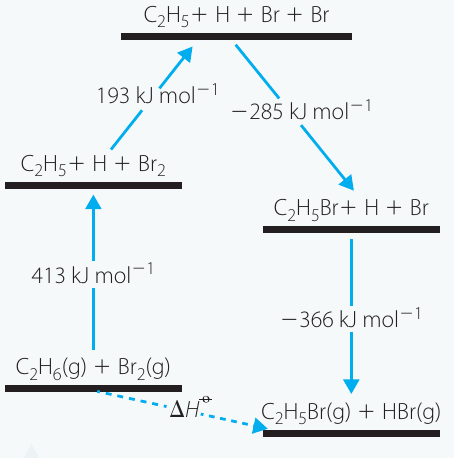
The energy diagram above shows the step-by-step process. The reactants first gain energy as bonds break, then release more energy as new bonds form, resulting in a net energy release of .
Accuracy and limitations
Important
Important consideration about accuracy:
Enthalpy changes calculated from bond energies are not particularly accurate. This is because bond energies vary slightly depending on the molecule. For example:
- The bond energy in chloromethane is not exactly the same as the bond energy in dichloroethane
- Values in Table 15.3 are averages across many compounds
When to use bond energies:
- For discussing stability and reactivity of compounds
- For estimating when standard enthalpies of formation are not available
- For getting a quick approximation of reaction energetics
For accurate calculations: Use standard enthalpies of formation with Hess's law whenever possible.
Summary
Key Points to Remember:
-
Bond energy is the energy needed to break a chemical bond. The symbol is used, such as or .
-
Heat of atomisation () is the enthalpy change to convert an element in its standard state into gaseous atoms, expressed per mole of atoms.
-
Strong bonds mean stable molecules: Higher bond energies indicate more stable, less reactive compounds. Weak bonds make molecules unstable and reactive.
-
To estimate ΔH for reactions: Use the formula . Breaking bonds requires energy, forming bonds releases energy.
-
Bond energies are averages: Values vary slightly between different molecules, so calculations give estimates rather than exact values. Use standard enthalpies of formation for accurate results.