Two Basic Drives (HSC SSCE Chemistry): Revision Notes
📚Revision Notes
Two Basic Drives
Introduction: predicting whether reactions will occur
With countless chemical compounds available, chemists face an important question: will a proposed reaction actually happen? When starting materials are mixed in the laboratory, sometimes no observable reaction occurs. This could mean either:
- The reaction is very slow under current conditions but might proceed under different conditions, or
- The reaction simply will not occur under any conditions.
Being able to calculate whether a reaction is possible would save significant time and effort. Fortunately, such calculations can determine:
- The reaction will not occur under any conditions, or
- The reaction may occur.
Note
Current knowledge cannot predict how fast a reaction will proceed. Despite this limitation, these calculations remain valuable—if a reaction won't occur, no time needs to be wasted trying to make it happen.
This section explores the question: Is a reaction spontaneous or not?
The energy drive: nature's preference for lower energy
Our everyday experiences show that systems naturally move towards states of lower energy:
- Stones roll down hills rather than up
- Water flows from clifftops to the ground below
- Compressed springs unwind and relax
In each case, the system moves from high potential energy to lower potential energy.
Chemical reactions follow the same principle. Exothermic reactions agree with this concept—chemicals move from higher chemical energy to lower chemical energy, releasing energy (usually as heat) in the process. This is why exothermic reactions are much more common than endothermic ones.
Note
The energy drive represents nature's tendency to move systems from high-energy states to low-energy states. This explains why reactions that release heat (exothermic reactions) are so common in nature.
The puzzle: spontaneous endothermic reactions
However, some endothermic reactions occur spontaneously, which seems contradictory. Consider these examples:
Important
The following reactions all absorb heat (endothermic with positive values) yet they occur spontaneously. This appears to contradict the energy drive, which suggests reactions should release energy!
Endothermic chemical reactions:
- Magnesium chloride and sodium carbonate solutions react to form magnesium carbonate precipitate:
- Crystalline barium hydroxide reacts with crystalline ammonium thiocyanate:
- Sodium hydrogen carbonate reacts with citric acid solution:
Endothermic physical changes:
- Liquids like ethanol evaporate:
- Sodium thiosulfate dissolves readily in water:
All these processes absorb heat as they occur, meaning the systems move naturally towards states of higher energy. This suggests another natural tendency must exist alongside the drive towards lower energy.
The entropy drive: nature's preference for chaos
In nature, there is a second fundamental drive: the drive towards increased chaos or increased randomness.
Observable examples of the entropy drive
Think about these everyday observations that demonstrate the tendency towards disorder:
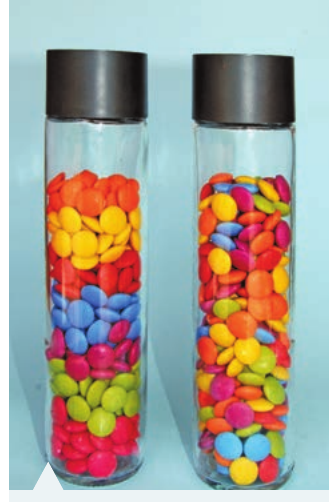
- Mixed coloured lollies never spontaneously separate into groups by colour
- When gases mix together, they never spontaneously separate
- A mixture of alcohol and water never separates on its own
- A tidy room becomes messy over time (never the reverse!)
Note
The reverse processes never occur naturally. You never see mixed gases spontaneously separate, or a messy room spontaneously becoming tidy. This demonstrates the universal tendency towards greater disorder.
Defining entropy
The physical quantity entropy (symbol: ) measures the amount of randomness, chaos, or lack of ordered structure in a substance.
Important
Key principle: A move from an ordered state to a less ordered one corresponds to an increase in entropy, meaning is positive.
If the entropy drive for a reaction is positive, the change in entropy is positive; if the entropy drive is negative, then is negative.
In the five endothermic processes described above (equations 16.1–16.5), there was a change from a fairly ordered state to a much less ordered one. Therefore, is positive for each process. The drive towards greater entropy (greater chaos) is stronger than the drive towards lower energy, so these reactions occur as written despite being endothermic.
Competition between the two drives
In chemical reactions, usually the energy drive dominates, which explains why exothermic reactions are more common. However, in some reactions the entropy drive is stronger than the energy drive, allowing endothermic reactions to be spontaneous.
The direction of a reaction depends on which drive is larger.
The relationship between drives and changes
Important
There's a crucial relationship to remember between the direction of drives and the sign of changes:
Entropy drive and :
- If the entropy drive is forward (positive), then is positive
- If the entropy drive is backward (negative), then is negative
Energy drive and (opposite relationship):
- If the energy drive is forward (reaction releases energy), then is negative (exothermic)
- If the energy drive is backward (reaction requires energy), then is positive (endothermic)
Notice how the entropy relationship is the reverse of the energy relationship!
Investigation 16.1: modelling entropy changes in reactions
This investigation helps students understand entropy by constructing models of substances undergoing physical or chemical changes. The key question is: Does randomness increase or decrease?
Aim
To model entropy changes in reactions and understand the concept of disorder.
Key parts of the investigation
Note
Part A: States of matter
- Model water molecules in solid, liquid, and gaseous states
- Compare randomness in each state
- Determine which state has greatest entropy
Part B: Dissolution
- Model sodium chloride as a solid and in aqueous solution
- Compare arrangement and randomness of ions
- Determine which state has greater entropy
Part C: Diffusion of perfume
- Observe how perfume molecules spread through air
- Demonstrate entropy increase through gas mixing
Part D: Ice cube melting
- Observe coloured ice cube in water
- Visual demonstration of entropy increase
Part E: Modelling gas production
- Use sugar cubes (solids) and milk cartons (gases) to represent entropy
- Model various reactions to predict entropy changes
- Determine if entropy increases, decreases, or stays constant
Part F: Teacher demonstration (endothermic reaction)
- Observe reaction between barium hydroxide and ammonium chloride
- Very endothermic reaction that produces gas
- Demonstrates entropy increase overcoming energy drive
Important safety considerations
The teacher demonstration in Part F involves hazardous chemicals:
| Hazard | Safety measures |
|---|---|
| Ammonia gas is released | Teacher demonstration only. Perform in fume cupboard or well-ventilated area. Check if students have asthma or respiratory conditions. |
| Barium hydroxide is very corrosive to skin and eyes | Wear safety glasses. Perform in fume cupboard. Use plastic spoon to transfer chemicals. |
Generalizations about randomness and entropy
Investigation 16.1 demonstrates several important principles about how entropy relates to the physical state and behavior of matter.
1. Entropy increases with state changes
Important
For any given substance, entropy increases in the order:
Solid < Liquid < Gas
This is one of the most fundamental patterns in chemistry!
Let's understand why this ordering exists:
- Solids: Particles are close together, vibrating about fixed positions. This is an orderly, low-entropy arrangement.
- Liquids: Particles are further apart, moving from place to place as well as vibrating. This is less orderly—higher entropy than solids.
- Gases: Particles are much further apart, moving rapidly and randomly. This is the most chaotic state—highest entropy.
2. Similar states have similar entropies
- Different solids have fairly similar entropy values per mole
- Different liquids have fairly similar entropy values per mole
- Different gases have fairly similar entropy values per mole
Note
However: The difference between states is much larger than differences within a state. The jump from liquid to gas is particularly large—gases have far more entropy than liquids or solids!
3. Dissolution increases entropy
When a solid dissolves in a solvent, there is an increase in entropy. The ordered crystal structure breaks down, and ions or molecules become dispersed throughout the solution.
Using these generalizations
To estimate qualitatively the entropy change () for a chemical reaction, consider:
- Count the moles of gas on each side of the equation. If gas moles increase, is positive.
- Look for solids dissolving to form solutions. This increases entropy.
- Compare number of particles in different states.
Example
Worked Example: Applying Entropy Generalizations
For the endothermic evaporation of ethanol (equation 16.4):
Analysis: One mole of liquid converts to one mole of gas. This corresponds to a great increase in randomness and entropy.
Conclusion: The drive towards increased entropy is large and strong enough to overcome the energy drive (which opposes the forward direction). Therefore, ethanol evaporates spontaneously.
Predicting reaction spontaneity: which drive wins?
The table below summarizes how the relative magnitudes of energy and entropy drives determine whether a reaction occurs as written:
| Direction of energy drive | Direction of entropy drive | Which drive is larger? | Does reaction go as written? |
|---|---|---|---|
| Forward | Forward | Does not matter | Yes |
| Forward | Backward | Energy | Yes |
| Forward | Backward | Entropy | No |
| Backward | Forward | Energy | No |
| Backward | Forward | Entropy | Yes |
| Backward | Backward | Does not matter | No |
Key insights from the table
Important
Both drives forward: The reaction always occurs spontaneously (both energy and entropy favour it).
Both drives backward: The reaction never occurs spontaneously in the forward direction (both oppose it).
Drives in opposite directions: The larger drive determines whether the reaction proceeds. You must determine which is dominant.
Note
Exam tip: When both drives point the same direction, the reaction outcome is certain. When drives oppose each other, you must evaluate their relative magnitudes to predict spontaneity.
Worked example: predicting entropy changes
Example
Worked Example: Predicting Entropy Changes
Question 1: Predict with justification whether the changes in entropy for the following reactions are positive or negative.
a)
Answer: One mole of solid and one mole of gas are replaced by one mole of solid. Effectively one mole of gas has disappeared. Since gases have very high entropies compared to solids, the entropy change is negative ().
b)
Answer: Two moles of solid have been replaced by two moles of different solid plus five moles of gas. Effectively five moles of gas have been created, so the entropy change is positive and very large ().
Question 2: Both reactions go in the direction shown. Reaction (a) is exothermic while reaction (b) is endothermic. Deduce the relative magnitudes of the energy and entropy drives.
Answer for (a):
- Energy drive: Forward (exothermic)
- Entropy drive: Backward (negative )
- Reaction proceeds forward
- Conclusion: Energy drive > Entropy drive
Answer for (b):
- Energy drive: Backward (endothermic)
- Entropy drive: Forward (positive )
- Reaction proceeds forward
- Conclusion: Entropy drive > Energy drive
Practice questions
Try predicting whether is positive or negative for these reactions:
a) ( is negative)
b) ( is positive)
Then deduce which drive is larger, given that reaction (a) goes as written while reaction (b) goes in the reverse direction.
Summary
Summary
Key Points to Remember:
-
Two fundamental drives govern chemical reactions: the energy drive (towards lower energy) and the entropy drive (towards greater randomness).
-
Entropy () measures randomness or disorder. An increase in disorder means is positive.
-
Entropy increases in the order: solids < liquids < gases. The jump to the gas phase is particularly large.
-
When both drives point in the same direction, the reaction outcome is certain. When drives oppose each other, the larger drive determines spontaneity.
-
Endothermic reactions can be spontaneous if the entropy drive is stronger than the energy drive opposing the reaction.
-
To estimate entropy changes, focus on changes in the number of gas moles and whether solids dissolve—these have the biggest effects on randomness.