Saturated Hydrocarbon Reactions (HSC SSCE Chemistry): Revision Notes
📚Revision Notes
Saturated Hydrocarbon Reactions
Introduction to saturated hydrocarbons
Saturated hydrocarbons, also called alkanes, are hydrocarbon molecules containing only single bonds between carbon atoms. The term 'saturated' refers to the fact that each carbon atom is bonded to the maximum number of hydrogen atoms possible.
Unlike alkenes and alkynes, alkanes show relatively low reactivity with most chemical substances. This is because they lack reactive functional groups such as double or triple bonds. The absence of these reactive sites means alkanes are quite stable under normal conditions.
Note
The stability of alkanes makes them useful for long-term storage and transportation of fuel, as they won't spontaneously react with air or water under normal conditions.
Despite their general unreactivity, alkanes do undergo two important types of chemical reactions that are crucial for their use as fuels and in chemical synthesis:
- Combustion reactions (burning in oxygen)
- Substitution reactions (replacing hydrogen atoms with halogen atoms)
Combustion of alkanes
Complete combustion
When alkanes burn in a plentiful supply of oxygen, they undergo complete combustion. This reaction produces carbon dioxide and water as the only products, along with releasing large amounts of heat energy. This high energy output makes alkanes ideal for use as fuels in heating, cooking, and transportation.
The general pattern for complete combustion is:
Alkane + Excess oxygen → Carbon dioxide + Water + Heat energy
For example, the complete combustion of propane:
And for octane, a component of petrol:
In both cases, notice that all the carbon atoms are converted to carbon dioxide () and all the hydrogen atoms form water (). This is what makes the combustion 'complete'.
Incomplete combustion
In many real-world situations, such as furnaces and car engines, oxygen is not present in excess amounts. When alkanes burn with limited oxygen supply, incomplete combustion occurs. This produces different products including carbon monoxide () and solid carbon particles, also known as soot.
The products formed during incomplete combustion depend on how much oxygen is available. Less oxygen generally leads to less oxidised products. The equations below show hexane burning with decreasing amounts of oxygen:
Example
Hexane Combustion with Varying Oxygen Levels
Complete combustion (produces only ):
Partial incomplete combustion (produces ):
Severe incomplete combustion (produces solid carbon):
Important
An important consequence of incomplete combustion is that it releases significantly less energy per mole of fuel compared to complete combustion. Complete combustion of hexane releases approximately , whilst the incomplete combustion producing carbon releases less than . This makes fuel use less efficient when incomplete combustion occurs.
To maximise efficiency, car engines are designed to allow as much air as possible into the combustion chamber. Regular vehicle servicing includes checking that air intake systems are working properly to encourage complete combustion.
Health and environmental impacts
The products of incomplete combustion pose serious health and environmental concerns beyond just wasting fuel.
Carbon monoxide effects:
Important
Carbon monoxide () is a colourless, odourless gas that is highly toxic to humans and animals. It impacts human health at concentrations above parts per million (ppm).
At lower levels ( ppm, typical of city traffic during peak hours), carbon monoxide causes:
- Impaired judgement
- Headaches
- Dizziness
- Altered visual perception
At higher concentrations above ppm, carbon monoxide can cause loss of consciousness and death.
Note
The reason carbon monoxide is so dangerous relates to how oxygen is transported in the blood. Normally, oxygen molecules bind to a protein called haemoglobin in red blood cells. This forms an equilibrium system that maintains sufficient oxygen levels in the body for cellular respiration. However, carbon monoxide binds to haemoglobin much more strongly than oxygen does. When carbon monoxide takes oxygen's place in this binding process, cells cannot function normally because they are deprived of oxygen.
Soot particle effects:
Carbon particles produced during incomplete combustion are known as soot. These are tiny crystalline carbon particles small enough to be inhaled deep into the lungs. Once inside the respiratory system, soot particles cause several problems:
- They coat the lungs, reducing the surface area available for gas exchange
- This decreases the body's ability to take in oxygen, impairing respiration
- The particles have molecules of unburnt fuel and other toxic substances bonded to their surface
- These toxins enter the body when inhaled along with the soot particles
Substitution reactions with halogens
Conditions and mechanism
In a substitution reaction, an atom of one element replaces (substitutes for) an atom in a molecule. For alkanes, substitution reactions involve replacing a hydrogen atom with a halogen atom (usually chlorine or bromine).
Note
These reactions have very specific requirements:
- They only occur with chlorine () or bromine ()
- They require ultraviolet (UV) light as an energy source
- Without UV light, the reaction will not proceed
The need for UV light is a key difference between alkane and alkene reactivity. Alkenes react readily with halogens at room temperature, whilst alkanes need the extra energy from UV light to initiate the reaction.
Chlorination and bromination
When methane is exposed to chlorine gas in the presence of UV light, one hydrogen atom is replaced by a chlorine atom. This forms chloromethane and hydrogen chloride as products:
Similarly, methane reacts with bromine to produce bromomethane and hydrogen bromide:
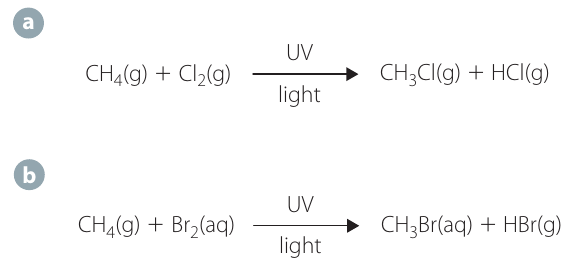
These substitution reactions produce molecules called haloalkanes (in this case, chloromethane and bromomethane). Haloalkanes are important in organic synthesis and industrial chemistry.
Multiple substitutions
Substitution reactions can continue beyond the first hydrogen replacement. Under continued exposure to UV light and halogen, additional hydrogen atoms can be substituted one at a time until all hydrogens have been replaced.
Example
Stepwise Chlorination of Methane
Chloromethane () can undergo further substitution to form:
- Dichloromethane ()
- Trichloromethane (), also known as chloroform
- Tetrachloromethane () - the final product with all four hydrogens replaced
Each substitution is a separate reaction that occurs stepwise, meaning four individual reactions would be needed to convert methane completely to tetrachloromethane.
The same stepwise process occurs with bromine, eventually forming tetrabromomethane ().
Comparing reactivity of alkanes and alkenes
Alkanes and alkenes show markedly different reactivity patterns with halogens. This difference can be demonstrated through simple laboratory tests.
When bromine water (aqueous bromine solution) is added to:
- An alkene (e.g., cyclohexene): The orange-brown colour of bromine disappears rapidly at room temperature due to an addition reaction
- An alkane (e.g., cyclohexane): No colour change occurs at room temperature; reaction only proceeds under UV light
Note
This difference in reactivity is due to the presence of the carbon-carbon double bond in alkenes, which makes them more reactive than alkanes. The double bond is a site of high electron density that readily reacts with electrophilic reagents like bromine.
Investigation 10.4 in the textbook demonstrates this comparison experimentally, testing the reactivity of hexane, cyclohexane (both alkanes), and cyclohexene (an alkene) with acidified potassium permanganate and bromine water. Such experiments clearly show that alkanes require much more forcing conditions (UV light, heat) to react compared to alkenes.
Remember!
Summary
Key Points to Remember:
-
Alkanes are saturated hydrocarbons containing only single carbon-carbon bonds, making them less reactive than alkenes and alkynes.
-
Complete combustion of alkanes in excess oxygen produces carbon dioxide and water, releasing maximum energy ( for hexane).
-
Incomplete combustion in limited oxygen produces carbon monoxide and/or soot, releasing less energy and creating serious health hazards including oxygen deprivation and lung damage.
-
Substitution reactions with chlorine or bromine replace hydrogen atoms with halogen atoms to form haloalkanes, but only occur when the mixture is exposed to UV light.
-
Multiple substitutions happen stepwise, with one hydrogen replaced at a time, eventually forming fully substituted products like tetrachloromethane.