Alkenes (HSC SSCE Chemistry): Revision Notes
📚Revision Notes
Alkenes
What are alkenes?
Alkenes are a family of organic compounds known as hydrocarbons. These molecules contain only carbon and hydrogen atoms. What makes alkenes special is that they have one pair of carbon atoms connected by a double bond, while all other carbon atoms in the molecule are connected by single bonds.
All members of the alkene family have names that end in -ene. The two simplest alkenes are:
- Ethene () - contains 2 carbon atoms
- Propene () - contains 3 carbon atoms
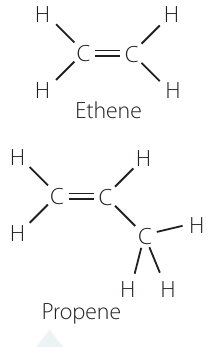
Because alkenes contain a carbon-carbon double bond, they are classified as unsaturated hydrocarbons. This means they have fewer hydrogen atoms than the corresponding alkane with the same number of carbons. The double bond creates a region of high electron density in the molecule, which makes alkenes more reactive than alkanes.
Note
The double bond in alkenes creates a region of high electron density, which is why alkenes are much more reactive than their saturated counterparts (alkanes). This reactivity makes alkenes important starting materials for many chemical reactions in industry.
General formula of alkenes
All alkenes follow a general molecular formula of , where represents the number of carbon atoms in the molecule.
This formula tells us that an alkene always has exactly twice as many hydrogen atoms as carbon atoms. For example:
- Ethene: , so the formula is (2 carbons, 4 hydrogens)
- Propene: , so the formula is (3 carbons, 6 hydrogens)
- Butene: , so the formula is (4 carbons, 8 hydrogens)
Note
The pattern in the general formula means that for every carbon atom in an alkene, there are exactly two hydrogen atoms. This predictable ratio makes it easy to determine the molecular formula of any alkene if you know the number of carbon atoms.
The alkene family forms a homologous series, where each successive member is formed by adding a unit to the previous member. This creates a predictable pattern in both the structure and properties of these compounds.
Naming alkenes
Naming alkenes follows systematic rules similar to those for alkanes, but with one crucial addition: we must specify where the double bond is located in the molecule.
Why position matters
The position of the double bond is important because it affects the structure of the molecule. Two molecules can have the same molecular formula but different structural formulas if the double bond is in a different position. These are called positional isomers.
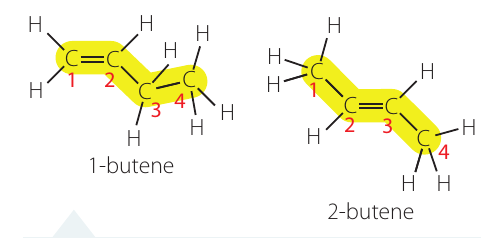
In the diagram above, both 1-butene and 2-butene have the formula , but they are different compounds because the double bond is in a different location.
Basic naming rules
Follow these steps to name simple alkenes:
Rule 1: Choose the stem and add -ene
Identify the stem name based on the number of carbon atoms in the longest chain (such as eth-, prop-, but-), and add the ending -ene.
Rule 2: Number the carbon chain
Number the carbon atoms in the chain starting from the end that is closest to the double bond. This ensures the double bond gets the lowest possible number.
Important
Always start numbering from the end of the chain that gives the double bond the lowest number, not from left to right or any other arbitrary starting point. This is a critical rule that students often forget!
Rule 3: Show the double bond position
Place a number in front of the name to indicate which carbon atom the double bond starts from, followed by a hyphen. For example:
- In 1-butene, the double bond is between carbons 1 and 2
- In 2-butene, the double bond is between carbons 2 and 3
Note that for ethene and propene, no number is needed because there is only one possible position for the double bond.
Rules for branched alkenes
When naming alkenes with branches (substituent groups), use these additional rules:
Rule 4: Identify the parent chain
The longest continuous carbon chain containing the carbon-carbon double bond becomes the parent chain. This may not necessarily be the longest carbon chain in the entire molecule. The name based on this parent chain, with the -ene ending, forms the main name of the compound.
Important
The parent chain MUST contain the double bond, even if there is a longer chain elsewhere in the molecule. This is different from alkanes where you simply choose the longest chain regardless of other features.
Rule 5: Priority to the double bond
When numbering the carbon chain, assign the lowest possible number to the double bond first, not to the substituent groups. This is different from alkanes, where substituents get priority in numbering.
Worked example: naming a branched alkene
Example
Worked Example: Naming a Branched Alkene
Let's name this molecule:
| Step | Process |
|---|---|
| Find the base name | Identify the longest continuous carbon chain that contains the double bond. This chain has 4 carbon atoms, and the double bond starts at the first carbon. Base name: 1-butene |
| Identify substituents | There is one methyl () group attached to carbon number 3. Substituent: 3-methyl |
| Write the final name | Combine the substituent and base name in alphabetical order (ignoring prefixes like di-, tri-). Final name: 3-methyl-1-butene |
Exam tip: Always check that you've numbered the chain from the end closest to the double bond, even if this means the substituent gets a higher number.
Drawing alkenes from names
To construct the structural formula of an alkene when given its systematic name, follow this systematic four-step process:
Step 1: Draw the carbon backbone
Use the main stem name to determine how many carbon atoms are in the longest chain. Draw this chain and number each carbon atom, starting with 1 at either end.
Step 2: Add the double bond
Look at the number in the main name (e.g., the "2" in 2-butene). Draw a double bond between the carbons indicated by this number. For example, 2-butene means the double bond goes between the second and third carbon atoms.
Step 3: Add the branches
Identify any substituent groups (such as methyl, ethyl) mentioned in the name and note which carbon atom they're attached to. Add these branch groups to the appropriate positions on the main chain.
Step 4: Complete with hydrogen atoms
Add hydrogen atoms to each carbon to ensure every carbon atom has exactly four bonds in total. Remember that:
- A carbon with a double bond already has two bonds to the adjacent carbon
- Each single bond to another carbon counts as one bond
- Fill the remaining bonds with hydrogen
Important
Common Mistake to Avoid:
Always double-check that each carbon has exactly four bonds - this is where many students make errors! A carbon atom in the double bond already has two bonds used up by that double bond, so it can only form two more bonds.
Remember!
Summary
Key Points to Remember:
- Alkenes contain a carbon-carbon double bond and have names ending in -ene
- The general formula for alkenes is
- Alkenes are unsaturated hydrocarbons because they contain double bonds
- When naming alkenes, always number the carbon chain from the end closest to the double bond
- The position of the double bond must be shown in the name (except for ethene and propene where only one position is possible)
- When drawing alkenes, ensure every carbon atom has exactly four bonds in total