Bonding in Carbon (HSC SSCE Chemistry): Revision Notes
📚Revision Notes
Bonding in Carbon
Introduction to carbon and organic chemistry
Carbon is a truly remarkable element in chemistry. It exists in more diverse forms and locations than any other element in nature. One of the most striking features of carbon is its ability to form more compounds than any other element—over 90% of all known chemical compounds contain carbon!

This vast number of carbon-containing compounds has led to an entire branch of chemistry dedicated to studying them: organic chemistry. Organic chemistry focuses specifically on carbon-based compounds and their properties, reactions, and applications.
Note
What is Organic Chemistry?
Organic chemistry is the branch of chemistry devoted to carbon-based compounds. Due to carbon's unique bonding properties and the sheer number of carbon-containing compounds, organic chemistry has become one of the largest and most important areas of chemical study.
The key to understanding why carbon forms so many compounds lies in its unique bonding properties. Carbon atoms readily form bonds with other carbon atoms, and each carbon atom can form a total of four bonds. These bonds can be single, double, or triple bonds, providing enormous flexibility in how carbon atoms connect to create different molecular structures.
To work effectively with millions of natural and synthetic organic compounds, chemists have developed classification systems based on structural features. The types of atoms present in a molecule and how they are arranged determine both the physical and chemical properties of that molecule.
Bonding in carbon atoms
In organic compounds, carbon atoms almost always form four bonds. This happens because carbon has four valence electrons that participate in bonding. Understanding how these electrons form bonds is fundamental to organic chemistry.
Types of carbon-carbon bonds
Carbon atoms can share their valence electrons with neighbouring carbon atoms in three different ways:
- Single bonds (one shared pair of electrons):
- Double bonds (two shared pairs of electrons):
- Triple bonds (three shared pairs of electrons):
Important
The Four Bonds Rule
Carbon atoms in organic compounds form exactly four covalent bonds. This is because carbon has four valence electrons, and forming four bonds allows carbon to achieve a stable electron configuration. These four bonds can be distributed as:
- Four single bonds
- Two single bonds and one double bond
- One single bond and one triple bond
- Two double bonds
Tetrahedral structure
In simple carbon-based compounds such as alkanes, all four bonds around a carbon atom are identical single bonds. These bonds arrange themselves in a tetrahedral orientation, meaning the four bonds point toward the corners of a tetrahedron. The angle between any two bonds is 109.5°.
Bonding with other elements
Valence electrons not involved in forming carbon-carbon bonds create bonds with other elements. The most common elements bonded to carbon in organic compounds are hydrogen, oxygen, and nitrogen.
When four carbon atoms bond together in a specific way, they can form completely different substances. For example, covalent network lattices where each carbon bonds to four other carbons create diamond and other carbon allotropes.
Visualising molecular structures
Chemists use different models to represent organic molecules, each serving a specific purpose.
Space-filling models
Space-filling models show the physical appearance of molecules. These models represent atoms as spheres that touch each other, giving a realistic picture of the molecule's shape and size. However, they don't clearly show the nature of chemical bonding.
Ball-and-stick models
Ball-and-stick models provide clearer information about bonding. In these models:
- Atoms are represented by balls (spheres)
- Bonds are represented by sticks connecting the balls
Ball-and-stick models make it easier to see bond angles and the overall molecular structure.
Note
Choosing the Right Model
- Space-filling models: Best for understanding the actual size and shape of molecules and how they might interact with other molecules
- Ball-and-stick models: Best for understanding bonding patterns, bond angles, and structural arrangements
Each model type emphasizes different aspects of molecular structure, so chemists often use both depending on what information they need to convey.
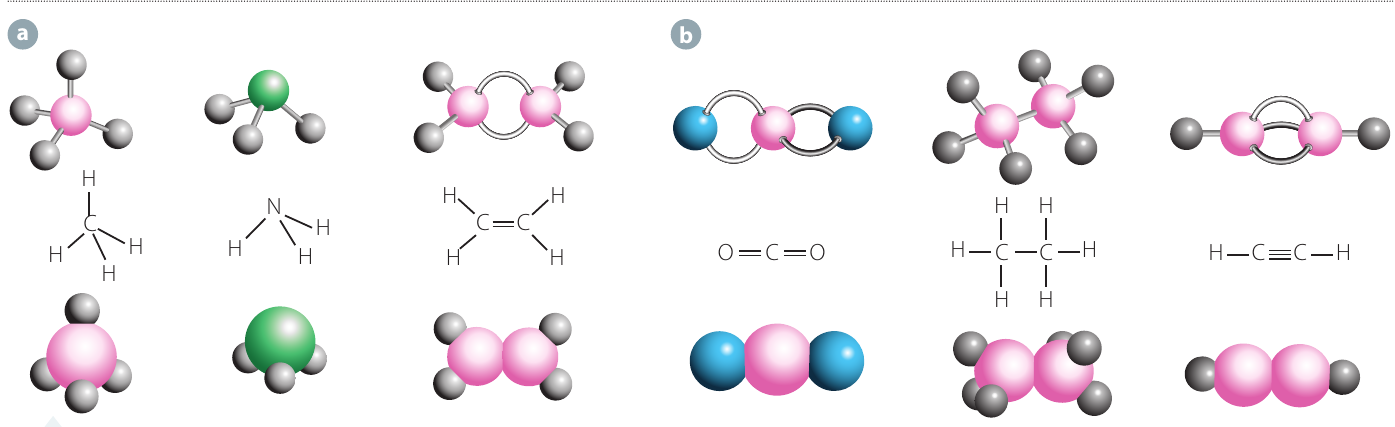
The figure above shows both space-filling models and ball-and-stick models alongside their structural formulae for several important molecules including methane, ammonia, ethene, carbon dioxide, ethane, and ethyne.
Geometrical arrangements around carbon
The number and type of bonds around a carbon atom determine its geometrical arrangement. There are four main arrangements to learn:
| Bonds around the C atom | Geometrical arrangement | Angle between bonds | Example |
|---|---|---|---|
| Four single bonds | Tetrahedral | Methane | |
| One double and two single bonds | Planar | Ethene | |
| Two double bonds | Linear | Carbon dioxide | |
| One triple and one single bond | Linear | Ethyne |
Important
Bond Geometry and Angles
The geometrical arrangement around carbon atoms is directly related to the types of bonds present:
- Tetrahedral (): Four single bonds spread out in three dimensions, maximizing the distance between electron pairs
- Planar (): Three bonds arranged in a flat plane when one double bond is present
- Linear (): Two bonds forming a straight line when double or triple bonds are present
These geometries are determined by electron pair repulsion—electrons arrange themselves to be as far apart as possible.
Types of hydrocarbons
Hydrocarbons are compounds made up of only hydrogen and carbon atoms. They form the foundation of organic chemistry, as almost all other organic compounds can be considered derivatives of simple hydrocarbons.
Hydrocarbons are classified into two main categories: aliphatic and aromatic.
Aromatic hydrocarbons
Aromatic hydrocarbons contain one or more benzene rings. A benzene ring is a special six-membered ring structure with alternating double bonds, often represented by a hexagon with a circle inside. The circle represents a ring of shared electrons that gives benzene its unique properties.
Aliphatic hydrocarbons
Aliphatic compounds include all other hydrocarbons that are not aromatic. In aliphatic compounds, carbon atoms may be bonded in:
- Chains (straight or branched)
- Non-aromatic rings
Aliphatic compounds are further classified into families based on the types of carbon-carbon bonds they contain.
Classification by bonding: saturated and unsaturated compounds
Hydrocarbons can be classified as either saturated or unsaturated, depending on the types of bonds between carbon atoms.
Alkanes (saturated compounds)
Alkanes are hydrocarbons where all the carbon-carbon bonds are single bonds (). Because alkanes contain only single bonds between carbon atoms, they are called saturated compounds. The term "saturated" means the carbon atoms are bonded to the maximum possible number of hydrogen atoms.
Alkenes (unsaturated compounds)
Alkenes are hydrocarbons in which at least one carbon-carbon bond is a double bond (). Alkenes are classified as unsaturated compounds because they contain multiple bonds. The presence of a double bond means the molecule contains fewer hydrogen atoms than a saturated compound with the same number of carbons.
Alkynes (unsaturated compounds)
Alkynes are hydrocarbons that have at least one carbon-carbon triple bond (). Like alkenes, alkynes are unsaturated compounds because they contain multiple bonds between carbon atoms.
Summary
Classification by Bonding Type
- Single bonds only → Saturated → Alkanes
- At least one double bond → Unsaturated → Alkenes
- At least one triple bond → Unsaturated → Alkynes
Memory Aid: "Single = Saturated" (both start with 'S'), while "Multiple bonds = Unsaturated"
Cyclic hydrocarbons
Cyclic hydrocarbons (also called alicyclic compounds) are hydrocarbon compounds in which carbon atoms have joined together to form a closed ring structure. These rings can contain anywhere from three to carbon atoms, though five-membered and six-membered rings are most common in nature.
Cyclic hydrocarbons can be either saturated or unsaturated:
- Cycloalkanes: Contain only single bonds
- Cycloalkenes: Contain double bonds
- Cycloalkynes: Contain triple bonds
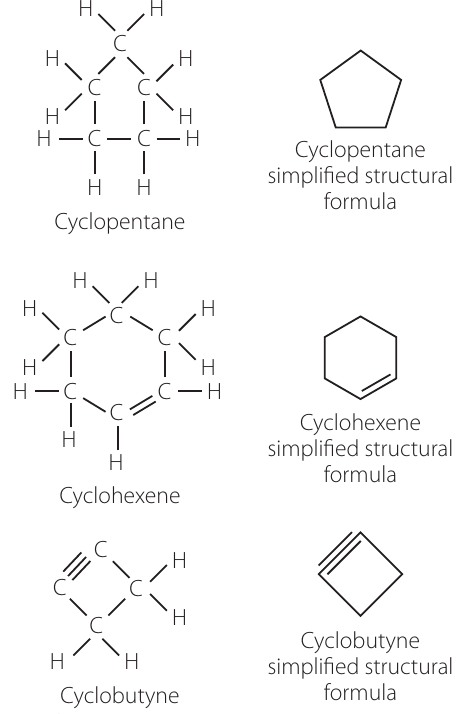
Example
Examples of Cyclic Hydrocarbons
The figure above shows examples of each type:
- Cyclopentane: A five-membered saturated ring with only single bonds between carbons
- Cyclohexene: A six-membered ring with one double bond, making it unsaturated
- Cyclobutyne: A four-membered ring with one triple bond, also unsaturated
Notice how the ring structure doesn't change the basic classification—cyclic compounds can still be saturated (alkanes) or unsaturated (alkenes or alkynes).
Representing organic molecules
Organic molecules can be represented in several different ways, each providing different types of information about the molecule's structure.
Molecular formula
A molecular formula (such as ) shows only the number of atoms of each element in the molecule. While this tells us the composition, it provides no information about how the atoms are arranged or bonded together.
Structural formulae
Structural formulae are more commonly used because they show how atoms are arranged within the molecule. This is crucial because molecules with the same molecular formula can have very different structures and properties.
There are three main types of structural representations:
Expanded formula
The expanded formula shows each individual atom and how it is arranged in relation to all other atoms. Every carbon atom, hydrogen atom, and bond is drawn explicitly. This gives the most detailed picture but can be time-consuming to draw for larger molecules.
Condensed formula
The condensed formula is more commonly used in practice. It condenses groups of atoms (such as and ) while still showing the overall arrangement of atoms in the molecule. This format provides a good balance between detail and simplicity.
Skeletal structure
The skeletal structure is the most basic representation, showing only the carbon chain arrangement. Individual atoms are not shown—carbon atoms are represented by line endpoints and junctions, while hydrogen atoms are implied. This format is quickest to draw and is commonly used for complex molecules.
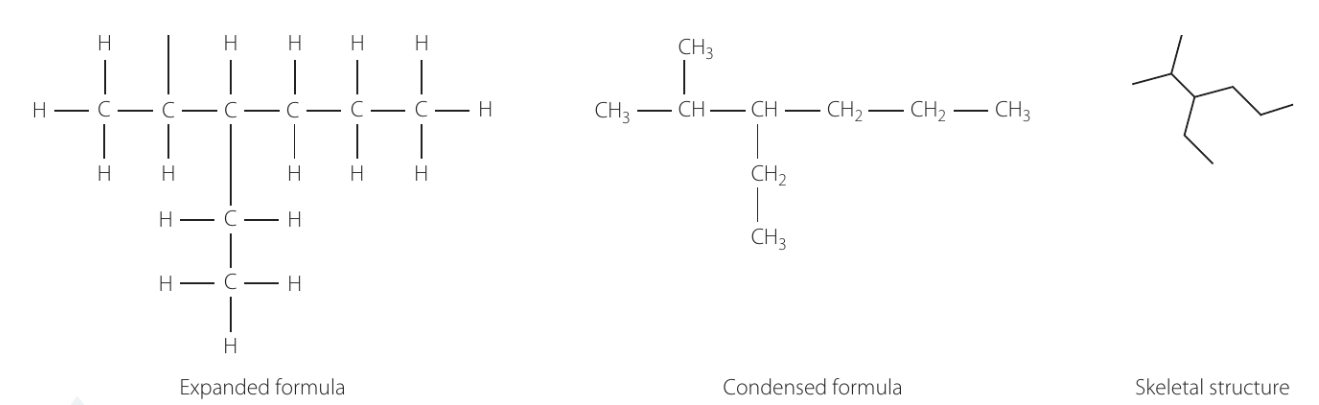
The figure above shows the same branched hydrocarbon molecule represented in all three ways, demonstrating how each format conveys the same structural information with varying levels of detail.
Note
Choosing the Right Representation
Different structural representations are useful in different contexts:
- Use expanded formula when you need to show all bonding details clearly, particularly for educational purposes or when analyzing specific bonds
- Use condensed formula for general structural information and everyday chemical communication
- Use skeletal structure for quick sketches or when working with complex molecules where showing every atom would be impractical
As molecules become larger and more complex, skeletal structures become increasingly useful because they reduce visual clutter while maintaining all essential structural information.
Remember!
Summary
Key Takeaways: Bonding in Carbon
-
Carbon forms more compounds than any other element—over 90% of all known compounds contain carbon, making organic chemistry a major branch of chemistry.
-
Carbon atoms always form four bonds using their four valence electrons, which can be arranged as single bonds (), double bonds (), or triple bonds ().
-
Bond geometry depends on bonding type:
- Tetrahedral arrangement () for four single bonds
- Planar arrangement () for one double and two single bonds
- Linear arrangement () for two double bonds or one triple bond
-
Hydrocarbons are classified as either aromatic (containing benzene rings) or aliphatic (chains or non-aromatic rings), and further classified as:
- Saturated (alkanes with single bonds only)
- Unsaturated (alkenes with double bonds, or alkynes with triple bonds)
-
Organic molecules can be represented using:
- Molecular formulae (atom counts only)
- Expanded formulae (all atoms and bonds shown)
- Condensed formulae (grouped atoms like )
- Skeletal structures (simplified carbon chain arrangements)