Halogenated Organic Compounds (HSC SSCE Chemistry): Revision Notes
📚Revision Notes
Halogenated Organic Compounds
What are halogenated organic compounds?
Halogenated organic compounds are organic molecules that contain one or more halogen atoms bonded to carbon atoms. The four main halogens found in these compounds are:
- Fluorine ()
- Chlorine ()
- Bromine ()
- Iodine ()
A single molecule can contain different types of halogen atoms. For example, a compound might have both bromine and chlorine atoms attached to its carbon chain.
Note
The halogen atoms form strong covalent bonds with carbon atoms, replacing hydrogen atoms in the original hydrocarbon structure. This substitution significantly changes the chemical and physical properties of the molecule.
Haloalkanes and their significance
Haloalkanes are a common type of halogenated organic compound. These molecules have been used extensively in various applications including:
- Refrigerants
- Firefighting agents
- Polymer production
However, many haloalkanes have caused environmental problems. When released into the atmosphere during manufacture, use, or disposal, these substances undergo chemical reactions in the upper atmosphere that contribute to depletion of the ozone layer.
Important
Environmental Impact
The environmental impact of haloalkanes has led to significant restrictions on their use. Many countries have banned or severely limited the production and use of certain haloalkanes, particularly chlorofluorocarbons (CFCs), due to their role in ozone layer destruction.
Naming halogenated hydrocarbons
To systematically name halogenated organic compounds using IUPAC nomenclature, follow these steps:
Step 1: Identify the main carbon chain
Find the longest continuous carbon chain in the molecule. This forms the base name (parent chain). If the molecule contains double or triple bonds, include their position in the base name.
Important
Priority Rule for Numbering
Double and triple bonds must be given the lowest possible numbers when numbering the carbon chain. This takes priority over substituent positions.
Step 2: Identify alkyl side chains
Look for any alkyl groups (such as methyl or ethyl groups) branching from the main chain. Note their positions and names as you normally would for any hydrocarbon.
Step 3: Identify and name halogen substituents
Find all halogen atoms attached to carbons in the main chain. Name them according to these rules:
- Fluorine becomes fluoro (e.g., -fluoro)
- Chlorine becomes chloro (e.g., -chloro)
- Bromine becomes bromo (e.g., -bromo)
- Iodine becomes iodo (e.g., -iodo)
Each halogen name must include the number of the carbon atom it is attached to. If multiple identical halogens are present, use prefixes:
- Two of the same halogen: di- (e.g., -dibromo)
- Three of the same halogen: tri- (e.g., -trichloro)
- Four of the same halogen: tetra-
Note
Choosing the Correct Numbering Direction
Choose the numbering direction that gives the lowest possible combination of numbers for all substituents. For example, -dibromo--chloro is correct, not -dibromo--chloro, because is lower than .
Step 4: Arrange substituents alphabetically
List all substituents (both halogen and alkyl groups) in alphabetical order.
Important
Alphabetizing Rule
When alphabetising, ignore prefixes such as di-, tri-, and tetra-. For example, "bromo" comes before "dichloro" in the name because we compare "b" with "c", not "d" with "c".
Worked examples
Example
Worked Example 1: Naming a haloalkane
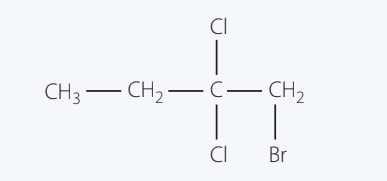
Let's name this compound:
| Answer | Logic |
|---|---|
| Name ends with 'butane' | Determine the longest continuous chain. This molecule has carbons, so the base name is butane. There are no double or triple bonds. |
| Name includes: 1-bromo and 2,2-dichloro | List all substituents with their positions. There is one bromine on carbon and two chlorines on carbon . |
| 1-bromo-2,2-dichlorobutane | Arrange substituents in alphabetical order (bromo before dichloro), ignoring the prefix "di-". Write the complete name. |
Example
Worked Example 2: Naming a haloalkene
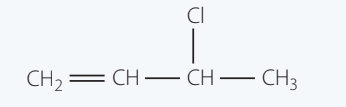
Let's name this compound:
| Answer | Logic |
|---|---|
| Name ends with '1-butene' | Determine the longest continuous chain. This molecule has carbons with a double bond. The double bond must receive the lowest possible number, so it is -butene. |
| Name includes: 3-chloro | List all substituents with their positions. There is one chlorine atom on carbon . |
| 3-chloro-1-butene | Arrange substituents in alphabetical order and write the complete name. |
Investigating hydrocarbon structures
Understanding the three-dimensional structure of organic molecules is important. Using molecular models (physical kits or digital tools) helps visualise how atoms are arranged in space. This activity demonstrates that carbon chains are not actually "straight" despite being drawn that way on paper. The tetrahedral geometry around each carbon atom creates a zigzag shape in the carbon backbone.
Note
Visualizing Molecular Structure
Molecular models reveal that the actual three-dimensional arrangement of atoms differs significantly from two-dimensional structural formulas. The tetrahedral bond angles (approximately ) around each carbon atom create the characteristic zigzag pattern of carbon chains.
Safety considerations for practical work
When conducting investigations with molecular models:
| What are the risks? | How can you stay safe? |
|---|---|
| Slipping on model components if they fall on the floor | Keep all components in containers when not being used |
Summary
Key Points to Remember:
-
Halogenated organic compounds contain one or more halogen atoms (, , , or ) bonded to carbon atoms in an organic molecule.
-
When naming haloalkanes, identify the longest carbon chain first, then list all substituents (including halogens) with their position numbers, and arrange them in alphabetical order while ignoring prefixes like di-, tri-, etc.
-
Halogen substituents are named as: fluoro, chloro, bromo, and iodo, with position numbers indicating which carbon they are attached to.
-
Double and triple bonds must receive the lowest possible numbers when numbering the carbon chain, taking priority over substituent positions.