Properties of Alkanes (HSC SSCE Chemistry): Revision Notes
📚Revision Notes
Properties of Alkanes
Understanding alkane structure and polarity
Alkanes are covalent molecular substances, meaning they consist of molecules held together by covalent bonds where atoms share electrons. Because of this molecular structure, alkanes share similar physical characteristics with other covalent compounds.
An important feature of alkanes is their non-polar nature. This occurs because carbon and hydrogen atoms have similar electronegativity values, meaning they attract electrons with nearly equal strength. Additionally, most hydrocarbon molecules have a relatively symmetrical shape, which further contributes to their non-polar character.
Note
Electronegativity is a measure of an atom's ability to attract electrons in a chemical bond. When two atoms have similar electronegativity values (like carbon and hydrogen), electrons are shared relatively equally, resulting in non-polar bonds.
Interestingly, alkenes and alkynes share a similar molecular structure to alkanes, which means these three types of hydrocarbons exhibit very similar physical properties.
Melting and boiling points of alkanes
The role of dispersion forces
Alkanes have relatively low melting and boiling points compared to many other substances. This is because dispersion forces (also called London forces) are the only type of intermolecular force that exists between alkane molecules. Dispersion forces are temporary, weak attractions that occur when electrons in one molecule create an instantaneous dipole that induces a dipole in a neighbouring molecule.
Important
Dispersion forces are the only intermolecular forces present in alkanes. This is a direct consequence of their non-polar nature. Unlike polar molecules, alkanes cannot form dipole-dipole interactions or hydrogen bonds, which are much stronger intermolecular forces.
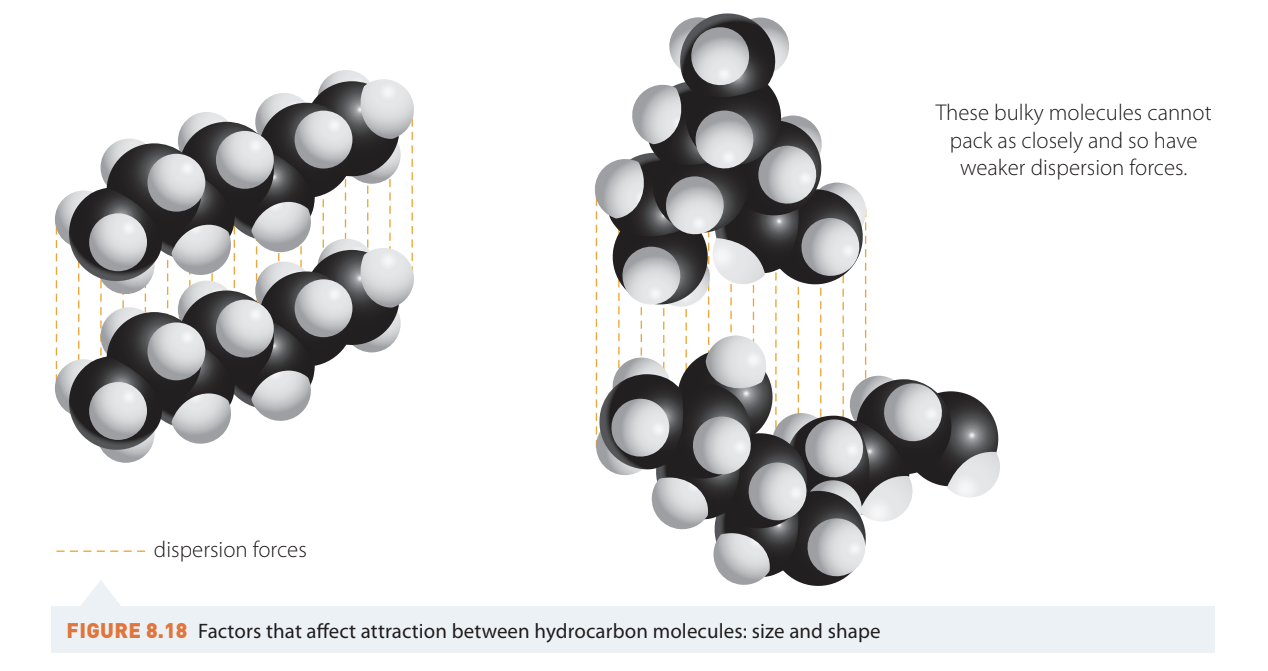
The diagram above shows how dispersion forces operate between hydrocarbon molecules. The yellow-orange dashed lines represent these weak intermolecular attractions. Notice how the linear molecules on the left can pack closely together, allowing multiple dispersion forces to form between adjacent molecules.
Effect of molecular size
As alkane molecules increase in size, they contain more atoms and therefore more electrons. The greater number of electrons means stronger overall dispersion forces can form between molecules. Larger molecules require more energy to overcome these intermolecular attractions, resulting in higher melting and boiling points.
This size effect explains why alkanes exist in different physical states at room temperature:
- Short chain alkanes (like ethane and propane): Gases at room temperature
- Medium chain alkanes (like octane, the main component of petrol): Liquids at room temperature
- Long chain alkanes (like waxes and tar): Solids at room temperature
Effect of molecular shape
The shape of hydrocarbon molecules also significantly influences their melting and boiling points. Linear (straight-chain) molecules can pack closely together in a regular arrangement. This close packing allows many points of contact between molecules, leading to numerous dispersion forces forming simultaneously. The cumulative effect creates a greater overall attraction between molecules.
In contrast, bulky or branched molecules cannot pack as neatly together. Their irregular shapes create more space between molecules, reducing the number of possible contact points. With fewer dispersion forces forming, these molecules experience weaker overall intermolecular attractions, which typically results in lower melting and boiling points compared to their straight-chain isomers.
Note
Isomers are molecules with the same molecular formula but different structural arrangements. Branched and straight-chain alkanes with the same number of carbon atoms are structural isomers of each other, but they have different physical properties due to their different shapes.
Trends in physical properties
The table below shows how physical properties change across the alkane homologous series. Notice the clear patterns as molecular weight increases.
| Name | Molecular weight | Melting point (°C) | Boiling point (°C) | Density of liquid (g/mL at 0°C) |
|---|---|---|---|---|
| Methane | Gas | |||
| Ethane | Gas | |||
| Propane | Gas | |||
| Butane | Gas | |||
| Pentane | ||||
| Hexane | ||||
| Heptane | ||||
| Octane | ||||
| Nonane | ||||
| Decane |
Summary
Key Observations from the Data:
- Both melting points and boiling points increase as molecular weight increases
- The density of liquid alkanes increases with molecular weight
- The first four alkanes (methane through butane) are gases at room temperature
- From pentane onwards, alkanes are liquids at room temperature
These trends occur because larger molecules have more electrons, creating stronger dispersion forces between molecules. More energy is needed to overcome these forces, resulting in higher melting and boiling points. The increasing density reflects how larger molecules pack more mass into a given volume.
Electrical conductivity of alkanes
Alkanes do not conduct electricity under any conditions. This property stems from their non-polar molecular structure. For a substance to conduct electricity, it must have mobile charged particles (either ions or free electrons) that can move through the material and carry an electrical current.
Important
Since alkanes are non-polar molecules, they lack both dipole charges (partial positive and negative regions) and ionic charges (fully charged ions). Without any charged particles available to move and transport electrical charge, alkanes cannot conduct electricity. This makes them excellent electrical insulators in many practical applications.
Solubility of alkanes
Insolubility in polar solvents
Alkanes are insoluble in water and other polar solvents. This occurs because alkanes cannot form favourable intermolecular interactions with polar molecules. Water molecules, for example, form strong hydrogen bonds with each other. For an alkane to dissolve in water, these hydrogen bonds would need to be broken, but alkanes cannot form bonds strong enough to compensate for this energy cost.
The principle "like dissolves like" applies here: non-polar substances do not dissolve in polar solvents because they cannot form sufficiently strong intermolecular attractions.
Solubility in non-polar solvents
Alkanes are soluble in non-polar solvents such as hexane. When alkanes mix with non-polar solvents, they can form dispersion forces with the solvent molecules. These dispersion forces are similar in strength to those that existed between the original solvent molecules and between the alkane molecules themselves. Since the energy released from forming new alkane-solvent interactions is comparable to the energy required to separate the original molecules, dissolution occurs readily.
Note
Why "Like Dissolves Like":
When a substance dissolves, existing intermolecular forces must be broken and new ones formed. For dissolution to be energetically favourable, the new interactions must be similar in strength to those being broken. Non-polar alkanes can only form weak dispersion forces, so they dissolve readily in non-polar solvents (which also rely on dispersion forces) but not in polar solvents (which have much stronger hydrogen bonding or dipole-dipole interactions).
Uses and applications of alkanes
Different alkanes serve specific purposes based on their physical properties. The variation in chain length determines whether an alkane is a gas, liquid, or solid at room temperature, which directly influences its practical applications.
Common alkanes and their applications
- Methane: The primary component of natural gas, used for heating and cooking
- Propane: Also known as LPG (liquid petroleum gas), used in portable heating and cooking appliances
- Pentane: Used as an industrial solvent in laboratories and manufacturing
- Octane: The main constituent of automobile fuel (petrol), providing energy for vehicle engines
- Nonane and decane: Used as additives in petrol to improve fuel performance
Longer chain alkanes
As the carbon chain length increases beyond decane, alkanes find different applications:
- Medium chain molecules ( to ): Form fuel oil and mineral oil, primarily used as lubricants for machinery
- Heavier molecules ( to ): Serve as the basis for petroleum jelly, greases, paraffin wax, and asphalt
Note
The physical state and viscosity of alkanes change dramatically with chain length. Short chains are gases, medium chains are thin liquids (like petrol), longer chains are thicker liquids (like oils), and very long chains form waxy solids. This makes alkanes incredibly versatile for different applications.
Industrial importance
Low molecular mass alkanes play a crucial role as starting materials for many organic chemistry-based industries. These include the manufacture of paints, plastics, and various synthetic materials.
The concept of feedstock
A feedstock is a chemical or substance used as the starting material to manufacture other useful materials and chemicals. Alkenes, particularly those with low molecular mass, serve as the foundation of the petrochemical industry.
Ethene as a feedstock
Ethene (ethylene) is the most important organic feedstock in the chemical industry. Produced from natural gas and crude oil, ethene serves as the starting material for numerous chemical products including:
- Polyethylene (plastic bags and containers)
- Vinyl chloride (PVC pipes and materials)
- Styrene (polystyrene and packaging materials)
- Ethanol (alcoholic beverages and fuel additive)
- Acetaldehyde (chemical synthesis)
Beyond manufacturing, ethene has other applications such as promoting the artificial ripening of fruits, serving as a general anaesthetic, and generating ethylene-oxygen flames for welding.
Propene as a feedstock
Propene is the second most important feedstock for organic products. It is primarily used to produce:
- Polypropylene (plastic containers and fibres)
- Various oxidation products including butanol, acrylic acid, acrolein, acrylic acid ester, glycerol, allyl chloride, and epichlorohydrin
Note
These products form the basis of countless everyday items, from food packaging to textile fibres to industrial chemicals. The ability to convert simple alkenes into complex useful materials is what makes the petrochemical industry so important to modern society.
Remember!
Summary
Key Points to Remember:
- Alkanes are non-polar covalent molecules because carbon and hydrogen have similar electronegativity and most hydrocarbons are symmetrical in structure.
- Dispersion forces are the only intermolecular forces in alkanes, giving them relatively low melting and boiling points compared to polar substances.
- As molecular size increases, stronger dispersion forces form due to more electrons, resulting in higher melting and boiling points.
- Linear alkanes have higher melting and boiling points than branched alkanes of the same molecular formula because they pack more closely together.
- Alkanes do not conduct electricity (no charged particles) and are insoluble in polar solvents but soluble in non-polar solvents.
- Alkanes have diverse practical applications ranging from fuels and lubricants to serving as essential feedstocks for the petrochemical industry.