Condensation Polymers (HSC SSCE Chemistry): Revision Notes
📚Revision Notes
Condensation Polymers
Introduction to condensation polymers
Condensation polymers are formed through a different process compared to addition polymers. While addition polymerisation requires monomers with double bonds, condensation polymerisation involves monomers with functional groups at each end of the molecule.
In condensation polymerisation, functional groups on one monomer react with functional groups on another monomer. This reaction joins the monomers together and eliminates a small molecule, typically water (). The process continues as more monomers join the growing polymer chain.
Note
The functional groups suitable for condensation polymerisation include:
- Amine groups ()
- Hydroxyl groups ()
- Carboxylic acid groups ()
- Acid chloride groups ()
There are two main types of synthetic condensation polymers: polyesters and polyamides (commonly known as nylons). In nature, condensation polymers include polysaccharides (cellulose and starch) and proteins.
Polyesters
What are polyesters?
Polyesters are condensation polymers where monomer units are connected through ester linkages. An ester linkage forms when a carboxylic acid group reacts with an alcohol group, producing an ester and water as a by-product.
For condensation polymerisation to occur, monomer molecules must be able to join at both ends. This means they need functional groups at each end of the molecule.
Note
Polyesters can form in two ways:
- From a single monomer that has a hydroxyl group () at one end and a carboxyl group () at the other end
- From two different monomers – one with hydroxyl groups at both ends (called a diol) and one with carboxyl groups at both ends (called a dicarboxylic acid)
When these monomers react, they must align so that hydroxyl and carboxyl groups are positioned next to each other.
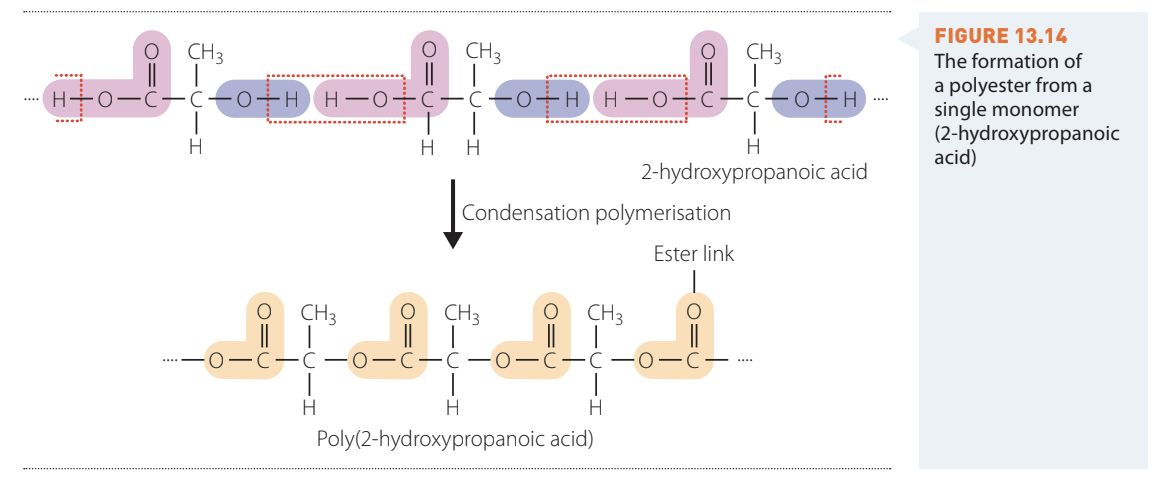
Example: Poly(lactic acid)
Example
Worked Example: Formation of Poly(lactic acid)
Poly(lactic acid), also called PLA, is an important biodegradable polyester. It is used to make surgical sutures that naturally break down in the body over time.
The monomer is lactic acid (2-hydroxypropanoic acid), which has the structure:
This molecule has a hydroxyl functional group at one end and a carboxyl functional group at the other end. During polymerisation, the hydroxyl group of one lactic acid molecule reacts with the carboxyl group of another molecule. Water is eliminated in each step, and an ester linkage forms between the monomers.
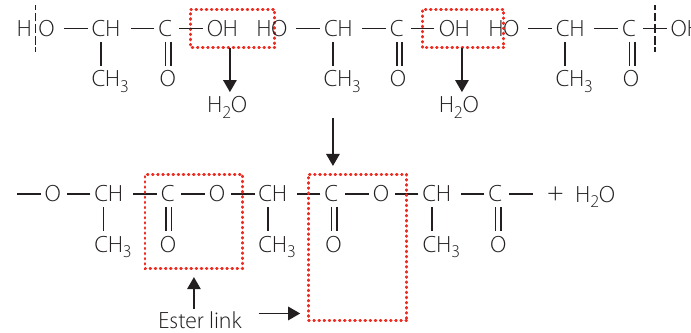
The resulting polymer has the general structure:
Formation from two different monomers
Polyesters can also form when a diol reacts with a dicarboxylic acid. In this case, the monomers must align so that a hydroxyl group is next to a carboxyl group. Because this polymer contains more than one type of monomer, it is classified as a copolymer.
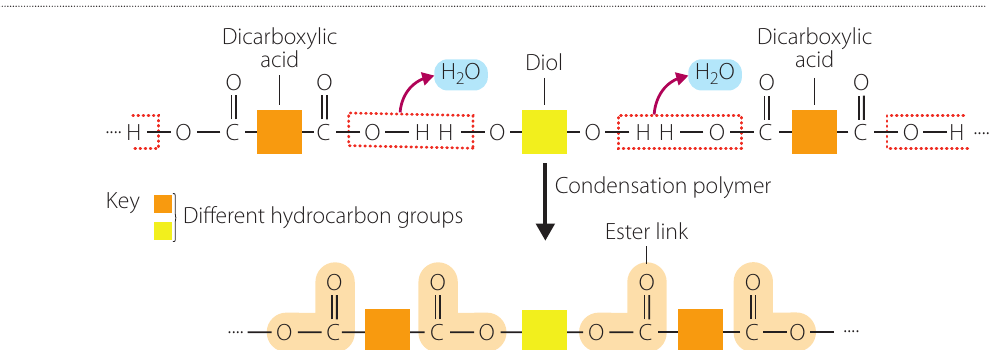
Example: Polyethylene terephthalate (PET)
Example
Worked Example: Structure and Formation of PET
Polyethylene terephthalate (PET) is one of the most widely used polymers. It is found in soft drink bottles, food containers, and textile fibres. When used in clothing and fabrics, it is commonly called "polyester" and sold under trade names such as Terylene and Dacron.
PET is a thermoplastic, which means it can be repeatedly melted and reshaped. When heated, molten PET can be:
- Pressed into moulds to make bottles or furniture
- Spun through tiny holes to form fibres for carpets, clothing, or quilts
The two monomers used to make PET are:

- Ethylene glycol (ethane-1,2-diol):
- Terephthalic acid (benzene-1,4-dicarboxylic acid): a benzene ring with carboxylic acid groups at opposite positions
The molecules polymerise through esterification. The carboxyl group of terephthalic acid reacts with the hydroxyl group of ethylene glycol, forming ester linkages and releasing water molecules.
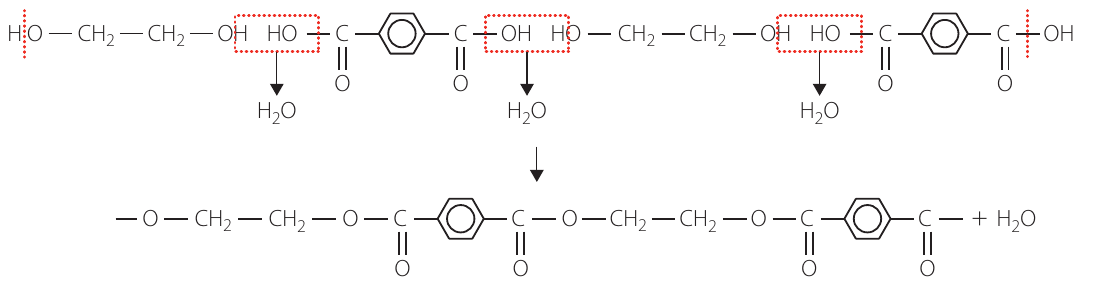
The abbreviated structure of the repeating unit in PET is:
Recycling and environmental considerations
Note
PET Recycling Success
PET is highly recyclable and carries the plastics identification code number 1. It represents a recycling success story, as used PET products can be transformed into many new items including:
- Clothing and carpet
- Luggage and tote bags
- New bottles and food containers
As a guide, five two-litre bottles provide enough material for one T-shirt or the filling for one ski jacket. One square metre of polyester carpet requires approximately 36 bottles.
Disadvantage of polyesters
Important
Acid and Alkali Damage
One significant disadvantage of polyester fabrics is their susceptibility to damage from acids and alkalis. If a dilute alkali (such as sodium hydroxide, ) is spilled on polyester fabric, the ester linkages break apart. This produces the original alcohol (ethane-1,2-diol) and the sodium salt of the carboxylic acid. The fibres are destroyed, leaving a hole in the fabric.
Polyamides
What are polyamides?
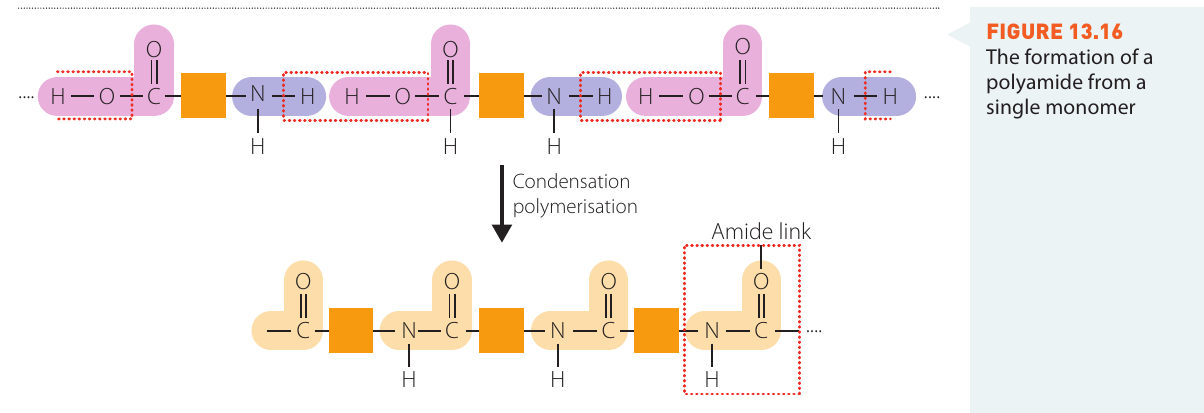
Polyamides are condensation polymers where repeating units are connected by amide linkages (). This same type of linkage occurs in proteins, where it is called a peptide link.
The most important natural polyamides are proteins. The most well-known synthetic polyamide is nylon, which was developed to replicate some properties of natural polyamides.
Note
Nylon has diverse applications including:
- Textile fibres for clothing and fabrics
- Machine components
- Domestic appliances
As with polyesters, polyamide monomers must be able to join at both ends. This requires functional groups at each end of the molecule. Polyamides can be produced from:
- A single monomer with an amine group () at one end and a carboxyl group () at the other end
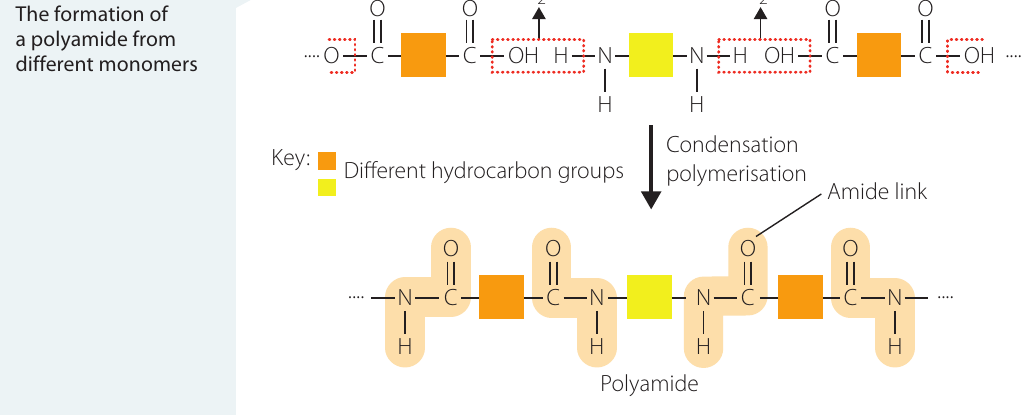
- Two different monomers – one with amine groups at both ends (a diamine) and one with carboxyl groups at both ends (a dicarboxylic acid)
For polymerisation to occur, the monomers must align so that amine and carboxyl groups are positioned next to each other.
Example: Nylon-6
Example
Worked Example: Formation of Nylon-6
Nylon-6 is produced from a single monomer called 6-aminohexanoic acid. This molecule has the structure:
The molecule has an amine functional group at one end and a carboxyl functional group at the other end. During polymerisation, the carboxyl group of one molecule reacts with the amine group of another molecule. Water is eliminated at each step, and an amide linkage forms.
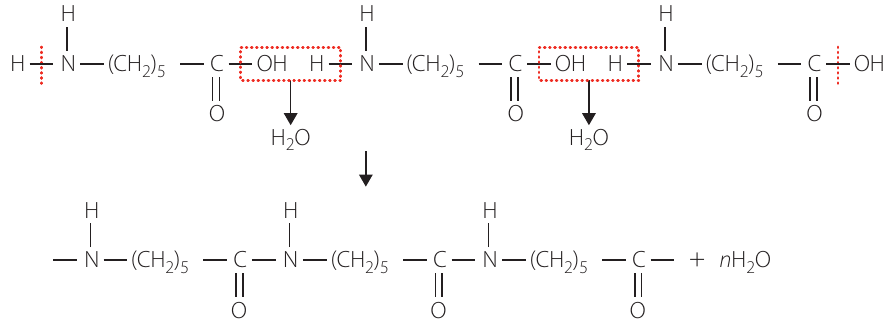
The general structure of nylon-6 is:
Formation from two different monomers
Polyamides can also form when a diamine reacts with a dicarboxylic acid. The monomers must align so that an amine group is next to a carboxyl group. Because this polymer is made from more than one monomer, it is a copolymer.
Example: Nylon-6,6
Example
Worked Example: Formation of Nylon-6,6
Nylon-6,6 was the first nylon to be produced commercially. It is made from two monomers, each containing six carbon atoms. The monomers are:
-
1,6-diaminohexane (also called hexamethylene diamine):
-
Hexanedioic acid (also called adipic acid):
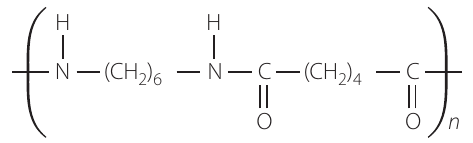
The two monomers react through condensation polymerisation. The amine groups of the diamine react with the carboxyl groups of the dicarboxylic acid, eliminating water molecules and forming amide linkages.
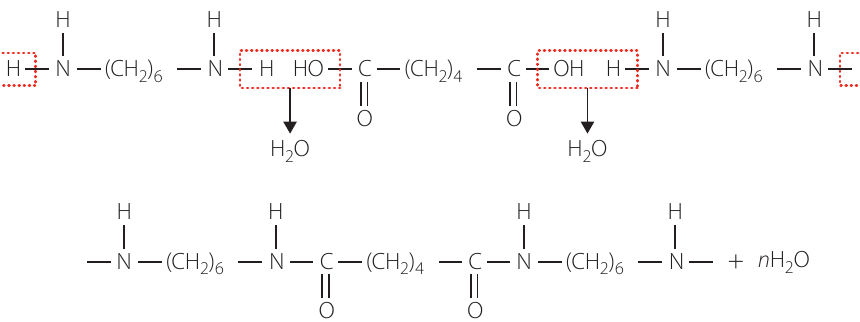
The abbreviated structure of nylon-6,6 is:
Naming nylons
Note
Nylon Naming Convention
The naming system for nylons reflects the number of carbon atoms in the monomer molecules used to make them. The number(s) of carbon atoms appear as a suffix in the name.
For nylons made from one monomer:
- Nylon-6 is made from one monomer containing six carbon atoms (with an amine group at one end and a carboxyl group at the other)
For nylons made from two monomers:
- The number for the diamine comes first
- Nylon-6,6 is made from a diamine with six carbon atoms and a dicarboxylic acid with six carbon atoms
Properties of different nylons
Different nylons have different properties depending on their structure. An important relationship is that the longer the chains of groups in the polymer:
- The lower the nylon's melting temperature
- The less water it absorbs
Together, nylon-6 and nylon-6,6 account for approximately 80% of all nylon manufactured globally. About 25% of this production is used for fibre applications in textiles.
Remember!
Summary
Key Points to Remember:
- Condensation polymerisation joins monomers by eliminating small molecules (usually water) when functional groups react, unlike addition polymerisation which requires double bonds
- Polyesters contain ester linkages () formed when carboxylic acid groups react with hydroxyl groups
- Polyamides contain amide linkages () formed when carboxylic acid groups react with amine groups
- Monomers need functional groups at both ends to form condensation polymers – either from a single bifunctional monomer or two different monomers
- Nylon names indicate carbon atoms in the monomers: nylon-6 has one monomer with 6 carbons; nylon-6,6 has two monomers each with 6 carbons