Summarising Organic Compounds and Reactions (HSC SSCE Chemistry): Revision Notes
📚Revision Notes
Summarising Organic Compounds and Reactions
Overview of organic chemistry
Throughout your study of organic chemistry, you have explored many different functional groups and how they transform from one to another. Understanding these relationships is essential for predicting reaction outcomes and planning synthesis routes. This note brings together all the organic compounds and reactions you have studied, showing how they interconnect in a comprehensive system.
Note
This summary integrates concepts from Chapters 8-12, connecting all the major organic compound classes including alkanes, alkenes, alkynes, haloalkanes, alcohols, aldehydes, ketones, carboxylic acids, esters, and amides. Each compound class can transform into others through specific chemical reactions.
The organic reactions flowchart
The diagram below illustrates the major organic compound classes and the reactions that connect them. Each arrow represents a specific type of chemical transformation, with the reagents and conditions labeled.
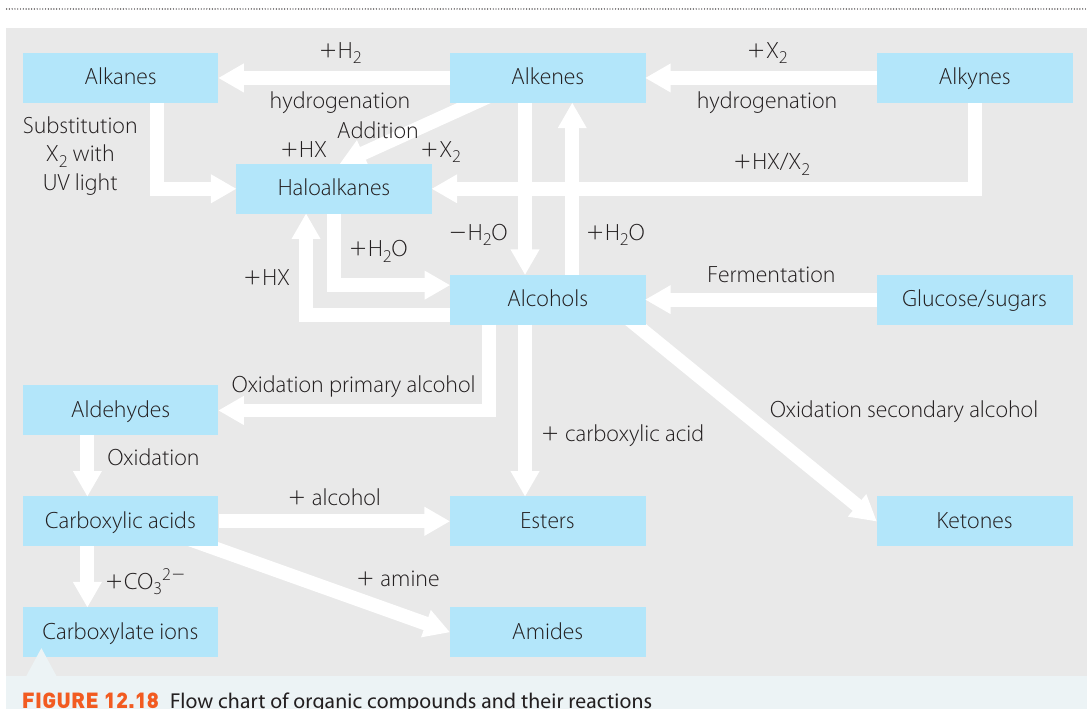
The flowchart shows the following compound classes and their relationships:
Hydrocarbons:
- Alkanes can undergo substitution with under UV light to form haloalkanes
- Alkenes form through dehydration of alcohols () or from alkanes/haloalkanes
- Alkynes are produced by adding halogens () to alkenes
Transformation pathways between hydrocarbons:
- Alkanes → Alkenes: Requires addition of hydrogen halides () or halogens ()
- Alkenes → Alkynes: Through hydrogenation ()
- Alkenes → Alkanes: Via hydrogenation ()
- Addition of hydrogen halides ( or ) forms haloalkanes
Note
Key reaction types in the flowchart:
- Hydrogenation: Addition of
- Halogenation: Addition of or
- Hydration: Addition of
- Dehydration: Removal of (shown as )
- Oxidation: Using acidified dichromate ions
Oxygen-containing compounds:
- Alcohols form from alkenes by hydration () or from haloalkanes ()
- Glucose/sugars can be converted to alcohols through fermentation
- Primary alcohols oxidise first to aldehydes, then to carboxylic acids
- Secondary alcohols oxidise to ketones
Carboxylic acid derivatives:
- Esters form when carboxylic acids react with alcohols
- Amides form when carboxylic acids react with amines
- Carboxylate ions form when carboxylic acids react with carbonate ions ()
Testing for organic compounds
Identifying organic compounds requires understanding both the reactions and the specific conditions or reagents needed for each test. When conducting chemical tests, you must carefully observe color changes, gas evolution, precipitate formation, or other distinctive signs.
Distinctive tests
Some chemical tests are highly specific and will only give a positive result for one functional group class. These are called distinguishing tests because they can definitively identify a particular compound type.
Example
Example: The Carbonate Test for Carboxylic Acids
Of all the organic compounds you have studied, only carboxylic acids will react with carbonate ions (). This reaction produces carbon dioxide gas, which can be identified by bubbling through limewater (causing it to turn cloudy). This makes the carbonate test an excellent distinguishing test for carboxylic acids.
Observation: Bubbles of gas that turn limewater cloudy
Important
A distinctive test gives a positive result for only one class of compounds. This makes it ideal for definitively identifying a specific functional group when you have an unknown compound.
Multiple-group tests
Other tests can give positive results for several different functional groups. While these tests are useful, they cannot definitively identify a compound without additional information.
Example
Example 1: Acidified Dichromate Test
Primary alcohols, secondary alcohols, and aldehydes will all react with acidified dichromate ions. The distinctive colour change is from orange to green, indicating that oxidation has occurred.
- Primary alcohols → oxidised to aldehydes (then carboxylic acids)
- Secondary alcohols → oxidised to ketones
- Aldehydes → oxidised to carboxylic acids
Because three different functional groups give positive results, this test alone cannot identify which type of compound you have.
Example
Example 2: Bromine Water Test
The orange-brown colour of bromine () will disappear when it reacts with various hydrocarbons. This decolourisation occurs through two different mechanisms:
- Addition reactions with alkenes and alkynes (the bromine adds across the double or triple bond)
- Substitution reactions with alkanes (under UV light, bromine replaces a hydrogen atom)
Since both addition and substitution can cause the colour change, you need to know the reaction conditions (presence of UV light) to distinguish between these mechanisms.
Important
Common pitfall: Don't assume that a positive bromine test automatically means you have an alkene. Remember that alkanes can also decolourise bromine under UV light conditions through substitution reactions!
Planning multistep synthesis
Both the flowchart and your knowledge of reactions can be used to design preparation methods for specific organic compounds. This process is called retrosynthetic analysis - planning a synthesis route by working backwards from your target molecule.
The working backwards method
To plan a synthesis:
- Start with your target product
- Identify which reaction produces this compound class
- Determine what starting material is needed for that reaction
- Note the required reagents and conditions
- If necessary, repeat steps 2-4 to get back to your given starting material
Note
Think of synthesis planning like solving a maze backwards: You start at the exit (your target product) and work your way back to the entrance (your starting material). Each step backward represents one chemical reaction in your forward synthesis route.
Example
Worked Example: Preparing Ethanoic Acid from Ethene
Target: Ethanoic acid ()
Starting material: Ethene ()
Planning backwards:
Step 1: Ethanoic acid is a carboxylic acid. From the flowchart, carboxylic acids form by oxidation of primary alcohols using acidified dichromate ions. Therefore, we need ethanol ().
Step 2: Ethanol is a primary alcohol. From the flowchart, alcohols form by adding water to alkenes (hydration). Since we start with ethene, this reaction will give us ethanol.
Writing the synthesis:
Reaction 1: Hydration of ethene
Reaction 2: Oxidation of ethanol
This two-step synthesis successfully converts ethene into ethanoic acid by first forming the intermediate ethanol.
Exam tips
- Always write the reagents and conditions clearly for each reaction
- Remember that some tests are specific (distinguishing tests) while others detect multiple functional groups
- When planning synthesis routes, work backwards from your target compound
- Learn the characteristic colour changes: orange to green (oxidation with dichromate), orange-brown to colourless (bromine test)
- For oxidation reactions, distinguish between primary alcohols (→ aldehydes → carboxylic acids) and secondary alcohols (→ ketones only)
Summary
Remember!
-
The organic reactions flowchart shows all major compound classes and the transformations between them, including reagents and conditions for each reaction.
-
Distinguishing tests are specific to one functional group class (e.g., carbonate test for carboxylic acids), while other tests give positive results for multiple groups.
-
Acidified dichromate causes an orange to green colour change when oxidising primary alcohols, secondary alcohols, or aldehydes.
-
Bromine water decolourises (orange-brown to colourless) with both alkenes/alkynes (addition) and alkanes (substitution with UV light).
-
Multistep synthesis is planned by working backwards from the target product, identifying each reaction and intermediate needed to reach your starting material.