Atomic Structure (HSC SSCE Chemistry): Revision Notes
📚Revision Notes
Atoms and Isotopes
What is an atom?
An atom is the smallest unit of matter that retains the properties of an element. Our modern understanding of atoms developed throughout the 19th and 20th centuries, building on the work of pioneering scientists like Lavoisier, Dalton, Thomson, Rutherford, Bohr, and many others.
Early chemists in the 18th and 19th centuries thought of atoms as solid, indivisible spheres. This simple model helped explain chemical reactions and compound formation, but it couldn't answer important questions like why atoms bond together or why some substances are more reactive than others.
Note
By the early 20th century, scientists discovered that atoms are not solid spheres at all - they have an internal structure made up of even smaller particles. This discovery revolutionized our understanding of matter and opened up entirely new fields of science.
Basic structure of an atom
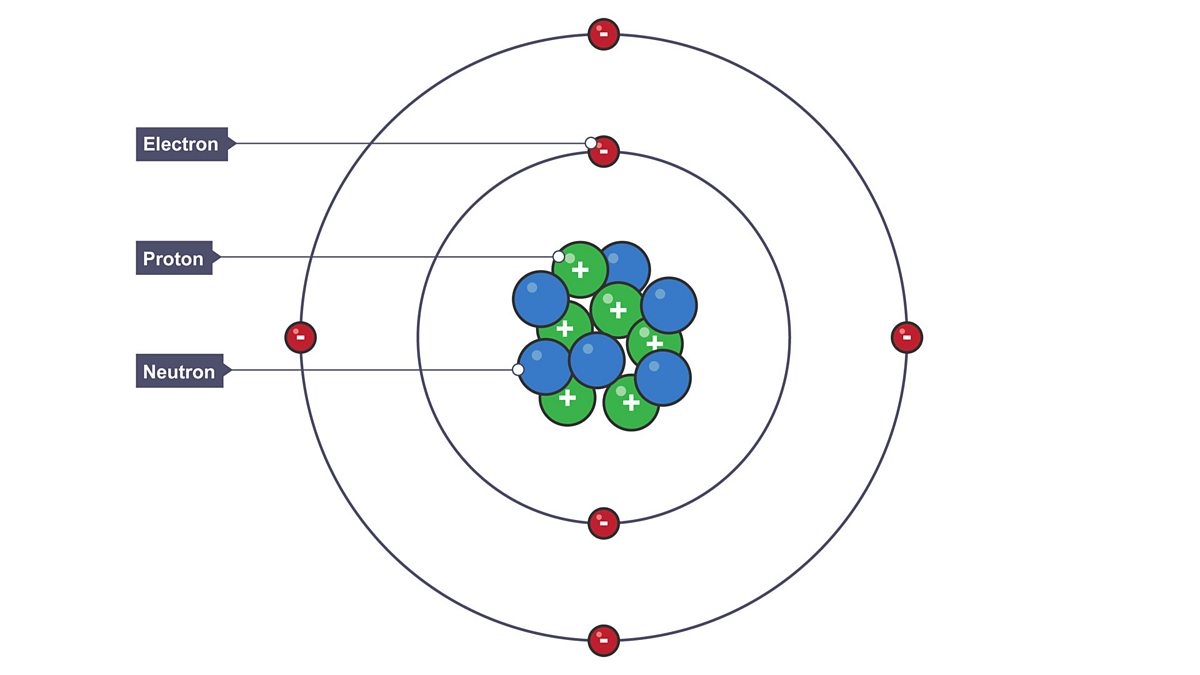
An atom consists of two main regions:
- The nucleus - an extremely small, dense core at the centre
- The electron cloud - a large region surrounding the nucleus
The nucleus is the tiny central core of the atom. Although it's incredibly small, it contains almost all of the atom's mass (over 99.95%). The nucleus carries a positive electrical charge.
The electron cloud is the region around the nucleus where electrons move. This cloud makes up most of the atom's volume, but contributes very little to its mass. The electron cloud carries a negative electrical charge.
Important
The positive charge in the nucleus exactly balances the negative charge in the electron cloud, making the whole atom electrically neutral. This electrical balance is fundamental to the stability of atoms.
Understanding the size of an atom
To understand just how small the nucleus is compared to the whole atom, imagine this:
If the nucleus were the size of a cherry stone placed at the centre of a large stadium, the electrons would be like tiny fruit flies buzzing around anywhere in the stadium - on the field, in the stands, even at the very back. But unlike fruit flies, electrons move incredibly fast, able to zip from near the nucleus to the outer edge of the atom in the tiniest fraction of a second.
Note
The nucleus diameter is less than one ten-thousandth the diameter of the whole atom. In other words, the nucleus occupies only about 0.0001% of the atom's volume!
The term 'electron cloud' describes how electrons move randomly through the space around the nucleus. Because electrons are so small and have so much room to move, they never collide with each other despite their random motion.
Subatomic particles
Atoms are made of three types of smaller particles called subatomic particles:
Protons
A proton is a positively charged particle found in the nucleus. Each proton has:
- A charge of +1 (relative charge)
- A mass approximately equal to the mass of a hydrogen atom (set as 1 on the relative mass scale)
Neutrons
A neutron is a neutral particle (no charge) also found in the nucleus. Each neutron has:
- A charge of 0
- A mass approximately equal to that of a proton (1 on the relative mass scale)
Electrons
An electron is a negatively charged particle found in the electron cloud surrounding the nucleus. Each electron has:
- A charge of -1 (equal in magnitude but opposite to a proton's charge)
- A mass of only that of a proton (electrons are extremely light)
Note
The actual charge on an electron is coulombs, but we use relative charges (+1, -1, 0) for simplicity in calculations and comparisons.
Properties comparison
| Particle | Symbol | Relative Mass | Relative Charge | Location |
|---|---|---|---|---|
| Electron | or | -1 | Electron cloud | |
| Proton | or | 1 | +1 | Nucleus |
| Neutron | or | 1 | 0 | Nucleus |
Important
Key point: In a neutral atom, the number of electrons equals the number of protons, so the positive and negative charges balance out. This is what makes an atom electrically neutral.
Composition of simple atoms
Hydrogen - the simplest atom
The simplest atom is hydrogen. Its nucleus contains just one proton (and no neutrons), with one electron in the electron cloud surrounding it.
Building up the elements
All other elements are formed by adding more protons to the nucleus. When we add protons, we must also add electrons to keep the atom neutral. The number of neutrons varies, but for lighter elements, the number of neutrons is approximately equal to the number of protons.
Example
Examples of element composition:
- Helium: 2 protons, 2 neutrons, 2 electrons
- Carbon: 6 protons, 6 neutrons, 6 electrons
- Oxygen: 8 protons, 8 neutrons, 8 electrons
- Sodium: 11 protons, 12 neutrons, 11 electrons
Here's the composition of the first ten elements:
| Element | Protons | Neutrons | Electrons | Mass Number |
|---|---|---|---|---|
| H | 1 | 0 | 1 | 1 |
| He | 2 | 2 | 2 | 4 |
| Li | 3 | 4 | 3 | 7 |
| Be | 4 | 5 | 4 | 9 |
| B | 5 | 6 | 5 | 11 |
| C | 6 | 6 | 6 | 12 |
| N | 7 | 7 | 7 | 14 |
| O | 8 | 8 | 8 | 16 |
| F | 9 | 10 | 9 | 19 |
| Ne | 10 | 10 | 10 | 20 |
Atomic number and mass number
Two important numbers describe every atom:
Atomic number (Z)
The atomic number () is the number of protons in the nucleus of an atom.
- The atomic number determines what element the atom is
- Each element has a unique atomic number
- For example: hydrogen has , carbon has , sodium has
Important
In a neutral atom, the atomic number also tells us the number of electrons. This is because the number of electrons must equal the number of protons for the atom to be electrically neutral.
Mass number (A)
The mass number () is the total number of protons plus neutrons in the nucleus.
- For helium:
- For carbon:
- For sodium:
Note
The mass number is sometimes called the nucleon number because protons and neutrons are collectively called nucleons (particles in the nucleus).
Calculating the number of neutrons
If you know the atomic number and mass number, you can work out the number of neutrons:
Example
Worked Example: Finding the number of neutrons
Calcium has and
Step 1: Use the formula
Step 2: Substitute the values
Therefore, calcium has 20 neutrons.
Isotopes
What are isotopes?
For most elements, not all atoms are identical. Some atoms of the same element have different numbers of neutrons in their nuclei.
Isotopes are atoms of the same element that have the same number of protons but different numbers of neutrons in their nuclei.
Because isotopes of the same element have the same number of protons, they have:
- The same atomic number ()
- Different mass numbers ()
- The same chemical properties
- Very similar physical properties
Isotope notation
We represent isotopes using the notation:
where:
- is the chemical symbol for the element
- is the mass number (top number)
- is the atomic number (bottom number)
Examples of isotopes
Example
Example 1: Chlorine isotopes
Chlorine has two naturally occurring isotopes:
- Chlorine-35: (17 protons + 18 neutrons)
- Chlorine-37: (17 protons + 20 neutrons)
Both isotopes have 17 protons (that's what makes them chlorine), but they differ in their number of neutrons.
Example
Example 2: Boron isotopes
Boron has two isotopes:
- Boron-10: (5 protons + 5 neutrons)
- Boron-11: (5 protons + 6 neutrons)
Example
Example 3: Copper isotopes
Copper has two isotopes:
- Copper-63: (29 protons + 34 neutrons)
- Copper-65: (29 protons + 36 neutrons)
Even the simplest elements have isotopes:
- Hydrogen has three: (normal hydrogen), (deuterium), and (tritium)
- Oxygen has three: , , and
- Carbon has three: , , and
Relative abundance
The relative abundance of an isotope is the percentage of that isotope present in a naturally occurring sample of the element.
Example
Worked Example: Understanding relative abundance
Copper has two isotopes:
- Copper-63 has a relative abundance of 69.1%
- Copper-65 has a relative abundance of 30.9%
This means that if you take any sample of natural copper, about 69 out of every 100 atoms will be copper-63, and about 31 will be copper-65.
Note
The isotopic composition of an element is approximately constant regardless of where in the world the element is found. This consistency is one of the remarkable properties of elements in nature.
Common isotopes and their relative abundances
| Element | Isotope | Mass Number | Relative Abundance (%) |
|---|---|---|---|
| Hydrogen | 1 | 99.99 | |
| 2 | 0.01 | ||
| Boron | 10 | 19.6 | |
| 11 | 80.4 | ||
| Carbon | 12 | 98.89 | |
| 13 | 1.11 | ||
| Magnesium | 24 | 78.7 | |
| 25 | 10.1 | ||
| 26 | 11.2 | ||
| Chlorine | 35 | 75.5 | |
| 37 | 24.5 | ||
| Copper | 63 | 69.1 | |
| 65 | 30.9 |
Unstable isotopes and radioactivity
What is radioactivity?
Some isotopes are radioactive, meaning they spontaneously emit radiation. Radioactivity is the spontaneous emission of radiation that occurs with certain isotopes because these isotopes are unstable.
Note
Radioactivity was first discovered because radioactive materials could darken photographic paper even when the paper was protected from light. This unexpected observation led to the discovery of a completely new phenomenon in nature.
Radioisotopes
Radioactive isotopes (or radioisotopes) are isotopes that spontaneously emit radiation. They are also called unstable isotopes.
Important
Important points about radioisotopes:
- The radioactive emission comes from the nucleus, not the electron cloud
- For some elements (like uranium and radium), all isotopes are radioactive
- For other elements (like carbon), only some isotopes are radioactive
- We talk about radioactive isotopes rather than radioactive elements because usually only specific isotopes are radioactive
Scientists describe nuclei as either:
- Stable nuclei - do not emit radiation
- Unstable nuclei - radioactive, emit radiation
Types of radiation
Radioactive substances can emit three different types of radiation, named before their true identities were discovered:
Alpha (α) particles
Alpha particles are helium nuclei (two protons and two neutrons stuck together). They have:
- Symbol: or
- Charge: +2 (two protons)
- Mass: 4 (2 protons + 2 neutrons)
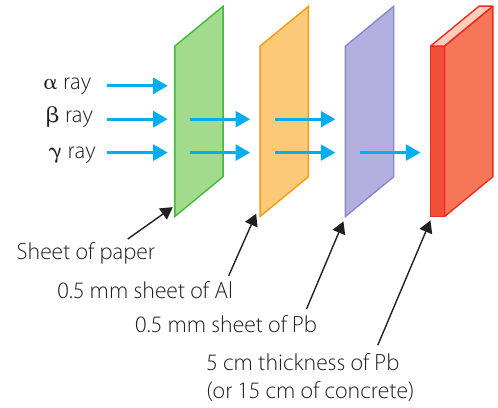
- Penetrating power: Low - stopped by a sheet of paper or a few centimetres of air
Beta (β) particles
Beta particles are high-speed electrons emitted from the nucleus. They have:
- Symbol: or
- Charge: -1
- Mass: (very light)
- Penetrating power: Moderate - can pass through paper and up to 0.5 mm of aluminium, but stopped by 0.5 mm of lead
Gamma (γ) rays
Gamma rays are a type of electromagnetic radiation (like X-rays, light, or radio waves, but with much shorter wavelengths). They have:
- Symbol:
- Charge: 0 (no charge)
- Mass: 0 (electromagnetic radiation has no mass)
- Penetrating power: High - very penetrating; require several centimetres of lead or 15 cm of concrete to stop them
Properties summary
| Emission | Symbol | Identity | Relative Charge | Relative Mass | Penetrating Power |
|---|---|---|---|---|---|
| Alpha | , | Helium nucleus | +2 | 4 | Low |
| Beta | , | Electron | -1 | Moderate | |
| Gamma | Electromagnetic radiation | 0 | 0 | High |
Important
Memory aid: Think "Big, Medium, Small" for penetrating power - Alpha (big particle) is stopped easily, Gamma (no particle, just energy) penetrates most. This is because larger, heavier particles interact more strongly with matter and lose their energy more quickly.
Nuclear equations
What are nuclear equations?
Nuclear equations show what happens when a radioactive nucleus disintegrates. They show:
- The original nucleus
- The particle emitted
- The new nucleus formed
Important
In nuclear equations:
- The atomic number () is written as a subscript on the left
- The mass number () is written as a superscript on the left
- The atomic and mass numbers must balance on both sides
Alpha decay
When a nucleus emits an alpha particle, it loses 2 protons and 2 neutrons.
Example
Worked Example 1: Uranium-238 alpha decay
Step 1: Identify what is lost The uranium nucleus originally had 92 protons and 146 neutrons.
Step 2: Calculate the new atomic number After losing 2 protons: protons
Step 3: Calculate the new mass number After losing 2 protons and 2 neutrons:
Step 4: Identify the new element 90 protons means the element is thorium (Th)
Step 5: Write the complete equation
Example
Worked Example 2: Radium-226 alpha decay
Step 1: Calculate the new atomic number protons (this is radon, Rn)
Step 2: Calculate the new mass number
Step 3: Write the complete equation
Beta decay
When a nucleus emits a beta particle (electron), one of its neutrons transforms into a proton and an electron:
The electron is ejected from the nucleus, while the proton remains. This means:
- The atomic number increases by 1 (one more proton)
- The mass number stays the same (total nucleons unchanged)
Example
Worked Example 1: Cobalt-60 beta decay
Step 1: Understand what happens The cobalt nucleus originally had 27 protons and 33 neutrons. One neutron becomes a proton and electron.
Step 2: Calculate the new atomic number protons (this is nickel, Ni)
Step 3: Calculate the new mass number Mass number stays at 60 (total nucleons unchanged)
Step 4: Write the complete equation
Example
Worked Example 2: Carbon-14 beta decay
Step 1: Calculate the new atomic number protons (this is nitrogen, N)
Step 2: Calculate the new mass number Mass number stays at 14
Step 3: Write the complete equation
Worked examples
Example
Example (a): Bismuth-213 alpha decay
| Step | Working |
|---|---|
| Start | |
| Calculate new atomic number | (thallium, Tl) |
| Calculate new mass number | |
| Complete equation |
Example
Example (b): Iodine-131 beta decay
| Step | Working |
|---|---|
| Start | |
| Calculate new atomic number | (xenon, Xe) |
| Calculate new mass number | |
| Complete equation |
Important
Exam tip: Always check that your atomic numbers and mass numbers balance on both sides of the equation! The sum of mass numbers on the left must equal the sum on the right, and the same applies to atomic numbers.
Why are some isotopes unstable?
Inside the nucleus, there are two competing forces:
- Electrostatic repulsion between positively charged protons (pushing them apart)
- Mass-mass attraction between all nucleons (pulling them together)
Note
This mass-mass attraction is like an extremely short-range gravitational force. For stable nuclei, these forces are balanced. When they are not balanced, the nucleus becomes unstable and radioactive.
Instability in large nuclei
For large nuclei (atomic mass greater than about 80), there are too many particles for the short-range attractive forces to overcome the electrostatic repulsions. This makes these nuclei unstable.
Important
All elements with atomic number greater than 83 (bismuth) are unstable and radioactive. This is why elements like uranium, plutonium, and radium are always radioactive.
Instability in lighter nuclei
For lighter nuclei, stability depends on the ratio of neutrons to protons (n:p ratio). There's a "zone of stability" - a range of n:p ratios that produces stable nuclei.
- If the n:p ratio is too high (too many neutrons), the isotope is a beta emitter
- If the n:p ratio is too low (too few neutrons), the isotope is an alpha emitter
Half-life
What is half-life?
Radioisotopes decay at different rates. Some decay quickly, others very slowly. We measure this using half-life.
The half-life of a radioisotope is the time required for half the atoms in a sample to undergo radioactive decay.
Important
Key point: Half-life is independent of the initial amount of isotope present. Whether you start with 1 g or 100 g, half will decay in the same time period. This is a fundamental property of radioactive decay.
Understanding half-life with an example
Example
Worked Example: Iodine-131 decay
Consider iodine-131, which has a half-life of 8 days.
Starting with 1.0 g of iodine-131:
| Time (days) | Number of half-lives | Amount remaining (g) | Calculation |
|---|---|---|---|
| 0 | 0 | 1.0 | Initial amount |
| 8 | 1 | 0.5 | |
| 16 | 2 | 0.25 | |
| 24 | 3 | 0.125 | |
| 32 | 4 | 0.063 | |
| 40 | 5 | 0.031 |
Formula: After half-lives, the amount remaining =
Common radioisotopes and their half-lives
| Name | Radiation Emitted | Half-life |
|---|---|---|
| Cobalt-60 | , | 5.3 years |
| Iodine-131 | , | 8 days |
| Plutonium-239 | , | years (24,000 years) |
| Radium-226 | , | years (1,600 years) |
| Sodium-24 | , | 15 hours |
| Uranium-238 | , | years (4.5 billion years) |
Note
Note the enormous range - from 15 hours (sodium-24) to 4.5 billion years (uranium-238)! This wide range of half-lives makes different radioisotopes useful for different applications.
Natural and human-made radioisotopes
Natural radioisotopes occur in nature, such as:
- Uranium isotopes
- Radium isotopes
- Carbon-14
- Hydrogen-3 (tritium)
Human-made radioisotopes are produced by:
- Nuclear reactors (as by-products or by deliberately placing materials in reactors)
- Particle accelerators like cyclotrons (by bombarding stable isotopes)
Example
Examples of human-made radioisotopes:
- Technetium-99m - made from decay of molybdenum-99 (reactor by-product); used in medical diagnosis
- Cobalt-60 - made by placing cobalt-59 in a nuclear reactor; used for cancer treatment
- Fluorine-18 - made by bombarding nitrogen with helium nuclei in a cyclotron; used in medical imaging
Remember!
Summary
Key Points to Remember:
-
An atom consists of a tiny, dense, positively charged nucleus surrounded by a large electron cloud containing negatively charged electrons. The nucleus contains over 99.95% of the atom's mass despite occupying only 0.0001% of its volume.
-
The three subatomic particles are protons (mass 1, charge +1, in nucleus), neutrons (mass 1, charge 0, in nucleus), and electrons (mass 1/2000, charge -1, in electron cloud). These particles determine all properties of atoms.
-
Atomic number (Z) = number of protons; mass number (A) = protons + neutrons. In a neutral atom, number of electrons = number of protons. The equation allows you to calculate the number of neutrons.
-
Isotopes are atoms of the same element with different numbers of neutrons. They have the same atomic number but different mass numbers. Isotope notation: where is mass number and is atomic number.
-
Radioactive isotopes (radioisotopes) spontaneously emit three types of radiation: alpha particles (helium nuclei, low penetration - stopped by paper), beta particles (electrons, moderate penetration - stopped by aluminium), and gamma rays (electromagnetic radiation, high penetration - requires lead or concrete).
-
Nuclear equations show radioactive decay and must have balanced atomic and mass numbers. Alpha decay decreases atomic number by 2 and mass number by 4; beta decay increases atomic number by 1 while mass number stays constant.
-
Half-life is the time for half the atoms in a sample to decay. It's constant for each radioisotope, regardless of the initial amount present. After half-lives, the amount remaining = .