Bohr, Schrödinger, and Atomic Structure (HSC SSCE Chemistry): Revision Notes
📚Revision Notes
Bohr, Schrödinger, and Atomic Structure
Introduction
Understanding the arrangement of electrons in atoms began with the study of emission spectra. When elements are heated or energised, they emit light at specific wavelengths, creating unique patterns of coloured lines. By carefully analysing these emission spectra, scientists were able to work out the energy levels and sublevels that electrons occupy within atoms. This discovery was crucial to developing our modern understanding of atomic structure.
Note
The study of emission spectra was revolutionary because it provided the first concrete evidence about the internal structure of atoms. Each element's unique "fingerprint" of spectral lines revealed that electrons must occupy specific energy states rather than having any arbitrary energy.
Emission spectra and early understanding
By 1910, scientists had measured the atomic emission spectra of many elements. They had also generally accepted the idea that atoms consist of a small, dense nucleus surrounded by electrons. However, a major puzzle remained unsolved. While scientists could observe and measure these emission spectra, they had no quantitative interpretation of them. In other words, they couldn't explain mathematically why individual elements produced emission lines at their particular wavelengths.
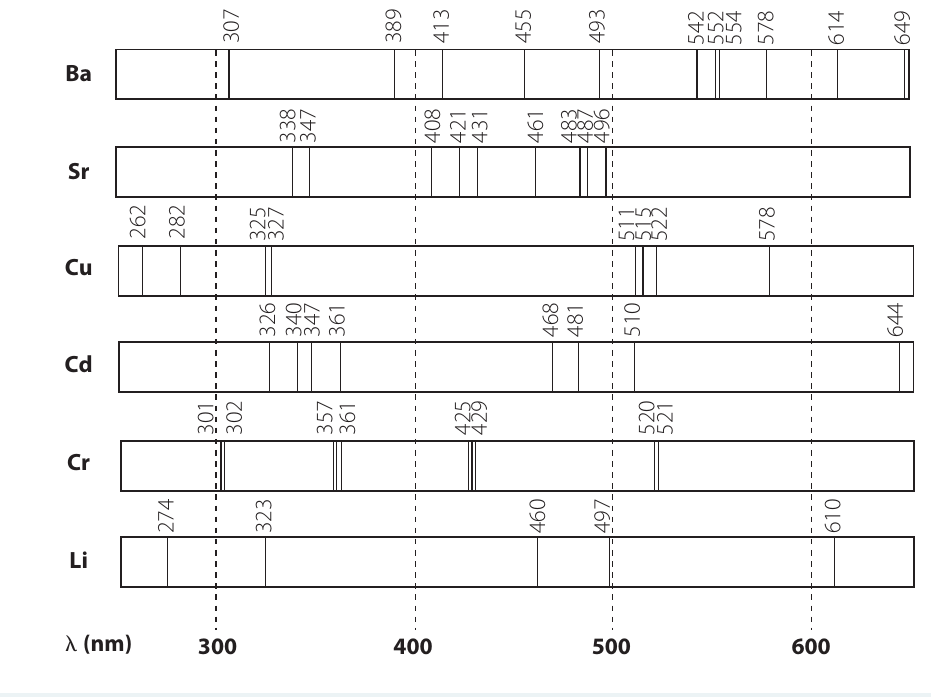
The diagram above shows emission spectra for several metallic elements. Each element produces a unique pattern of lines, like a fingerprint. These patterns held the key to understanding electron arrangement in atoms, but scientists needed a theory to explain them.
Important
The Central Problem of 1910:
Scientists could measure and observe emission spectra with great precision, but they lacked any mathematical framework to explain why these specific wavelengths appeared. This gap between observation and understanding represented one of the greatest challenges in physics at the time.
Bohr's theory
In 1913, a young Danish physicist named Niels Bohr proposed a groundbreaking theory that could quantitatively explain the emission spectrum of hydrogen and a few other elements.
Key principles of Bohr's model
Bohr's theory introduced several revolutionary ideas about how electrons behave in atoms:
- Fixed orbits: Electrons travel around the nucleus in specific, unchanging circular paths, similar to how planets orbit the Sun. Each orbit corresponds to a particular distance from the nucleus.
- Energy absorption and emission: When electrons absorb energy, they jump to orbits with a larger radius (further from the nucleus). When they emit energy in the form of light, they fall back to smaller orbits (closer to the nucleus).
- Discrete energies: Bohr incorporated Planck's quantum theory by proposing that electrons can only possess certain specific energy values, not any value in between. This means energy in atoms is quantised—it comes in discrete packages rather than being continuous.
- Energy levels: The atom contains a set of distinct energy levels, each one corresponding to a particular radius of electron orbit around the nucleus.
This model explained why emission spectra showed distinct lines rather than a continuous rainbow of colours. Each line represented an electron falling from one specific energy level to another, releasing a precise amount of energy as light of a particular wavelength.
Note
Why Bohr's Model Explained Spectral Lines:
Think of energy levels like steps on a staircase—you can stand on one step or another, but not in between. When an electron "steps down" from a higher energy level to a lower one, it releases the exact energy difference as light. Since only certain steps exist, only certain wavelengths of light can be emitted, creating the distinct lines we observe in emission spectra.
Successes and limitations
Bohr's theory was remarkably successful for simple atoms. It could quantitatively explain the hydrogen spectrum, accurately predicting the wavelengths of light that hydrogen atoms emit. This was a major achievement that earned Bohr international recognition.
However, the theory had significant limitations. Whilst it worked qualitatively for all elements (providing a general framework for understanding), it could not be used to quantitatively interpret the more complex spectra of atoms with many electrons. The mathematical predictions simply didn't match the observed emission lines for these more complicated atoms.
Important
The Limitation That Changed Everything:
Bohr's model was a brilliant first step, but its failure with multi-electron atoms revealed that the true nature of electrons in atoms was more complex than simple planetary orbits. This limitation drove scientists to search for a more fundamental understanding of electron behaviour.
From particles to waves
In the years following Bohr's proposal, scientists made a startling discovery about the nature of electrons. The prevailing view had been that electrons were simply particles—tiny lumps of matter. However, evidence began to accumulate that electrons possessed wave properties as well as particle properties.
Scientists found that electrons could be assigned a wavelength, just like light waves. Even more remarkably, electrons could undergo diffraction, which is the bending of waves around obstacles—behaviour typically associated with light and -rays rather than particles. This wave-particle duality of electrons opened up new possibilities for understanding atomic structure.
Important
A Revolutionary Discovery:
The realization that electrons behave as both particles and waves fundamentally challenged classical physics. If electrons have wavelength and can diffract like waves, then perhaps the wave nature of electrons was the key to understanding their behaviour in atoms. This insight paved the way for Schrödinger's breakthrough.
Schrödinger's theory
In 1923, Austrian physicist Erwin Schrödinger took a radically different approach to understanding electrons in atoms. Instead of treating the electron as a particle orbiting the nucleus, he treated it as a wave.

The Schrödinger equation
Schrödinger used an expression that related the wavelength of an electron to its energy. He then applied the mathematical principles used to describe waves to develop a complex equation. This equation, now known as the Schrödinger equation, calculates the probability of finding an electron at any particular location around the nucleus.
Note
The Probabilistic Revolution:
The Schrödinger equation doesn't tell us exactly where an electron is at any given moment. Instead, it tells us the likelihood of finding it in different regions around the nucleus. This probabilistic approach represented a fundamental shift in how scientists thought about electrons—moving from certainty about position to probability distributions.
Orbitals versus orbits
The most surprising result from Schrödinger's calculations was that for a hydrogen atom, there is a significant probability of finding the electron at any position within a spherical volume surrounding the nucleus. The electron doesn't travel in a fixed circular path, as Bohr had proposed. Instead, it moves at extremely high speeds somewhat randomly throughout a three-dimensional region of space.
This conclusion was very different from Bohr's idea of electrons travelling in fixed orbits like planets around the Sun. To distinguish between these two concepts, scientists introduced the term orbital. An orbital is the volume of space around the nucleus in which there is a high total probability of finding the electron. Unlike an orbit (a fixed path), an orbital is a region or zone where the electron is likely to be found.
Important
Orbit vs. Orbital—A Critical Distinction:
-
Orbit (Bohr): A fixed, circular path that an electron follows, like a planet around the Sun. This implies we know exactly where the electron is at any moment.
-
Orbital (Schrödinger): A three-dimensional volume of space where there is a high probability of finding the electron. This reflects the wave nature of electrons and acknowledges that we cannot know the exact position at any moment.
This shift from orbits to orbitals represents the transition from classical to quantum mechanics.
Success with complex atoms
When scientists applied the Schrödinger equation to the hydrogen atom, it led to the same idea of discrete energy levels that Bohr's theory had predicted. However, Schrödinger's approach proved far more powerful. When applied to atoms with more than one electron, it successfully predicted the existence of sublevels within energy levels and sets of orbitals. The description of electron arrangement in atoms is based upon Schrödinger's theory.
The Schrödinger equation succeeded where Bohr's theory had failed—it could be used to interpret the emission spectra of atoms with many electrons. Because every line in an emission spectrum corresponds to a decrease in energy when an electron falls from an excited energy level to a lower energy level, scientists were able to work out the detailed energy level structure of atoms. Starting with hydrogen and working up through increasingly complex atoms, they pieced together the complete picture of energy levels and sublevels.
Quantum mechanics
The approach of calculating atomic and molecular properties based on the idea of electrons as waves with quantised energy is called quantum mechanics. This field of physics has become fundamental to our understanding of matter at the atomic and molecular scale. Quantum mechanics successfully explains not only emission spectra but also chemical bonding, molecular shapes, and many other properties of matter.
Summary
Key Points to Remember:
-
Bohr's model (1913) treated electrons as particles travelling in fixed circular orbits around the nucleus, with electrons able to occupy only certain discrete energy levels. This successfully explained hydrogen's spectrum but failed for more complex atoms.
-
Wave-particle duality led scientists to recognise that electrons behave as both particles and waves, possessing wavelength and undergoing diffraction.
-
Schrödinger's equation (1923) treats electrons as waves and calculates the probability of finding an electron at any location around the nucleus. This introduced the concept of orbitals—volumes of space where electrons are likely to be found.
-
Quantum mechanics, based on Schrödinger's theory, successfully explains the emission spectra of all atoms and forms the foundation of modern atomic theory, with energy existing in discrete, quantised packages.
-
Scientists determined the energy levels and sublevels in atoms by analysing emission spectra, where each spectral line represents an electron transition between specific energy levels.