Electrons and the Periodic Table (HSC SSCE Chemistry): Revision Notes
📚Revision Notes
Electrons and the Periodic Table
Introduction to energy levels
Understanding how electrons are arranged in atoms is crucial to chemistry. While the number of protons, neutrons, and electrons in an atom is important, the arrangement of electrons is what determines how atoms behave chemically.
Note
You might wonder why electrons don't simply fall into the nucleus, since opposite charges attract. The answer is that electrons possess energy—enough energy to resist being pulled into the positively charged nucleus. This is why the electron cloud maintains its structure rather than collapsing.
In 1913, scientist Niels Bohr developed a groundbreaking theory to explain electron arrangement. His work was later refined by other scientists, including Erwin Schrödinger, to give us our current understanding.
What are energy levels?
Electrons in an atom exist in discrete energy levels (also called energy shells). Think of these as specific "floors" where electrons can exist—first level, second level, third level, and so on. Each level has a fixed amount of energy:
- Electrons in the first energy level have the least energy
- Electrons in the second energy level have more energy than those in the first
- Electrons in the third energy level have even more energy
- And so on—each successive level has greater energy
Important
Electrons must occupy one complete energy level or another. They cannot exist at energy values between two levels.
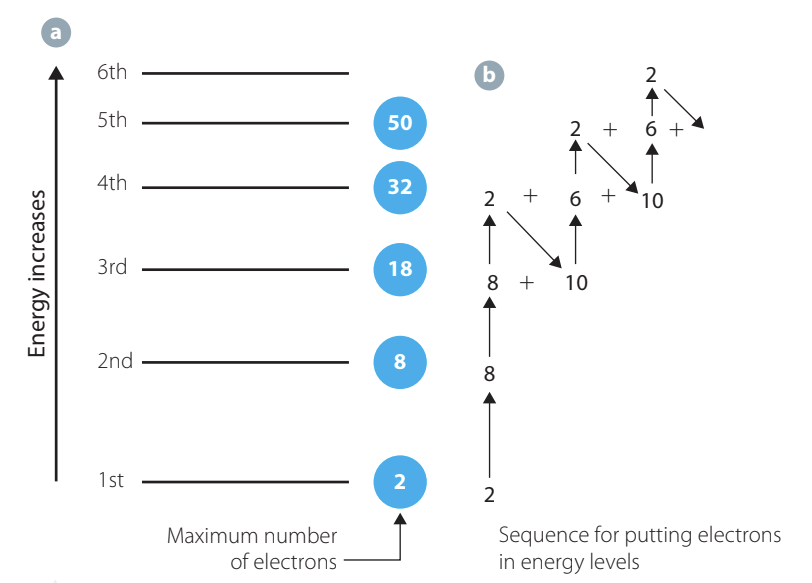
Maximum capacity of energy levels
Each energy level can hold only a certain maximum number of electrons:
- First level: maximum of electrons
- Second level: maximum of electrons
- Third level: maximum of electrons
- Fourth level: maximum of electrons
The general formula for the maximum number of electrons in any level is , where is the energy level number.
Important
In atoms, electrons always occupy the lowest available energy levels first—this is the most stable arrangement.
Electron configurations
What is an electron configuration?
The electron configuration of an atom is simply the way its electrons are arranged across the different energy levels. To work out an electron configuration, you allocate electrons to energy levels starting from the lowest, remembering the maximum capacity of each level.
Examples of electron configurations
Let's look at some examples:
Example
Worked Example: Building Electron Configurations
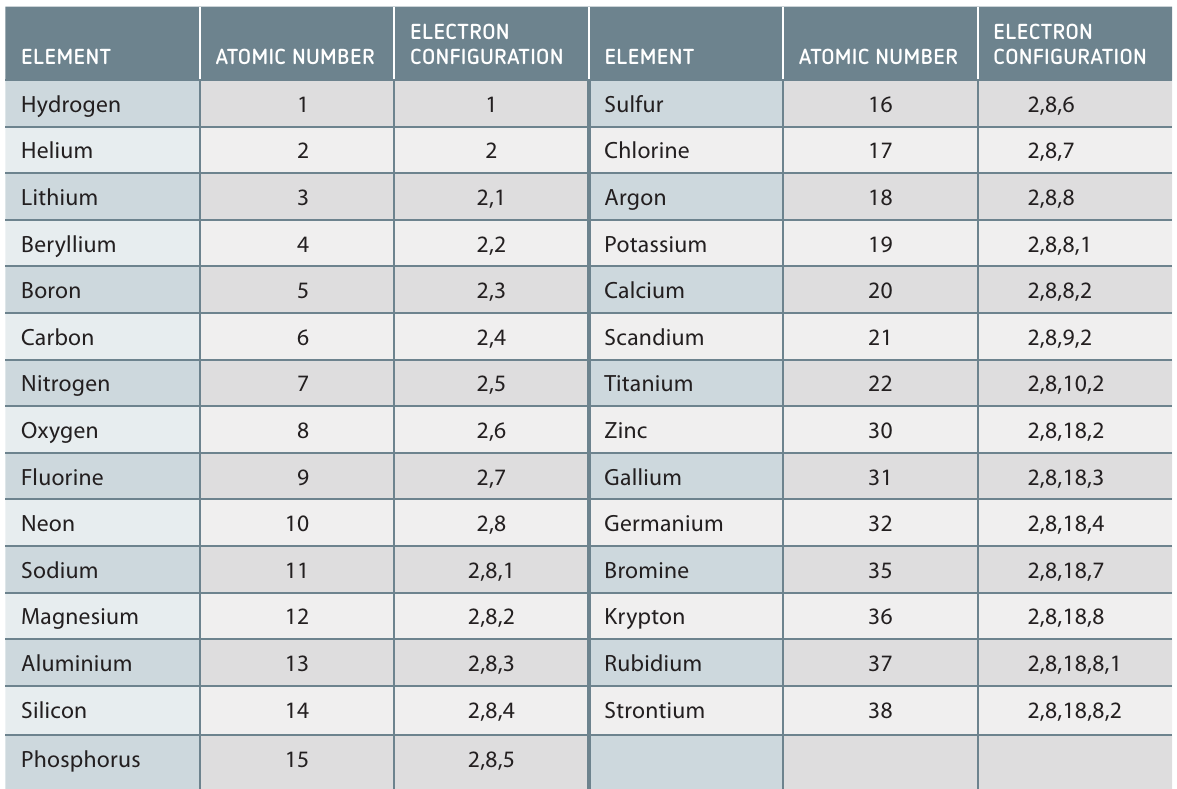
- Hydrogen ( electron): The single electron goes in the first level:
- Helium ( electrons): Both electrons fit in the first level:
- Lithium ( electrons): Two electrons fill the first level, the third goes in the second level:
- Beryllium ( electrons):
- Boron ( electrons):
- Neon ( electrons): — the second level is now full
For sodium with electrons, the first two levels are full , so the eleventh electron must go into the third level: .
A complication: the unusual filling pattern
As we continue from sodium to argon ( electrons), each additional electron goes into the third level, giving argon the configuration .
Now, here's where it gets interesting. The third level can hold up to electrons, so we might expect potassium ( electrons) to be . But it's not!
Note
What actually happens is this: after eight electrons occupy the third level, the next two electrons go into the fourth level instead. This is because these configurations are more stable:
- Potassium: — not
- Calcium: — not
After placing two electrons in the fourth level, we then go back and complete the filling of the third level:
- Scandium ( electrons):
- Titanium ( electrons):
- Zinc ( electrons): — third level now completely filled
Once the third level has electrons, additional electrons continue filling the fourth level:
- Gallium ( electrons):
- Krypton ( electrons):
Stable electron configurations
When we examine electron configurations across the periodic table, we discover important patterns that explain chemical behaviour.
Noble gases: the most stable configurations
The noble gases (helium, neon, argon, krypton, xenon, and radon) are famously unreactive—they rarely undergo chemical reactions. Looking at their electron configurations reveals why:
- Helium: — first level completely filled
- Neon: — second level completely filled
- Argon: — filled to eight electrons in the outer level
- Krypton: — filled to eight electrons in the outer level
Important
These configurations are extremely stable. The fact that noble gases don't react tells us that having a filled outer energy level (or eight electrons in the outer level) is a very stable arrangement.
Alkali metals
The alkali metals (lithium, sodium, potassium, rubidium, and caesium) are all highly reactive metals with similar chemical properties. They share a common feature: each has one more electron than a nearby noble gas.
- Lithium: — one more than helium
- Sodium: — one more than neon
- Potassium: — one more than argon
Note
Alkali metals tend to lose that one extra electron to achieve the stable electron configuration of the nearby noble gas. This is why they all behave similarly in chemical reactions.
Halogens
The halogens (fluorine, chlorine, bromine, and iodine) are reactive non-metals that also share similar properties. They each have one electron fewer than a nearby noble gas:
- Fluorine: — one less than neon
- Chlorine: — one less than argon
- Bromine: — one less than krypton
Note
Halogens tend to gain one electron to achieve the stable configuration of the nearby noble gas. Again, this explains their similar chemical behaviour.
The driving force behind chemical reactivity
From these observations, we can identify a fundamental principle:
Important
The Fundamental Principle of Chemical Reactivity:
The driving force behind chemical reactivity is that atoms tend to lose, gain, or share electrons to achieve the stable electron configuration of the nearby noble gas.
This principle explains why:
- Elements in the same group have similar properties—they all gain or lose the same number of electrons
- Oxygen and sulfur both gain two electrons (to become like neon and argon)
- Magnesium and calcium both lose two electrons (to become like neon and argon)
- Nitrogen and phosphorus both gain three electrons (to become like neon and argon)
Valence electrons
What are valence electrons?
The electrons in the outermost energy level (the highest energy level) are called valence electrons. The outermost energy level itself is called the valence shell.
Important
Valence electrons are particularly important because they are the electrons involved in chemical bonding and reactions.
Examples
Example
Determining Valence Electrons:
- Magnesium : Has valence electrons (the two in the third level)
- Fluorine : Has valence electrons (the seven in the second level)
- Silicon : Has valence electrons (the four in the third level)
The periodic table
Structure of the periodic table
The periodic table is organized so that elements with similar properties fall into the same vertical columns called groups. Elements are arranged in horizontal rows called periods in order of increasing atomic number.
The table is constructed so that elements with similar electron configurations (and therefore similar chemical properties) are positioned vertically beneath one another.
Key groups include:
- Group 18 (far right): Noble gases—helium, neon, argon, krypton, xenon, radon
- Group 17 (second from right): Halogens—fluorine, chlorine, bromine, iodine
- Group 1 (far left): Alkali metals—lithium, sodium, potassium, rubidium, caesium
Note
Hydrogen is often shown separately because it has unique properties. It can both lose an electron (forming ) and gain an electron (achieving helium's configuration), making it unlike any group in the table.
Relationship between the periodic table and electron configuration
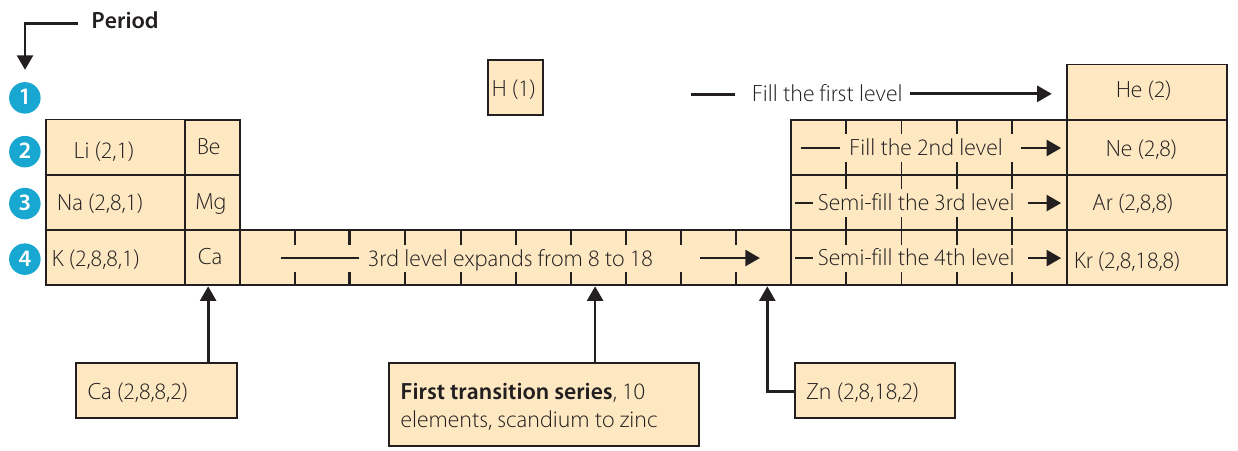
The layout of the periodic table directly reflects how electron energy levels are filled. Each period (horizontal row) corresponds to filling a particular energy level:
- Period 1: Fills the first energy level (helium: electrons)
- Period 2: Fills the second energy level (lithium to neon: adds electrons)
- Period 3: Semi-fills the third energy level (sodium to argon: adds electrons)
- Period 4: Semi-fills the fourth level, then completes the third level
Note
The transition elements (groups 3 to 12) are the elements that appear when a semi-filled energy level (with eight electrons) expands to become completely filled (with electrons). For example, the first transition series (scandium to zinc, elements) represents the third energy level expanding from to electrons.
Valence electrons and position in the periodic table
The way the periodic table is constructed gives us useful shortcuts:
Important
Key Patterns for Determining Valence Electrons:
-
Elements in the same group have the same number of valence electrons
-
For main-group elements:
- Groups 1 and 2: Number of valence electrons = group number
- Groups 13-18: Number of valence electrons = group number minus 10
-
All transition elements have two valence electrons (though their chemistry often involves electrons in the next lower energy level, making their valence harder to predict)
These patterns mean you don't need to work out the full electron configuration to determine valence electrons—the periodic table position tells you directly!
Summary
Key Points to Remember:
- Energy levels are discrete "shells" where electrons exist, with each level holding a maximum number: , , , (formula: )
- Electron configuration describes how electrons are arranged in energy levels, always filling from the lowest level first
- Noble gases have the most stable electron configurations (filled outer levels) and are unreactive
- The driving force of chemical reactivity is atoms seeking to achieve noble gas electron configurations by gaining, losing, or sharing electrons
- Valence electrons are the electrons in the outermost energy level and determine an element's chemical properties
- Elements in the same group of the periodic table have the same number of valence electrons and similar chemical properties
- The periodic table structure directly reflects the pattern of electron energy level filling, making it a powerful tool for predicting chemical behaviour