Ionic Bonding (HSC SSCE Chemistry): Revision Notes
📚Revision Notes
Ionic Bonding
What is ionic bonding?
Ionic bonding is a fundamental type of chemical bond that occurs when electrons are completely transferred from one atom to another. This process creates charged particles called ions, which are then held together by strong electrostatic forces of attraction. Understanding ionic bonding is essential because it explains the formation and properties of many common compounds, including table salt (sodium chloride).
When atoms form ionic bonds, they transfer electrons to achieve more stable electron configurations, typically matching those of the nearest noble gas. The atom that loses electrons becomes positively charged, while the atom that gains electrons becomes negatively charged. These oppositely charged ions then attract each other strongly, forming an ionic compound.
Formation of ions through electron transfer
The formation of ionic bonds is best understood through specific examples that demonstrate how different elements combine.
Example 1: Formation of sodium chloride
Example
Worked Example: Formation of Sodium Chloride (NaCl)
Sodium chloride () provides an excellent example of ionic bonding. Let's examine how sodium and chlorine atoms combine to form this compound.
Step 1: Sodium loses one electron
- Sodium atoms have an electron configuration of 2,8,1
- Sodium loses its single outer electron
- Forms with configuration 2,8 (same as neon)
Step 2: Chlorine gains one electron
- Chlorine atoms have an electron configuration of 2,8,7
- Chlorine gains one electron
- Forms with configuration 2,8,8 (same as argon)
Step 3: Electrostatic attraction
- One electron transfers from sodium to chlorine
- Both achieve stable noble gas configurations
- Opposite charges attract: and
- Formula: NaCl (1:1 ratio)
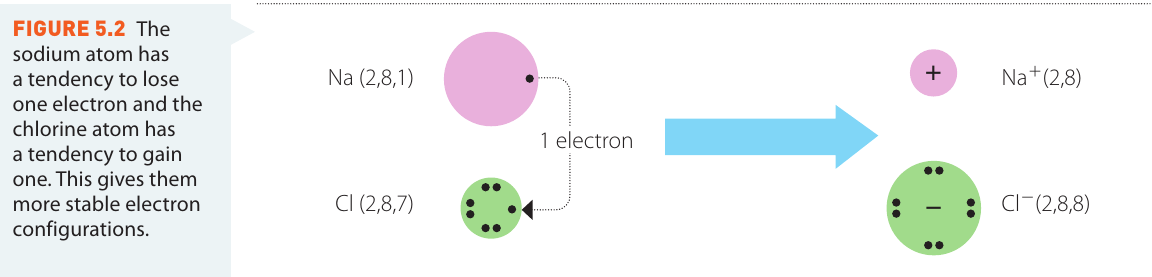
The electron transfer process is straightforward: one electron moves from a sodium atom to a chlorine atom. This single electron exchange allows both atoms to achieve stable noble gas electron configurations simultaneously. As a result, the compound formed contains one ion for every ion, giving the formula .
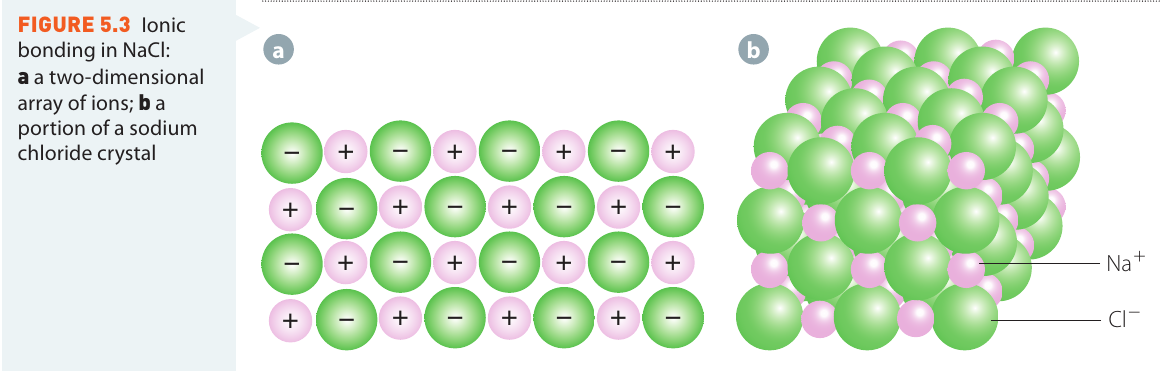
The strong electrostatic attraction between the positive sodium ions and negative chloride ions holds the structure together. In solid sodium chloride, these ions arrange themselves in a highly organised crystal lattice structure, where each ion is surrounded by ions of opposite charge. This arrangement extends throughout the entire crystal, creating an extremely large array of alternating positive and negative ions.
Note
Sodium chloride doesn't exist as separate molecules. Instead, the crystal consists of countless ions packed together in an orderly fashion, with electrostatic forces extending throughout the whole structure.
Example 2: Formation of calcium fluoride
Example
Worked Example: Formation of Calcium Fluoride (CaF₂)
Calcium fluoride demonstrates a different ratio of ions in ionic bonding, showing what happens when the charges on the ions are not equal.
Step 1: Calcium loses two electrons
- Calcium atoms have configuration 2,8,8,2
- Calcium loses both outer electrons
- Forms with configuration 2,8,8 (same as argon)
Step 2: Fluorine gains one electron (each atom)
- Fluorine atoms have configuration 2,7
- Each fluorine gains one electron
- Each forms with configuration 2,8 (same as neon)
Step 3: Charge balance
- One calcium atom donates two electrons
- Two fluorine atoms are needed (each accepts one electron)
- Formula: CaF₂ (1:2 ratio)
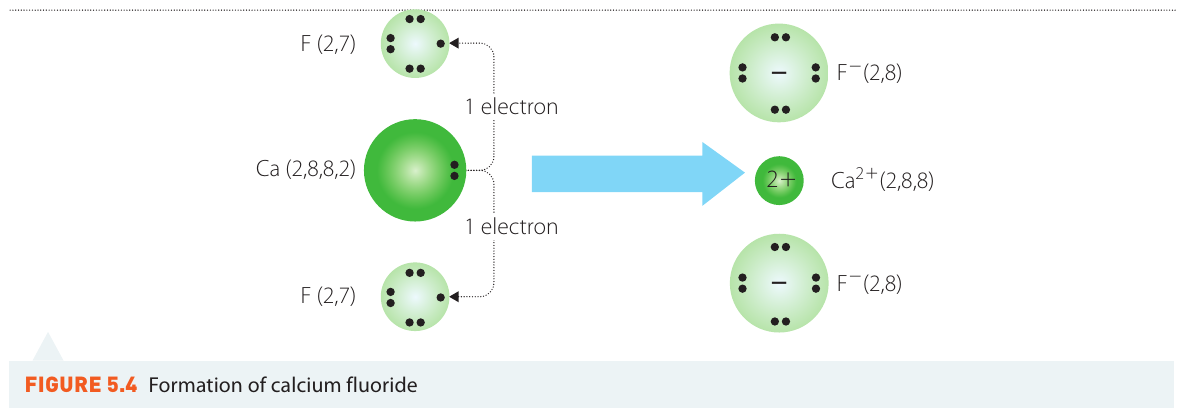
Because each calcium atom can donate two electrons, but each fluorine atom can only accept one electron, two fluorine atoms must combine with each calcium atom. This gives the ionic compound calcium fluoride the formula , consisting of calcium ions () and fluoride ions () in a 1:2 ratio.
Understanding cations and anions
Ions are classified into two categories based on their electrical charge. This classification is essential for understanding and predicting how ionic compounds form.
Cations are positive ions that form when atoms lose electrons. Because they have lost negatively charged electrons, they have more protons than electrons, resulting in a net positive charge. Examples include (sodium ion) and (calcium ion). Metal atoms typically form cations.
Anions are negative ions that form when atoms gain electrons. Having gained extra electrons, they have more electrons than protons, resulting in a net negative charge. Examples include (chloride ion) and (fluoride ion). Non-metal atoms typically form anions.
Note
The names of anions are derived from the element name but with the ending changed. For example:
- Chlorine → chloride
- Fluorine → fluoride
- Oxygen → oxide
Writing formulae for ionic compounds
To write the formula for an ionic compound correctly, we must apply a fundamental principle: ionic compounds are electrically neutral overall. This means the total positive charge must equal the total negative charge. This occurs because the total number of electrons lost by one element equals the number gained by the other element.
For sodium chloride, one ion (with a 1+ charge) combines with one ion (with a 1- charge), giving . The charges balance: +1 and -1 equals zero overall.
For calcium fluoride, one ion (with a 2+ charge) requires two ions (each with a 1- charge) to balance the charges. This gives . The charges balance: +2 and (2 × -1) equals zero overall.
To determine the values of and in the general formula for an ionic compound, we choose the smallest values that satisfy:
Example
Worked Example: Aluminium Oxide
Aluminium oxide contains aluminium ions () and oxide ions (). Let's write the formula as .
Step 1: Set up the equation Using our formula:
Step 2: Find the smallest values The smallest values that satisfy this equation are:
Step 3: Write the formula Therefore, the formula for aluminium oxide is Al₂O₃.
Step 4: Verify We can verify: , which gives ✓
The compound has a total charge of zero: ✓
What ionic compound formulae mean
The formulae of ionic compounds have a specific meaning that differs from molecular compounds. For ionic compounds like or , the formula specifies the ratio of ions present, not the composition of individual molecules.
Important
This type of formula is called an empirical formula. An empirical formula gives the simplest whole-number ratio of atoms or ions in a compound, rather than stating the actual numbers of atoms in a molecule. All ionic compound formulae are empirical formulae because ionic compounds don't exist as discrete molecules – they exist as extended crystal lattices containing vast numbers of ions.
For example, doesn't mean "one molecule containing one sodium atom and one chlorine atom." Instead, it means "sodium and chloride ions are present in a 1:1 ratio throughout the crystal structure."
Ionic bonding and the periodic table
The periodic table is an invaluable tool for predicting which elements will form ions and what charges those ions will have. Elements achieve stable noble gas electron configurations by losing or gaining a small number of electrons (typically one, two, or three). This generally applies to elements that are close to a noble gas in the periodic table.
Group 1 metals (alkali metals)
The Group 1 metals – lithium (), sodium (), potassium (), rubidium (), and caesium () – all have one electron in their outermost shell. They all readily lose this single electron to form singly charged positive ions: , , , , and .
These elements form only ionic compounds, never covalent compounds.
Group 2 metals (alkaline earth metals)
The Group 2 metals – beryllium (), magnesium (), calcium (), strontium (), and barium () – have two electrons in their outermost shell. They lose both electrons to form doubly charged positive ions: , , , , and .
Like Group 1, these elements form only ionic compounds.
Group 17 elements (halogens)
The Group 17 non-metals – fluorine (), chlorine (), bromine (), and iodine () – have seven electrons in their outer shell. They need just one more electron to achieve a stable configuration, so they gain one electron to form singly charged negative ions: , , , and .
These elements can form both ionic and covalent compounds, depending on what they combine with.
Group 16 elements
The Group 16 non-metals – oxygen (), sulfur (), selenium (), and tellurium () – have six electrons in their outer shell. They gain two electrons to form doubly charged negative ions: , , , and .
Like Group 17, these elements can form both ionic and covalent compounds.
Transition metals
All transition metals lose electrons to form positive ions (such as , , , , and ). However, it's not possible to predict the charge on transition metal ions simply from their position in the periodic table, as many can form ions with different charges.
Note
Periodic Table Patterns:
A useful generalisation is that metals typically form positive ions (cations), while non-metals typically form negative ions (anions) when they form ionic compounds.
Quick reference:
- Group 1 → 1+ ions
- Group 2 → 2+ ions
- Group 16 → 2- ions
- Group 17 → 1- ions
Understanding valence
Valence (also called valency) is an important concept in chemistry that helps us understand how elements combine to form compounds. The valence of an element is a number that measures the combining power of that element. It tells us the ratios in which elements combine when forming compounds.
When an element forms ionic compounds, its valence equals the numerical value of the charge on its ion. The sign (positive or negative) is typically omitted when stating valency, though sometimes you'll see valencies written with signs like +1, +2, -1, -2.
Note
Examples of valencies:
- Sodium (), potassium (), rubidium (), and silver () all have a valency of 1 (they form 1+ ions)
- Magnesium (), calcium (), barium (), and zinc () all have a valency of 2 (they form 2+ ions)
- Fluorine (), chlorine (), bromine (), and iodine () all have a valency of 1 (they form 1- ions)
- Oxygen () and sulfur () have a valency of 2 (they form 2- ions)
Knowing the valency of elements allows you to work out the formula of any compound they form together.
Naming simple ionic compounds
Chemical nomenclature (the system for naming compounds) follows specific rules to ensure clarity and consistency.
Binary ionic compounds
Binary compounds contain only two elements. To name binary ionic compounds, we follow this simple rule: name the positive ion (metal) first, then the negative ion (non-metal). The positive ion keeps the element name (such as "sodium" or "calcium"), while the negative ion has the ending of the element name changed to "-ide".
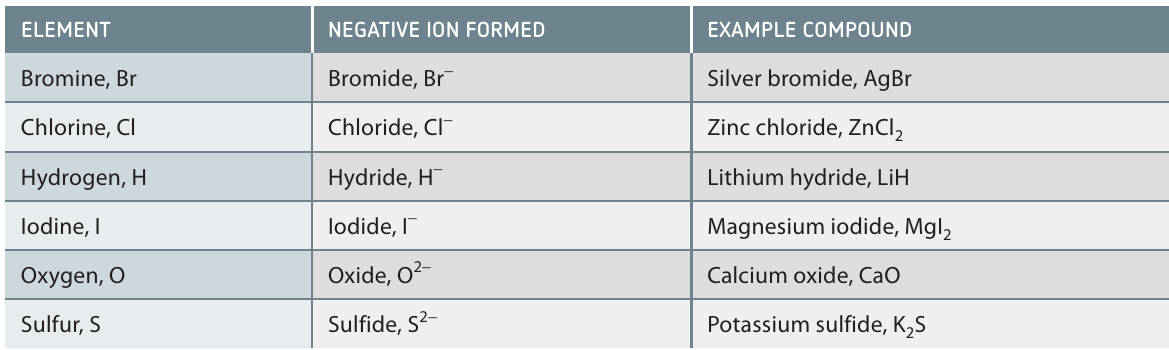
Examples:
- is sodium chloride
- is magnesium oxide
- is potassium sulfide
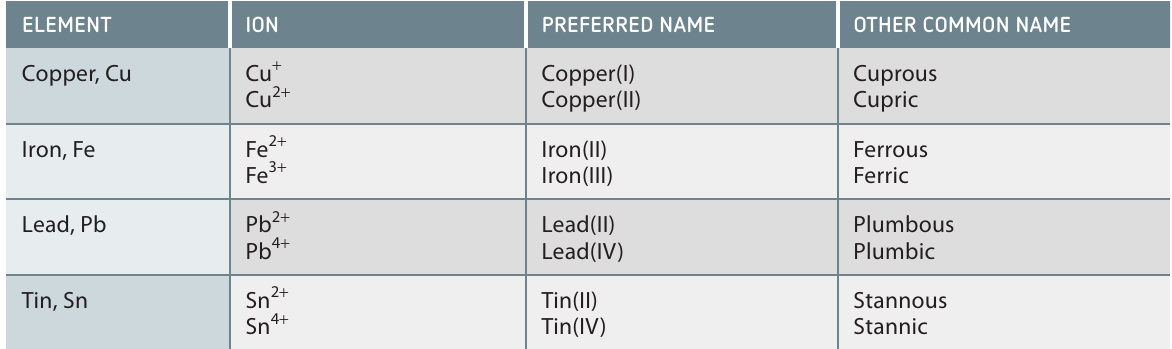
Elements with variable valencies
Some metals, particularly transition metals, can form ions with different charges. For these elements, we must indicate which ion is present in the compound being named. There are two methods for doing this:
Method 1: Roman numerals (preferred)
Place the valency as a Roman numeral in brackets immediately after the metal name:
- is iron(II) chloride
- is iron(III) chloride
- is copper(I) oxide
- is copper(II) oxide
Method 2: Special endings (traditional)
Use "-ous" for the lower valency state and "-ic" for the higher valency state, sometimes with a Latinised metal name:
- is cuprous sulfide
- is cupric sulfide
- is ferrous chloride
- is ferric chloride
Note
The Roman numeral method is preferred in modern chemistry, but the traditional names remain in widespread use. For metals like copper and lead, chemists often omit the Roman numeral for the more common valency. For example, "copper sulfate" usually means copper(II) sulfate, as copper(I) compounds are relatively rare.
Polyatomic ions
Not all ions consist of a single atom. Polyatomic ions are ions formed from two or more atoms joined together. Despite being composed of multiple atoms, each polyatomic ion behaves as a single unit when forming compounds. The atoms within a polyatomic ion remain bonded together and don't separate during chemical reactions.
Common polyatomic ions include:
- Ammonium ion: (valency 1)
- Hydroxide ion: (valency 1)
- Nitrate ion: (valency 1)
- Sulfate ion: (valency 2)
- Carbonate ion: (valency 2)
- Phosphate ion: (valency 3)
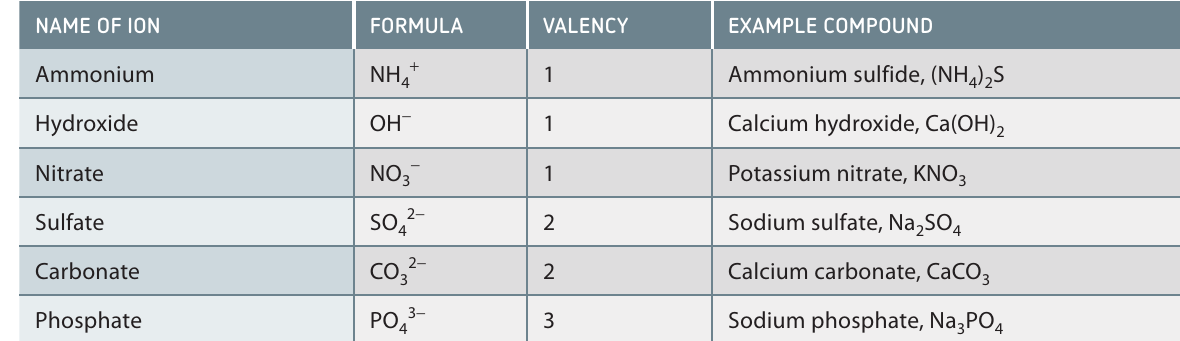
When writing formulae for compounds containing polyatomic ions, we use the same charge-balancing principle as before.
Example
Examples of Compounds with Polyatomic Ions:
Sodium sulfate:
- Two ions (each 1+) balance one ion (2-)
- Calculation: ✓
Magnesium nitrate:
- One ion (2+) needs two ions (each 1-)
- Calculation: ✓
- Brackets are used when we need more than one polyatomic ion
Calcium phosphate:
- Three calcium ions (each 2+) give total charge of 6+
- Two phosphate ions (each 3-) give total charge of 6-
- Calculation: ✓
- Result: neutral compound
Summary
Key Points to Remember:
-
Ionic bonding involves complete electron transfer from one atom to another, creating oppositely charged ions that attract each other through electrostatic forces.
-
Cations are positive ions (formed when atoms lose electrons), while anions are negative ions (formed when atoms gain electrons).
-
Ionic compound formulae represent ratios, not molecules. They are empirical formulae showing the simplest whole-number ratio of ions in the crystal structure.
-
The periodic table predicts ion formation:
- Group 1 forms 1+ ions
- Group 2 forms 2+ ions
- Group 17 forms 1- ions
- Group 16 forms 2- ions
-
To name binary ionic compounds, give the metal name first, then the non-metal name with an "-ide" ending. For metals with variable valencies, use Roman numerals to indicate the charge.
-
Polyatomic ions act as single units in compounds and follow the same charge-balancing rules as simple ions.