Properties of Ionic and Covalent Molecular Substances (HSC SSCE Chemistry): Revision Notes
📚Revision Notes
Properties of Ionic and Covalent Molecular Substances
Understanding the differences between ionic and covalent molecular substances is crucial for predicting how materials will behave. These two types of substances have very different properties because of their different bonding arrangements.
Overview of ionic and covalent molecular substances
Ionic substances are always compounds formed when metals transfer electrons to non-metals, creating positive and negative ions held together by strong electrostatic forces. Examples include sodium chloride () and magnesium oxide ().
Covalent molecular substances can be either elements (like iodine or phosphorus ) or compounds (like water or carbon dioxide ). These substances consist of molecules where atoms share electrons to form covalent bonds.
Note
The fundamental difference between these substance types lies in how electrons are involved in bonding: ionic substances involve complete electron transfer creating charged ions, while covalent substances involve electron sharing between atoms within molecules.
Comparing properties
The table below summarises the key differences between these two types of substances:
| Property | Ionic Substances | Covalent Molecular Substances |
|---|---|---|
| State at room temperature | Solid | Usually gases (, , ) or liquids (, , methanol); few are solids (, , ) |
| Melting point | High (typically > 400°C) | Low (generally < 200°C) |
| Boiling point | High (typically > 1000°C) | Low (generally < 400°C) |
| Hardness when solid | Hard and brittle | Soft |
| Electrical conductivity as solid | Does not conduct | Does not conduct |
| Electrical conductivity when molten | Conducts electricity | Does not conduct |
| Electrical conductivity in aqueous solution | Conducts electricity | Does not conduct (unless it reacts with water to form ions) |
Note
Notice the pattern: ionic substances generally have extreme properties (high melting/boiling points, hard), while covalent molecular substances have moderate properties (low melting/boiling points, soft). This reflects the strength of the forces holding the particles together.
Properties of ionic substances explained
Understanding why ionic substances have their characteristic properties requires looking at their structure and the forces holding them together.
Crystal structure and strong forces
Ionic substances exist as giant three-dimensional lattices where each positive ion is surrounded by negative ions and vice versa. The electrostatic forces between these oppositely charged ions are very strong throughout the entire crystal structure.
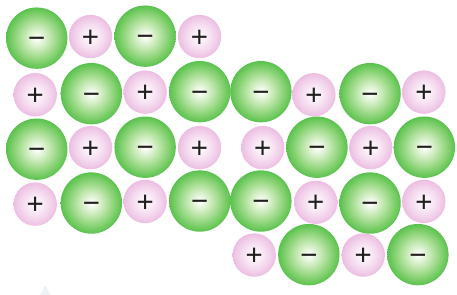
High melting and boiling points
When you melt an ionic solid, you must break apart this orderly arrangement of ions. The strong electrostatic forces between the ions require a large amount of energy to overcome, which means high temperatures are needed. Typically, ionic substances have melting points above 400°C.
Boiling an ionic substance requires even more energy because you need to separate the ions completely to form a vapour of ion pairs. This is why boiling points are typically above 1000°C.
Example
Worked Example: Energy Required for Melting
Consider sodium chloride (NaCl):
- Melting point: 801°C
- The high temperature is needed because:
- Each Na⁺ ion is surrounded by 6 Cl⁻ ions
- Each Cl⁻ ion is surrounded by 6 Na⁺ ions
- All these strong electrostatic attractions must be overcome simultaneously
- The result is a very stable structure requiring large energy input to disrupt
Hardness and brittleness
The strong electrostatic attraction between ions makes ionic substances hard. However, they are also brittle. When you apply a strong force to an ionic crystal, the orderly arrangement of ions can shift slightly. This causes ions with the same charge to come close together. These like-charged ions repel each other strongly, which causes the crystal to shatter rather than deform. This brittleness is a distinctive property of ionic materials.
Important
Common Misconception: Students often think that because ionic substances are hard, they should also be tough. However, the brittleness of ionic crystals means they fracture easily when sufficient force is applied. The hardness and brittleness occur for the same reason: the strong, rigid arrangement of ions in the crystal lattice.
Electrical conductivity
The ability of a substance to conduct electricity depends on whether it contains charged particles that can move freely.
As solids: Ionic compounds do not conduct electricity when solid because the ions are locked tightly in fixed positions within the crystal lattice. Although the ions are charged, they cannot move towards electrodes, so no electrical current can flow.
Note
The ions in a solid ionic compound are charged and capable of conducting electricity, but they are held so rigidly in place by electrostatic forces that they cannot move. It's the lack of mobility, not the lack of charge, that prevents conduction.
When molten: When an ionic substance melts, the crystal lattice breaks down and the ions become free to move around in the liquid. These mobile ions can migrate towards oppositely charged electrodes, allowing electric current to flow. This is why molten ionic substances conduct electricity.
In aqueous solution: When ionic substances dissolve in water, the crystal structure is completely broken apart. The individual ions move randomly through the water and can migrate towards electrodes. Therefore, aqueous solutions of ionic substances conduct electricity.
Properties of covalent molecular substances explained
Covalent molecular substances have very different properties from ionic substances because their bonding is organised differently.
Understanding molecular structure
In covalent molecular substances, atoms share electrons to form strong covalent bonds within each molecule. However, the forces between separate molecules are much weaker. Understanding this distinction is essential for explaining their properties.
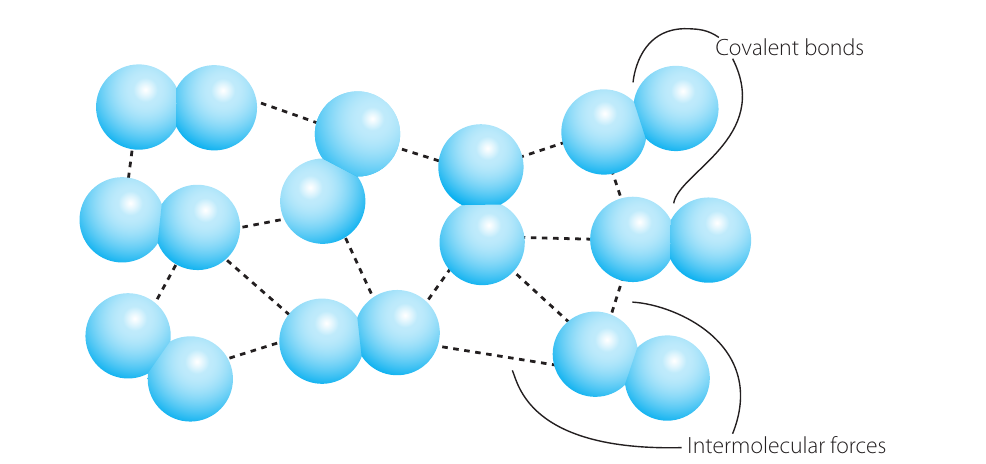
The diagram above shows how molecules are held together. Strong covalent bonds exist within each molecule, but only weak intermolecular forces exist between neighbouring molecules.
Low melting and boiling points
When a covalent molecular substance melts or boils, the weak intermolecular forces between molecules are overcome, but the strong covalent bonds within each molecule remain intact. This is a crucial point:
- Melting disrupts the orderly arrangement of molecules in a solid
- Boiling completely separates molecules from each other
- Neither process breaks the covalent bonds within molecules
Important
Critical Concept: During melting or boiling of covalent molecular substances, you are NOT breaking covalent bonds. You are only overcoming the weak intermolecular forces between molecules. The molecules themselves remain intact with their covalent bonds unbroken. This is why these processes require relatively little energy.
Because intermolecular forces are relatively weak, only small amounts of energy are needed to overcome them. This explains why covalent molecular substances typically have low melting points (less than 200°C) and low boiling points (less than 400°C).
Example
Worked Example: Boiling Bromine
Bromine () has a boiling point of only 58°C.
Analysis:
- The covalent bond within each molecule is strong
- The intermolecular forces between molecules are weak
- When bromine boils at 58°C:
- The weak intermolecular forces are overcome
- The covalent bonds remain intact
- Each molecule of stays as
This explains why only 58°C is needed - we're only overcoming weak forces, not breaking strong covalent bonds.
Note
Exam tip: Remember that the strength of intermolecular forces varies between different molecular compounds. Substances with stronger intermolecular forces have higher melting and boiling points, but these are still low compared to ionic substances.
Softness of molecular solids
When covalent molecular substances form solids, they are soft because the weak intermolecular forces are easily overcome. This makes it easy to distort the structure, unlike the hard ionic solids where strong electrostatic forces resist deformation.
Electrical conductivity
Covalent molecules are neutral species with no overall charge. They contain no charged particles that can move and carry electric current. Therefore, pure covalent substances do not conduct electricity whether they are solid or liquid.
Even when dissolved in water, most covalent molecular substances remain as neutral molecules and do not conduct electricity. Examples include sugar (sucrose) and iodine dissolved in water.
Important
Important exception: Some covalent substances react with water to form ions. When this happens, the resulting solution does conduct electricity. Examples include hydrogen chloride (), sulfuric acid (), and nitric acid (). However, this conductivity is due to the ions formed by the chemical reaction, not the original covalent molecules.
Intermolecular forces vs intramolecular bonds
A key concept for understanding properties is distinguishing between two types of forces:
Important
Critical Distinction:
Intramolecular bonds are the strong covalent bonds holding atoms together within a molecule. These bonds involve the sharing of electrons between atoms.
Intermolecular forces are the weak attractive forces between separate molecules. These are the forces that must be overcome during melting and boiling.
Remember: "intra" = within, "inter" = between
Physical vs chemical changes
This distinction helps us understand the difference between physical and chemical changes:
- Physical changes (like melting and boiling) overcome intermolecular forces but do not break intramolecular bonds. The molecules themselves remain intact.
- Chemical changes (like electrolysis) break intramolecular bonds and form new ones. This changes the actual molecules present.
Example
Worked Example: Water - Physical vs Chemical Change
Physical Change (Boiling):
- Water boils at 100°C
- The weak intermolecular forces between molecules are overcome
- The covalent bonds within each water molecule remain intact
- Result: Water molecules change from liquid to gas, but are still
Chemical Change (Electrolysis):
- The covalent bonds are broken
- New bonds form to create hydrogen gas () and oxygen gas ()
- Result: Water molecules no longer exist; new substances are formed
Practical investigations
Two investigations help demonstrate these concepts:
Note
Investigation 5.2 compares physical and chemical changes in water by heating water to boiling (physical change) and performing electrolysis (chemical change). This demonstrates that boiling only overcomes intermolecular forces, while electrolysis breaks intramolecular covalent bonds.
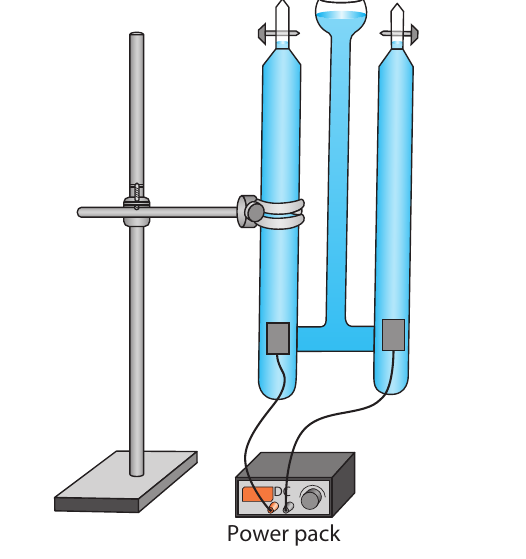
Investigation 5.3 uses modelling to visualise what happens during boiling versus electrolysis. Models help us understand processes at the molecular level that we cannot see directly.
Note
Exam tip: When answering questions about melting, boiling, or dissolving, always specify whether intermolecular forces or intramolecular bonds are being overcome. This demonstrates deeper understanding of the processes involved.
Summary
Summary
Key Points to Remember:
-
Ionic substances have high melting and boiling points, are hard but brittle, and conduct electricity when molten or in solution (but not as solids). These properties result from strong electrostatic forces between ions in a crystal lattice.
-
Covalent molecular substances have low melting and boiling points, are soft when solid, and do not conduct electricity. These properties result from weak intermolecular forces between molecules, even though the covalent bonds within molecules are strong.
-
Intermolecular forces are weak forces between molecules that are overcome during melting and boiling (physical changes).
-
Intramolecular bonds are strong covalent bonds within molecules that are broken during chemical changes like electrolysis.
-
The key to predicting properties is understanding the type of bonding present and the strength of the forces between particles.