Allotropy (HSC SSCE Chemistry): Revision Notes
📚Revision Notes
Allotropy
What is allotropy?
Allotropy is when a single element exists in two or more physically different forms in the same physical state (solid, liquid, or gas). These different forms are called allotropes.
Allotropes are forms of the same element that:
- Exist in the same physical state
- Have distinctly different physical properties such as colour, density, hardness, and electrical conductivity
Note
The reason allotropes have different properties is because their atoms are arranged or bonded together in different ways to form molecules or crystals. This structural variation at the atomic level leads to dramatically different macroscopic properties.
Common elements displaying allotropy
Several elements display allotropy, including:
- Carbon (diamond, graphite, buckminsterfullerene, carbon nanotubes)
- Phosphorus (white, red, black)
- Sulfur (rhombic, monoclinic, plastic)
- Oxygen ( and )
- Tin
Allotropes of carbon
Carbon shows the most striking differences between its allotropes. Let's explore the main carbon allotropes and understand how their structures determine their properties.
Diamond structure and properties
Diamond consists of carbon atoms, where each carbon atom is covalently bonded to four other carbon atoms in a tetrahedral arrangement. This creates a three-dimensional network structure.
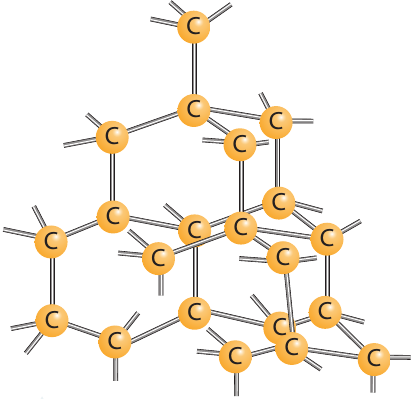
Key structural features:
- Each carbon atom forms four strong covalent bonds
- Tetrahedral arrangement around each carbon atom
- Carbon atoms arranged in six-membered rings that are buckled (not flat)
- Three-dimensional covalent lattice structure
- All valence electrons are tied up in strong covalent bonds
Physical properties:
- Colourless and transparent
- Extremely hard (hardest naturally occurring material)
- Very high melting point (3550°C)
- Does not conduct electricity (no mobile electrons available)
- Not soluble in cyclohexane
- Brilliant appearance due to orderly atomic arrangement
Note
The extreme hardness of diamond comes from its rigid three-dimensional structure where all atoms are locked in place by strong covalent bonds. The network extends throughout the entire crystal, making it incredibly difficult to break or deform.
Important
Diamond cannot conduct electricity because all its valence electrons are used in bonding, leaving no free electrons to carry charge. This is a crucial distinction from graphite, which has delocalized electrons available for electrical conduction.
Graphite structure and properties
Graphite is also a covalent network solid, but its structure is very different from diamond. Each carbon atom is bonded to only three other carbon atoms, forming flat, two-dimensional layers.

Key structural features:
- Each carbon atom forms three covalent bonds to other carbon atoms
- Planar (flat) layers of hexagonal six-membered rings
- Each carbon atom has one free valence electron
- Free electrons form a delocalised electron cloud (similar to metals)
- Weak intermolecular forces between layers (335 pm apart)
- Strong covalent bonds within layers (142 pm between atoms)
Physical properties:
- Black in colour
- Soft and slippery texture
- Used as a dry lubricant
- Conducts electricity
- Very high melting point (3974°C)
- Not soluble in cyclohexane
Note
The layers in graphite can easily slide over each other because only weak intermolecular forces hold them together. This explains why graphite feels slippery and works well as a lubricant, despite being made of the same element as diamond.
Important
Graphite conducts electricity because the delocalised electrons can move freely through the structure when a voltage is applied. This is why graphite is used in electrodes and electrical contacts, while diamond is an insulator.
Buckminsterfullerene (C₆₀)
Buckminsterfullerene, often called 'buckyball', is a more recently discovered allotrope of carbon with the molecular formula .
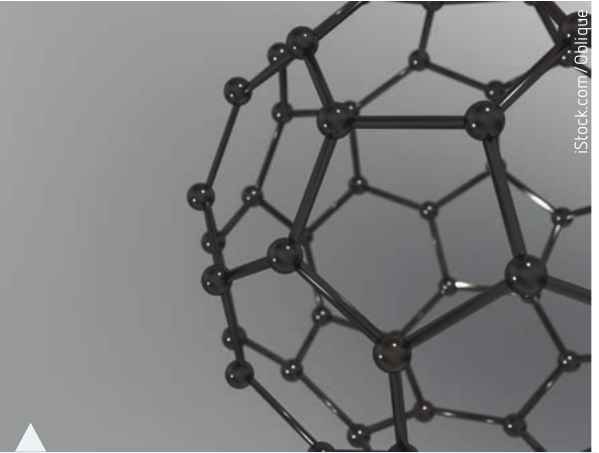
Key structural features:
- Contains exactly 60 carbon atoms arranged in a spherical cage
- Structure resembles a football (soccer ball)
- Made up of 20 hexagonal rings and 12 pentagonal rings joined together
- Each carbon atom bonded to three other carbon atoms
- Bonds are not planar but form a curved surface
- Has some delocalised electrons but is less reactive than graphite
Physical properties:
- Yellow-brown colour
- Much lower melting point than diamond or graphite (550°C)
- Soluble in organic solvents like benzene, toluene, and cyclohexane (unlike diamond and graphite)
- Electrical conductivity properties are uncertain
Note
The name comes from architect Buckminster Fuller, who designed geometric dome structures similar to this molecular shape. You can visualise the structure by imagining a carbon atom at each of the 60 vertices (corners) of a football.
Other fullerenes
Related molecules with formulae and have also been prepared. These are called fullerenes and are more egg-shaped than spherical. Each fullerene is an allotrope of carbon.
Carbon nanotubes
Carbon nanotubes are a synthetic allotrope of carbon that consists of small sheets of graphite rolled into cylinders.
Key features:
- Extremely strong
- High electrical conductivity
- Very small diameter (typically 1.3 nm)
- Can be very long (up to 1 cm, which is huge for a molecule)
Comparison of carbon allotropes
| Allotrope | Melting point (°C) | Conducts electricity? | Soluble in cyclohexane? |
|---|---|---|---|
| Graphite | 3974 | Yes | No |
| Diamond | 3550 | No | No |
| Buckminsterfullerene () | 550 | Unknown | Yes |
Important
Exam tip: Be able to explain the differences in properties based on the structures. For example, graphite conducts electricity because it has delocalised electrons, while diamond does not conduct because all electrons are locked in covalent bonds.
Allotropes of phosphorus
There are three allotropes of phosphorus: white, red, and black. They differ significantly in their reactivity.
White phosphorus
Structure:
- Consists of molecules packed into a crystal
- Each phosphorus atom is covalently bonded to three other phosphorus atoms in a tetrahedral arrangement
Properties:
- Very reactive
- Must be stored under water for safety
- Least stable allotrope
Red phosphorus
Structure:
- Consists of chains of units
- One P—P bond in each unit has 'opened out' to join with neighbouring units
- Forms a polymeric chain structure

Properties:
- Considerably less reactive than white phosphorus
- More stable than white phosphorus due to chain structure
Black phosphorus
Structure:
- Consists of puckered (buckled) layers of phosphorus atoms
- Each phosphorus atom bonded to three other phosphorus atoms
- Strong covalent bonds within layers
- Only weak forces between layers
Properties:
- Most stable allotrope
- Least reactive
- The layered structure provides greatest stability
Note
The trend in reactivity (white > red > black) relates directly to the structural stability, with more extended structures being more stable and less reactive. This demonstrates how molecular architecture directly influences chemical behavior.
Allotropes of sulfur
There are three allotropes of sulfur: rhombic, monoclinic, and plastic.
Rhombic and monoclinic sulfur
Structure:
- Both contain molecules with eight sulfur atoms ()
- Sulfur atoms joined by single covalent bonds in a ring structure
- The difference is only in how the molecules are packed in the crystals
Properties:
- Similar chemical reactions (because they have the same molecular structure)
- Only small differences in physical properties
Note
Since rhombic and monoclinic sulfur both consist of rings, they show identical chemical reactivity. The only differences are in how these rings are arranged in the crystal lattice, leading to minor variations in physical properties like density and crystal shape.
Plastic sulfur
Structure:
- Consists of long chains of sulfur atoms singly bonded to each other
- Non-crystalline (amorphous) structure
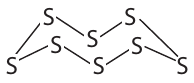
Properties:
- Rubbery texture
- Slowly reverts back to rings on standing
Allotropes of oxygen
Oxygen exists in two allotropic forms:
Oxygen gas ()
Structure:
- Diatomic molecules
- Contains two oxygen atoms bonded together
Properties:
- Boiling point: −183°C
- Essential for respiration
Ozone ()
Structure:
- Triatomic molecules
- Contains three oxygen atoms bonded together
Properties:
- Poisonous gas
- Boiling point: −111°C (considerably higher than oxygen)
- Important in Earth's upper atmosphere where it absorbs harmful UV radiation
Note
The higher boiling point of ozone compared to oxygen reflects the larger molecular size and therefore stronger dispersion forces between molecules. This demonstrates how molecular size affects intermolecular attractions.
Remember!
Summary
Key Points to Remember:
-
Allotropy is the existence of two or more physically distinct forms of the same element in the same physical state. These different forms are called allotropes.
-
Diamond has a three-dimensional tetrahedral structure with each carbon bonded to four others, making it extremely hard and a non-conductor of electricity. Graphite has a layered planar structure with each carbon bonded to three others, making it soft, slippery, and electrically conductive due to delocalised electrons.
-
Buckminsterfullerene () has a spherical cage structure with 60 carbon atoms arranged like a football, with lower melting point and solubility in organic solvents unlike diamond and graphite.
-
Elements displaying allotropy include carbon (diamond, graphite, fullerenes), phosphorus (white, red, black), sulfur (rhombic, monoclinic, plastic), and oxygen ( and ).