The Elements and the Periodic Table (HSC SSCE Chemistry): Revision Notes
📚Revision Notes
The Elements and the Periodic Table
Understanding how elements are organised and classified is fundamental to chemistry. The periodic table is one of the most powerful tools in science, allowing us to predict properties and understand relationships between different elements.
Note
The periodic table is more than just a chart - it's a predictive tool that reveals patterns in nature. Scientists use it to understand why elements behave the way they do and to predict properties of elements they've never encountered before.
What are elements?
Elements are the simplest pure substances in chemistry. They cannot be broken down into simpler materials by chemical means. Currently, there are approximately 118 known elements, each with unique properties and characteristics.
Occurrence of elements in nature
Most elements exist in nature as compounds rather than as free elements. Over billions of years since Earth's formation, elements have reacted chemically with each other. These reactions produced two types of compounds:
- Insoluble compounds remained part of the solid Earth, forming minerals and ores
- Soluble compounds gradually dissolved in water and accumulated in rivers, lakes, and oceans
Note
The type of compound an element forms determines where we find it today. Elements that form predominantly soluble compounds (such as sodium, potassium, calcium, and magnesium) are commonly found dissolved in natural water sources. Elements like aluminium, iron, and copper are typically extracted from insoluble mineral ores.
Free elements in nature
Only a few elements occur naturally in their uncombined (free) state:
- Atmospheric gases: Oxygen () makes up 21% of dry atmosphere, nitrogen () comprises 78%
- Noble gases: Argon makes up about 1% of the atmosphere, whilst helium, neon, krypton, xenon, and radon exist in trace amounts
- Precious metals: Gold and platinum occur as uncombined elements
- Other elements: Sulphur, copper, and silver are sometimes found as free elements, though they more commonly exist as compounds
Physical states of elements
At room temperature (25°C), elements exist in three physical states:
- Most elements are solids at room temperature
- Only two elements are liquids: mercury (Hg) and bromine (Br)
- Several elements are gases: hydrogen, nitrogen, oxygen, fluorine, chlorine, and all the noble gases (helium, neon, argon, krypton, xenon, radon)
Note
The physical state of an element at room temperature is determined by its melting point and boiling point. These properties vary enormously between elements - from helium which boils at -269°C to tungsten which melts at 3422°C!
Investigation 2.3: Classifying elements by physical state
Example
Investigation: Determining Physical States from Data
This investigation uses secondary data sources to determine which elements are solids, liquids, or gases at 25°C. The key data required are the melting point and boiling point of each element:
- An element is a solid if its melting point is above 25°C
- An element is a liquid if its melting point is below 25°C but its boiling point is above 25°C
- An element is a gas if its boiling point is below 25°C
Students typically colour-code a blank periodic table to show these three states, revealing patterns in how physical states are distributed across the table.
Metals and non-metals
Chemists classify elements into two main categories: metals and non-metals. This classification is useful because elements in each category typically behave similarly in chemical reactions.
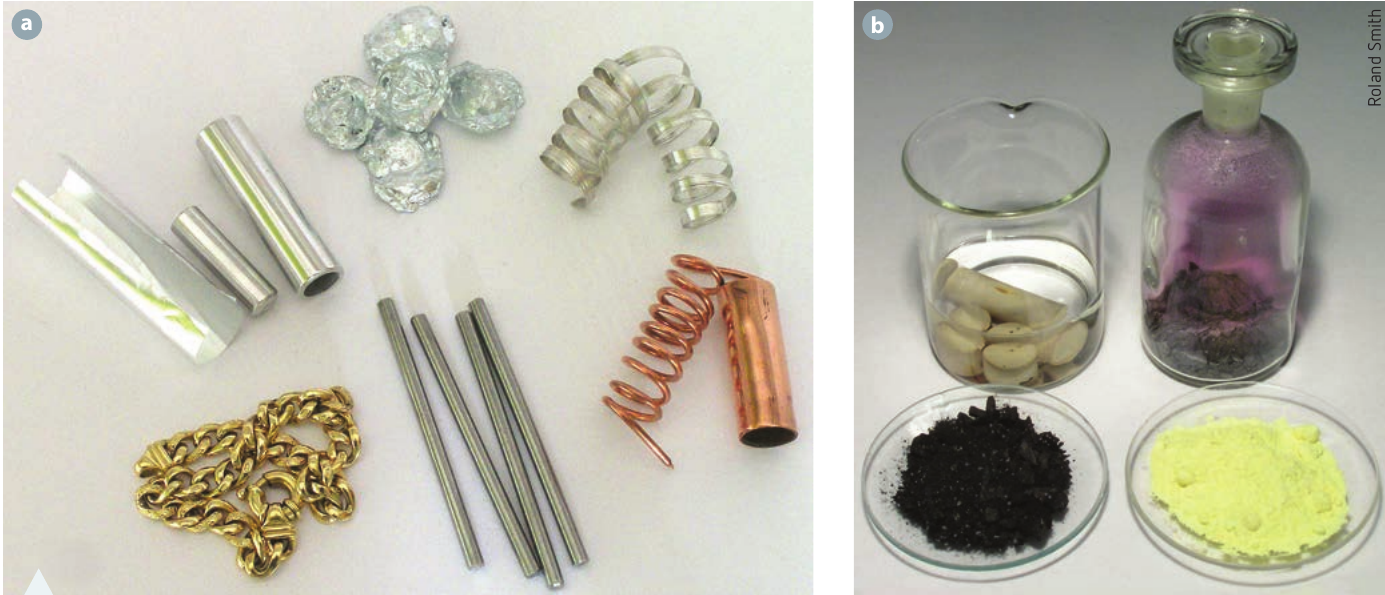
Properties of metals
Metals are elements that exhibit the following characteristics:
- They are solids at room temperature (except mercury, which is liquid)
- They have a shiny or lustrous appearance when freshly cleaned
- They are good conductors of both heat and electricity
- They are malleable, meaning they can be hammered or rolled into thin sheets without breaking
- They are ductile, meaning they can be drawn out into wires
Common metallic elements include gold, aluminium, zinc, magnesium, copper, iron, cobalt, nickel, potassium, sodium, silver, and tin.
Properties of non-metals
Non-metals comprise most of the remaining elements. Their typical properties include:
- They can be solids or gases at room temperature (with bromine being the only liquid non-metal)
- They generally have a dull, non-lustrous appearance (diamond, a form of carbon, is a notable exception)
- They are generally poor conductors of heat and electricity (graphite, another form of carbon, is an exception as it conducts electricity moderately well)
- They are neither malleable nor ductile - they typically shatter or break when force is applied
Examples of non-metals include argon, bromine, chlorine, hydrogen, nitrogen, oxygen, phosphorus, carbon, iodine, and sulphur.
Important
Common Misconception Alert
Melting and boiling points are not useful properties for distinguishing between metals and non-metals, as both groups contain elements with widely varying melting and boiling points. Instead, focus on appearance, conductivity, malleability, and ductility.
Semi-metals (metalloids)
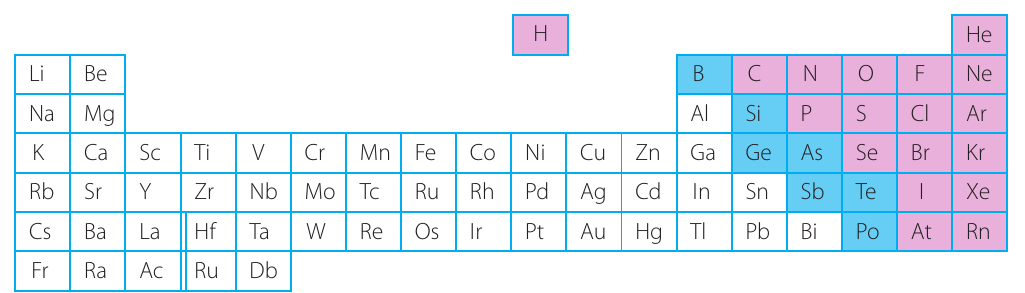
Some elements don't fit neatly into either category because they display properties of both metals and non-metals. These are called semi-metals or metalloids. The semi-metals include:
- Boron (B)
- Silicon (Si)
- Germanium (Ge)
- Arsenic (As)
- Antimony (Sb)
- Tellurium (Te)
Note
For example, silicon is shiny like a metal but brittle like a non-metal. It conducts electricity better than non-metals but not as well as metals, making it valuable in electronic components.
Classifying borderline elements
Sometimes elements must be classified based on the balance of their properties:
- Mercury is classified as a metal even though it's a liquid at room temperature, because it has a shiny appearance and conducts electricity well
- Carbon in the form of graphite conducts electricity fairly well and is solid, but is classified as a non-metal because its other properties more closely resemble non-metals
Investigation 2.4: Testing elements to classify them
Example
Investigation: Testing Physical and Electrical Properties
This practical investigation examines various elements to classify them as metals or non-metals by testing:
- Appearance: Is the element shiny (lustrous) or dull?
- Hardness: How easily can the surface be scratched or the material broken?
- Malleability: Does the element flatten when struck with a hammer, or does it shatter?
- Electrical conductivity: Does the element allow electric current to flow through it?
Students test samples of elements such as aluminium, carbon (charcoal), copper, iodine, iron, lead, magnesium, sulphur, and zinc. Based on these observations, they can determine which elements are metals and which are non-metals.
Safety note: When working with iodine, only small amounts (0.2 g) should be used, and it must be handled in a fume cupboard as it is toxic and a lung irritant.
The periodic table
The periodic table is a chart that organises all known elements in a way that reveals patterns and relationships. Elements with similar properties are arranged in the same vertical column, making it a powerful tool for predicting chemical behaviour.
Structure of the periodic table
The periodic table has two main organisational features:
Groups (vertical columns)
Groups are the vertical columns in the periodic table, numbered from 1 to 18. Elements within the same group have very similar chemical properties. For example:
- Lithium (Li), sodium (Na), potassium (K), rubidium (Rb), and caesium (Cs) all fall in Group 1 and share similar properties
- Fluorine (F), chlorine (Cl), bromine (Br), and iodine (I) are all in Group 17 and behave similarly
Note
The groups are divided into two categories:
- Main-group elements: Groups 1, 2, and 13-18
- Transition elements: Groups 3-12
Periods (horizontal rows)
Periods are the horizontal rows in the periodic table, numbered from 1 to 7:
- Period 1 contains only two elements: hydrogen (H) and helium (He)
- Periods 2 and 3 each contain eight elements (Li to Ne, and Na to Ar respectively)
- Periods 4 and higher contain larger numbers of elements because they include transition elements
Whilst there is often a gradual change in properties as you move across a period, periods are less useful than groups for predicting specific element properties.
Special group names
Some groups have specific names because their elements share particularly distinctive properties:
| Group Number | Special Name | Elements |
|---|---|---|
| Group 1 | Alkali metals | Li, Na, K, Rb, Cs |
| Group 2 | Alkaline earth metals | Be, Mg, Ca, Sr, Ba |
| Group 17 | Halogens | F, Cl, Br, I, At |
| Group 18 | Noble gases | He, Ne, Ar, Kr, Xe, Rn |
Note
About numbering systems: An older numbering system exists that numbers main groups as I to VIII and leaves transition element groups unnumbered. The modern system (1-18) is now preferred and is the one you should use.
Using the periodic table to predict properties
A major advantage of the periodic table is that it allows us to deduce properties of unfamiliar elements. If you know the properties of one element in a group, you can predict that other elements in the same group will behave similarly.
Example
Worked Example: Predicting Element Properties
If you know nothing about rubidium (Rb) but notice it's in the same group as sodium (Na), you can predict that:
- Rubidium will react with water (because sodium does)
- Rubidium will form similar compounds to sodium
- Rubidium will have similar physical properties to sodium
Similarly, if you understand chlorine's chemistry, you can predict that bromine and iodine will form the same types of compounds.
Important
These strong family relationships are particularly evident in groups at either side of the table (especially Groups 1, 2, 17, and 18). In the middle groups, such as Group 14, properties change more significantly as you move down the group.
Location of metals and non-metals in the periodic table
The periodic table shows a clear pattern in the distribution of metals and non-metals:
- Non-metals are located near the top and right of the periodic table
- Metals make up most of the other elements
- Semi-metals form a diagonal band that separates metals from non-metals, running from boron (B) down to astatine (At)
Trends in metallic character
Within groups 13 to 16, there is a clear trend:
- Metallic character increases as you move down a group (from top to bottom)
- Metallic character decreases as you move across a period from left to right
Example
Example: Group 14 Trends
In Group 14, you can observe the trend in metallic character:
- Carbon (C) at the top is a non-metal
- Silicon (Si) and germanium (Ge) in the middle are semi-metals
- Tin (Sn) and lead (Pb) at the bottom are metals
This pattern helps explain why elements in different parts of the periodic table behave so differently.
Remember!
Summary
Key Points to Remember:
-
Elements are organised in the periodic table by arranging those with similar properties in the same vertical column (group).
-
Metals are shiny, solid (except mercury), conduct heat and electricity well, and are malleable and ductile. They are found on the left and centre of the periodic table.
-
Non-metals are dull, can be solids or gases (bromine is the only liquid), are poor conductors, and are not malleable. They are found in the top right of the periodic table.
-
The periodic table has 18 groups (vertical columns) and 7 periods (horizontal rows). Groups 3-12 are transition elements; groups 1, 2, and 13-18 are main-group elements.
-
Important group names to remember: Group 1 = alkali metals, Group 2 = alkaline earth metals, Group 17 = halogens, Group 18 = noble gases.
-
You can predict an element's properties by looking at other elements in its group, as elements in the same group behave similarly.