Collision Theory (HSC SSCE Chemistry): Revision Notes
📚Revision Notes
Collision Theory
What is collision theory?
Collision theory explains how and why chemical reactions occur at different rates. For a chemical reaction to take place, reactant particles must interact with each other in a specific way. This theory helps us understand why some reactions happen quickly while others proceed very slowly.
The theory states that reactant molecules need to overcome an energy barrier before they can form products. This energy barrier is called the activation energy (). We can think of activation energy as a hill that reactants must climb before they can transform into products. The higher this energy barrier, the more difficult it is for reactants to get over it, and therefore the slower the reaction proceeds at a given temperature.
Note
The Hill Analogy for Activation Energy
Imagine activation energy as a hill between reactants and products:
- Reactants with sufficient energy can climb over the hill and become products
- Reactants with insufficient energy only climb partway up before falling back down
- They remain as unreacted particles after the collision
When reactants have sufficient energy, they can climb to the top of this energy barrier and then "fall" down the other side to become products. However, if they have less than the required amount of energy, they only climb part way up the hill before falling back down. In this case, the particles simply collide and bounce apart, remaining as reactants without reacting.
The three requirements for chemical reaction
According to collision theory, three specific conditions must be met for a chemical reaction to occur. The reactant particles must:
- Collide with each other - particles must physically come into contact
- Have sufficient kinetic energy - they must possess more than a minimum amount of energy (the activation energy)
- Be correctly orientated - they must approach each other at the right angle and position
Important
All Three Requirements Must Be Met
If any one of these three requirements is not met, the collision will be unsuccessful and no reaction will occur. This explains why not all collisions between reactant particles lead to products, even when particles are constantly moving and colliding.
Quantitative expression of collision theory
We can express the relationship between these three factors mathematically. The rate of a chemical reaction depends on:
Note
This equation shows us that increasing any of these three factors will increase the reaction rate. For example, if we increase the number of collisions, or increase the fraction of high-energy collisions, or improve the chance of correct orientation, the reaction will proceed faster.
Effect of concentration on collision frequency
The number of collisions per unit volume per unit time can be understood through the kinetic theory of gases. This theory makes three key assumptions about gas particles:
- Gases consist of very small particles that are well separated from one another
- These particles are in continuous random motion
- The forces between particles are extremely small because the particles are so far apart
When we apply physics principles to these assumptions, we find that the number of collisions per unit volume per unit time depends directly on the concentration of the colliding particles. This provides a clear explanation for why reaction rate increases when we increase the concentration of reactants - there are simply more particles available to collide with each other in a given volume of space during a given time period.
Energy distribution and temperature effects
Kinetic theory also tells us that the average kinetic energy of gas particles is directly proportional to the absolute temperature (temperature in Kelvin). However, it's important to understand that not all molecules in a sample have the same kinetic energy. Some molecules move faster than others, creating a distribution of energies.
The Maxwell-Boltzmann distribution shows us how kinetic energies are spread among molecules in a gas sample at different temperatures.
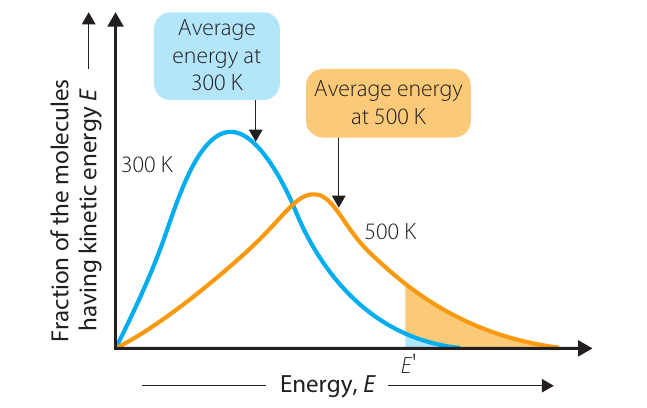
At lower temperatures (such as K), only a very small fraction of molecules possess kinetic energy greater than the activation energy (). This small fraction is represented by the shaded area under the curve. Because so few molecules have enough energy to react, the reaction rate is quite slow.
At higher temperatures (such as K), a much larger fraction of molecules has kinetic energy exceeding the activation energy. Both shaded areas under the curve represent molecules with sufficient energy to react. This larger fraction means that the reaction rate increases significantly with temperature. Even a modest increase in temperature can dramatically increase the number of successful collisions, leading to a much faster reaction.
Note
Temperature and Energy Distribution
Remember that temperature affects the energy distribution of molecules. Higher temperature doesn't just shift the average energy higher - it also creates a broader distribution with many more high-energy molecules. This is why even small temperature increases can have dramatic effects on reaction rates.
The importance of molecular orientation
Even when particles collide with sufficient energy, they must also be correctly orientated for a reaction to occur. The position and angle at which molecules approach each other determines whether bonds can break and new bonds can form.
Example
Worked Example: CO + NO₂ Reaction
Consider the reaction between carbon monoxide and nitrogen dioxide:
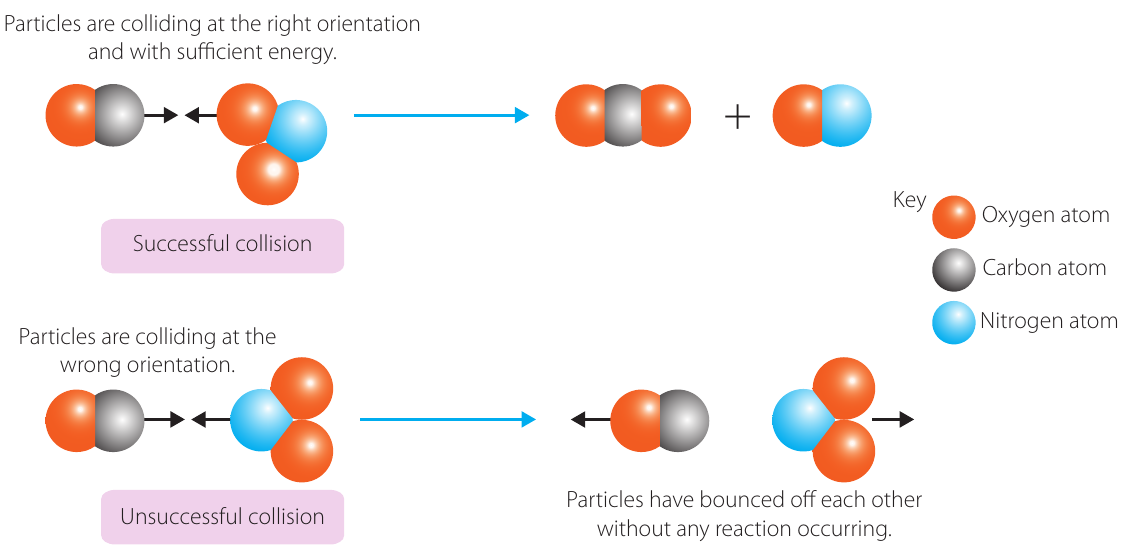
Successful collision: For this reaction to be successful, the carbon monoxide (CO) molecule must collide with one of the oxygen atoms of nitrogen dioxide (). This allows the oxygen atom to transfer from to CO, forming carbon dioxide () and leaving nitrogen monoxide (NO).
Unsuccessful collision: However, if the CO molecule collides with the nitrogen atom of instead, the molecules simply bounce apart without reacting. The collision is unsuccessful because the orientation is wrong - the reactive parts of the molecules didn't come into contact with each other.
This requirement for correct orientation explains why many collisions don't lead to reaction, even when the particles have sufficient energy. The molecules must not only hit each other hard enough, but they must also hit each other in the right way.
Note
Explaining Slower-Than-Expected Rates
When explaining why reaction rates are often slower than collision theory might predict, remember to mention that only a fraction of collisions have both sufficient energy AND correct orientation. Both conditions must be satisfied simultaneously for a successful reaction.
Remember!
Summary
Key Points to Remember:
-
Collision theory requires three conditions: particles must collide, have sufficient kinetic energy (above activation energy), and be correctly orientated for a reaction to occur.
-
Activation energy acts as an energy barrier: the higher the activation energy, the slower the reaction because fewer molecules can overcome the barrier.
-
Concentration affects collision frequency: increasing the concentration of reactants increases the number of collisions per unit time, therefore increasing reaction rate.
-
Temperature affects energy distribution: higher temperatures increase both the average kinetic energy and the fraction of molecules with energy exceeding the activation energy, dramatically increasing reaction rate.
-
Molecular orientation matters: even with sufficient energy, molecules must collide at the correct angle and position for bonds to break and form successfully.